
 E-Paper



Startup Mantra: A device that detects, kills silent invaders of agricultural fields
Mukund Choudhary and Maitree Dedhia teamed up during the pandemic to help farmers control pests, especially hard-to-detect ones, destroying their crops. And, Trebirth Pvt Ltd was born.


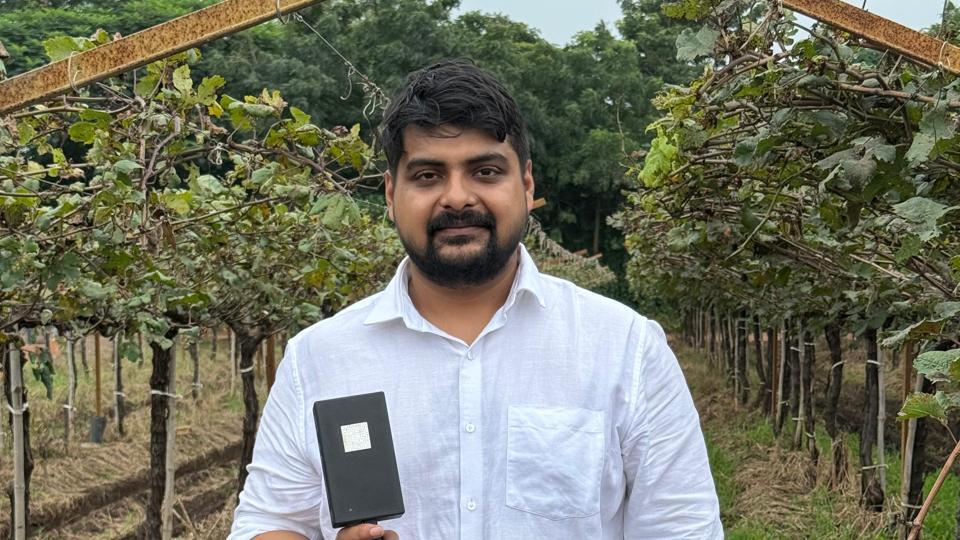
It was the stem borer, an agriculture pest, that fuelled Mukund Choudhary, a tech engineer, and Maitree Dedhia, a design student, into action that would help farmers protect their crops from the relentless gnawing of the silent attackers. Seeing the farmers’ struggle with the extremely difficult-to-detect intruders, both of them put their minds together to develop a non-destructive scanning system that beats all the existing ones in the pest-control field.
About stem borer
The stem borer and termites carry the (dis)reputation of being the most dangerous of pests as they work stealthily, giving detection the slip. According to the ‘All India Coordinated Rice Project and Other Agricultural Studies’, these pests cause massive losses, ranging anywhere between 20 to 80%, to the farmers. At times, this can even soar up to 100%!
Traditional farming methods to ward off these invaders of fields include tearing of stems, spraying excessive chemicals and pesticides, burning trees, etc. While these methods have different levels of efficacy, when it comes to detection of the stem borer, they fail.
Filling the gap
To fill in this gaping hole, Trebirth Private Limited entered the field. Two students from different fields joined hands to work together towards a common goal. Mukund Choudhary, who was studying Computer Science Engineering at SRM University, and Maitree Dedhia, who was studying Product Design at Indian School of Design and Innovation, came together in 2020, when they signed up for their graduation project internship programme at Digital Impact Square, run by the TCS Foundation, to give students an insight into farming issues.
Mukund elaborated: “In our final year of college, we came across this opportunity, where we saw first-hand the problems that farmers at the grape farms of Nashik faced. We met the farmers and other stakeholders such as FPOs (Farmer Producer Organisation) and got a fairly clear understanding of the pest issues in the farms.”
It was then that they arrived at a decision to solve the problem of stem borers for the farmers.
Mukund continued: “These stem borers are like cancer for the plants. Like cancer, it was hard to detect early on, and by the time a farmer found out, half or more of the plant was destroyed and the fruit yield reduced to half or even less. In severe cases, the farmer had to uproot the plant that often reduced its productive life of 8-10 years to maybe 4-5.”
Covid-19 stalls plan
Within six months of that resolution, however, Covid-19 arrived and all farm visits stopped. But, there were some farmers who were still hopeful that someone would be willing to look into their problem. Mukund said, “They would bring samples of cut tree stems to our homes so that we could study these in our lab.”
And, study they did, because here was this problem staring them in the face and they both felt that there had to be a way to find a solution.
Mukund said, “At Digital Impact Square, we were introduced to the problem at an industrial level. In addition, we did a lot of research meetings with farmers and FPOs to understand better how deep the problem was. We realised that this problem existed not just in grapes but also in coffee,mango, palm, sugarcane, and most of the cash crops.”
Defining the problem
When they dug deeper, they saw that there were solutions available in the market but these were mostly preventive. But, what about the trees already infected by the borer? How can these be saved? That was the question foremost on their minds.
They found that there were some companies that manufactured chemicals to kill the stem borer, but the application was not precise. So, the problem persisted. How to detect in which part of the plant the borer had made its home?
Some farmers used other interventions such as deploying solar or light traps. But, these, again, were effective in catching beetles, but the larvae stayed active. These would grow and escape through a tiny hole in the stem. Or, the beetles would escape from one farm to the neighbouring farm,spreading the infection.
Mukund said, “Some farmers used very crude techniques like drilling a hole about 3 to 4 feet and pouring chemicals or petrol into it to kill the larvae. But, this technique destroyed the plant further. Hence, this solution, too, was ineffective.
Silver lining
But, the silver lining was that they got a clearer understanding of the problem. And, after some brain storming, they agreed on developing a detection system that could find out where exactly in the tree the stem borer was breeding.
Mukund said, “We knew that we had to first find a way to detect the larvae, and, thereafter, find a way to kill it.”
So, detection became their primary focus. It took them three years from the time they started the internship programme to finally arrive at a solution.
The solution
They looked at other industries. There were similar problems in the termite pest control business. What were they doing? The nature of termites is similar to stem borers. So, it was a great analogy for them to study.
Mukund said, “Much like the parking sensor that tracks a wall or barrier whilst reversing or a speed gun that estimates the speed, we felt we had to make our own sensor that could penetrate wood in a non-destructive way. A sensor whose frequency could detect movement activity and breathing, since these pests constantly move. Our sensor should be able to penetrate a stem and detect if there was any living organism in it. It should be a hand-held tool that could be used easily.”
After three years of research, they finally zeroed in on a doppler-based radar.
Tackling challenges
Now that they had found a solution, there was another hurdle to cross. Initially, their device would take too long, almost a week, to scan a few hundred trees. Since it was not necessary to scan all the 800-1000 trees a farmer may have in his one-acre plot, he would visually scan his trees to check which ones were infected by what is technically called frass.
“Frass is the wood-shaving that drops from a tree stem after it has been infected. Or, the farmer could detect infection by the discolouring of the leaves. Based on such visual cues that the farmer gives us, we begin scanning those trees with our device.”
The frass or discoloration does not give the exact location of the larvae. It could, at best, locate it at a distance of 3 feet. But, this helped to limit the area that needed to be treated with chemical or organic pesticides, or physically bore holes to remove them.”
However, Mukund soon realised that merely depending on the farmers to give visual cues was not enough. The plants adjoining the infected ones were susceptible, yet not detectable.
“So, we decided to take help from agronomists to help us tackle this problem more effectively.
We came up with a sampling strategy. We randomly picked out trees in the area adjoining the infected ones and scanned and treated them, too, if required.”
Funding project
To build the device, the duo had to hire a multi-skilled team. Mukund said, “Initially, we had an R&D team that included experts from the fields of electronics, software, firmware, agronomy, entomology.”
Towards the end of 2023, their device was ready. It cost them a total of ₹1.2 crore, including equity funding of ₹30 lakh and government grants of ₹1.2 crore.
Pilot studies
After building their device, they conducted seasonal pilot studies. Mukund said, “Currently, we have an active pilot study going on in the coffee plantations of Karnataka. This is to study the yield based on the intervention.”
Market strategy
He emphasised that given the markets that this device will operate in, Trebirth has to look carefully at its approach to new buyers. “Everything has to be translated into numbers. They need to know how much yield they will get if they use our device to detect the stem borers. Also, there was an issue from our end. The device takes 20 minutes to detect the larvae. So, if a farmer has a 100-acre plot, we will need at least 25 people with 25 devices to do the detection.”
And the way they decided on to resolve this problem was to raise funds to develop manufacturing units to produce more devices.
Competition
Mukund said there are a few pest control corporations and a start-up in Israel that works in a similar field. “However, we have an edge over them since their device takes two weeks for detection whilst ours takes just 20-25 minutes. Moreover, our device is totally non-destructive while theirs is not,” he said.
Looking ahead
As of now, Trebirth has scanned 10,000 trees in Nashik and removed 2,000 trees. The 2,000 trees were freed of the borers via physical removal, after drilling 5-cm holes into them. “Since our random sampling system is under construction, we did not do any scanning of the neighbouring area. Hence, our success was not 100% .Once we have that ready, we can offer 100% removal of stem borer infestation.”
With regards to sales, they plan to tie up with FPOs and other B2B (Business-to-Business) players. Mukund said, “Instead of selling directly to farmers, we plan to sell via B2B players and FPOs. Getting into managing staff to scan farms will be an unnecessary waste of our time and effort. Why not tie up with people who are already in the business, instead?”
Meanwhile, they have plans in place for the funds that they will raise.“Other than stem borers, our device works very well on termites. So, we are also using it to detect termites in commercial areas to enable structural pest control.”
They plan to use 60% of the funds raised on marketing the product. And the balance will be used to refine the device, which needs a random sampling unit, which, according to Mukund, will be ready by June this year.


