
 E-Paper



AAIB launches probe into Baramati plane crash that killed Ajit Pawar
A specialised AAIB team reached the crash site on Wednesday evening and initiated forensic procedures, including securing wreckage, mapping debris distribution and collecting critical data for analysis


The Aircraft Accident Investigation Bureau (AAIB) has begun a comprehensive investigation into the Learjet 45 crash near Baramati that claimed the lives of Maharashtra deputy chief minister Ajit Pawar and four others, with investigators focusing on visibility conditions, pilot decisions and operational limitations at the uncontrolled airfield.
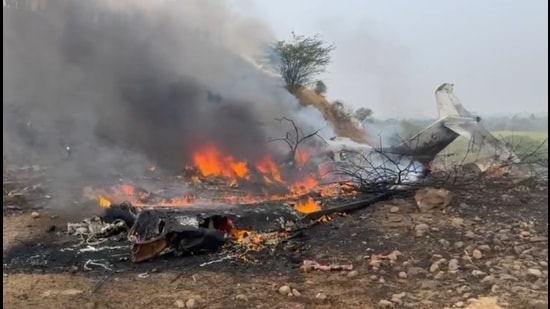
A specialised AAIB team reached the crash site on Wednesday evening and initiated forensic procedures, including securing wreckage, mapping debris distribution and collecting critical data for analysis. Officials said the probe would examine technical, operational and environmental factors surrounding the accident, which occurred during the aircraft’s second attempt to land.
Investigators have sought airframe and engine logbooks, maintenance records, inspection histories, work orders and onboard documents from the aircraft’s operator, Delhi-based VSR Ventures Pvt. Ltd. In addition, documents related to crew qualifications and aircraft certification have been requisitioned from the Directorate General of Civil Aviation (DGCA). Radar data, air traffic communication recordings, CCTV footage and hotline exchanges are also being analysed to reconstruct the final moments of the flight.
The business jet, registered as VT-SSK, was operating a Mumbai–Baramati charter flight when it crashed at around 8.44 am on Wednesday, killing all five occupants — two pilots and three passengers, including Pawar.
According to the civil aviation ministry, the aircraft first established contact with Baramati airfield at 8.18 am, shortly after departing Mumbai at 8.10 am. During the first approach to Runway 11, the crew reported that the runway was not visible and initiated a go-around. After repositioning, the aircraft informed the airfield that it would report once the runway came into view.
At 8.43 am, the aircraft was cleared to land on Runway 11, but no readback of the landing clearance was received, officials said. A minute later, airfield personnel observed flames near the runway threshold, prompting emergency services to rush to the site.
Baramati is an uncontrolled airfield where air traffic information services are provided by flying training organisations rather than the Airports Authority of India, a factor that is likely to form a key part of the investigation.
Union civil aviation minister Ram Mohan Naidu said the probe would be conducted in a transparent and accountable manner. “Preliminary inputs indicate that visibility was poor at the time, but we cannot draw conclusions without a complete investigation. The AAIB is the competent authority and will establish the facts,” Naidu told reporters in Pune.
He said that during the first landing attempt, the pilot had informed airfield personnel that the runway was not in sight, leading to a standard missed approach. “During the second attempt, the pilot initially did not respond to the visibility query and later said the runway was visible. Landing clearance was given, after which the accident occurred,” Naidu said, stressing that these details were based only on initial communication records.
The DGCA, in its preliminary note, said the crew had been advised to descend under visual meteorological conditions at the pilot’s discretion, with reported visibility of around 3,000 metres and calm winds at the time.
Vijay Kumar Singh, director and key stakeholder of VSR Ventures Pvt. Ltd, said the aircraft was properly maintained and airworthy. “As per our information, there was no technical fault. The pilot took a missed approach due to visibility and attempted a second landing. This is an extremely unfortunate incident,” he said.
Singh said the captain had over 16,000 flying hours, while the co-pilot had logged around 1,500 hours, adding that both were experienced professionals. He clarified that a previous runway excursion involving the company in 2023 at Mumbai airport was unrelated and occurred under different circumstances.
The crash has renewed scrutiny of safety oversight for non-scheduled charter operations and infrastructure at smaller regional airfields. VSR Ventures operates a fleet of 17 aircraft, including seven Learjet 45 jets. The DGCA said the operator’s last regulatory audit was carried out in February 2025, with no major deficiencies flagged. However, this is the second serious incident involving the operator in Maharashtra in less than three years, with the earlier case still under investigation.
Aviation experts said the AAIB would examine multiple scenarios. “Any aircraft accident typically boils down to a few broad possibilities — technical malfunction, landing configuration issues, bird strike or sudden loss of visibility,” said aviation analyst Subhash Goyal, noting that Baramati lacks a fully equipped, computerised ATC system, forcing pilots to rely heavily on visual assessment during landing.
Another aviation expert, Sanjay Lazar, said the absence of a readback after landing clearance could be significant. “The sequence suggests the aircraft was on final approach when communication ceased and a fireball was observed. That could indicate terrain contact or loss of situational awareness,” he said, adding that approach aids such as RNAV systems could reduce risks at such airfields.
The AAIB has formally taken charge of the investigation, with its director general also proceeding to Baramati. Officials said more information would be released once data analysis and on-site examinations progress.


