
 E-Paper



Astronomers discover giant ring system causing rare, nine-month dimming of star
ASASSN-24fw is a star a little bigger and heavier than our Sun. It is an F-type, main-sequence star which means it is hot, bright, and stable and not prone to sudden explosions

 Prefer HTon Google


An international team of astronomers has observed one of the longest and most unusual stellar dimming events ever recorded, caused by a giant ring system around a brown dwarf companion of the star ASASSN-24fw located about 3,000 light-years away in the Monoceros constellation (a faint constellation in the night sky located on the equator of the Milky Way).
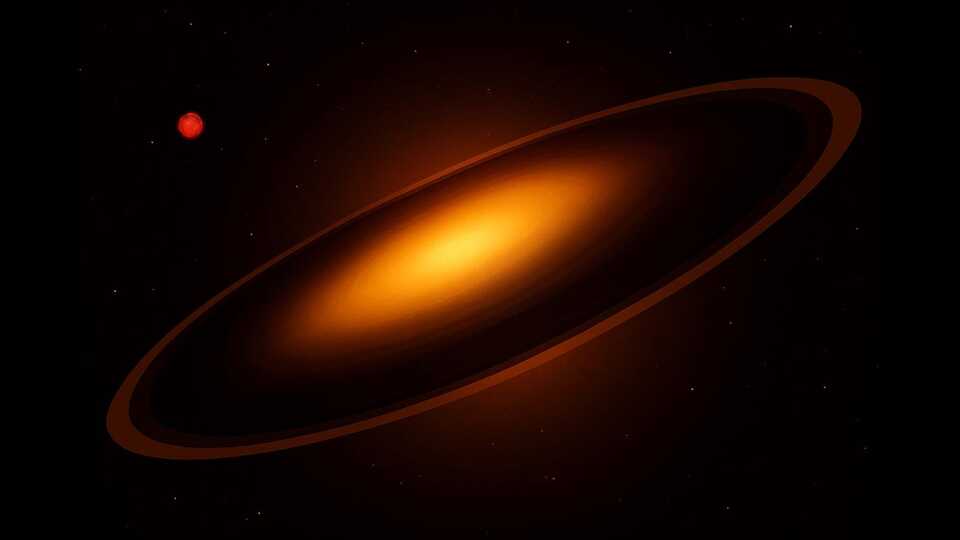
ASASSN-24fw is a star a little bigger and heavier than our Sun. It is an F-type, main-sequence star which means it is hot, bright, and stable and not prone to sudden explosions. Normally it shines steadily but between late 2024 and mid-2025, it dimmed for about nine months losing almost 3% of its light which is unusual for stars like this. Unlike most stellar eclipses that last a few days or weeks, this one lasted nearly 200 days (nine months) making it one of the longest observed. The dimming wasn’t the star’s fault; it was caused by something passing in front of the star like an eclipse in Space. Detailed analysis suggests that this object is a brown dwarf heavier than a planet but lighter than a star surrounded by a dense and vast ring system.
“The dimming began gradually because the outer rings are thin, becoming more pronounced as the denser inner regions passed in front of the star,” explained Sarang Shah, researcher at the Inter-University Centre for Astronomy and Astrophysics (IUCAA), Pune.
Whereas the companion is estimated to have a mass more than three times that of Jupiter, with rings extending to about 0.17 astronomical units, roughly half the distance between the Sun and Mercury. Analysis also revealed that ASASSN-24fw itself has a complex circumstellar environment, likely remnants from past or ongoing planetary collisions unusual for a star over a billion years old. In addition, a red dwarf star was discovered near ASASSN-24fw during the observations, adding further interest to the system.
Jonathan Marshall, an independent researcher affiliated with Academia Sinica, Taiwan, said, “Large ring systems are expected around massive objects, but they are very difficult to observe directly to determine their characteristics. This rare event allows us to study such a complex system in remarkable detail. In fact, while studying this dimming, we also serendipitously discovered that ASASSN-24fw also has a red dwarf star in its vicinity.”
The study was conducted by an international collaboration including professor Ashish Mahabal of Caltech (also adjunct faculty at IUCAA) with observations contributed by telescopes worldwide. It has been published in the Monthly Notices of the Royal Astronomical Society (MNRAS) on February 12, 2026.
Future studies are planned using the JWST (James Webb Space Telescope), a powerful space telescope launched in 2021 that can see infrared light from distant stars and planets; ALMA (Atacama Large Millimetre/submillimetre array) or large group of radio telescopes in Chile that observe cold gas and dust in Space and can map the structure of rings and disks around stars; and VLT (Very Large Telescope) or a group of four optical telescopes in Chile, run by the European Southern Observatory; to better understand the formation and evolution of this extraordinary system.
The discovery not only sheds light on brown dwarfs and their massive ring systems but also provides insights into the dynamics of circumstellar material and planetary formation processes around mature stars. Astronomers hope continued observations will reveal more about this rare and complex system.


