
 E-Paper



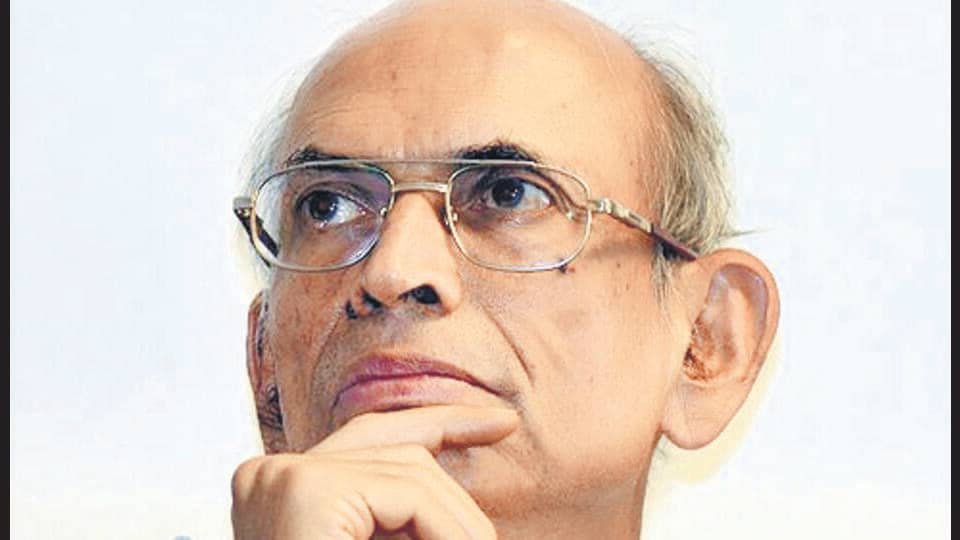
Dr Madhav Gadgil: Voice of the ‘ecosystem people’
Gadgil experienced the wrath of politicians and several members of society throughout his career. But he never stopped speaking and writing about the wide spectrum of social conflicts over natural resources in contemporary India.

 Prefer HTon Google


Pune: In 1982, India organised the first Green Revolution, and Dr Madhav Gadgil was then a member of a Government of India committee to advise on legislation and other measures to promote environmental protection. On behalf of this committee, he had spent over a month talking to fishers, herders, peasants, and rural artisans about their perceptions of India’s environmental problems in many different parts of the country.
One of the themes that recurred in these conversations was the perception, across the board, that the Green Revolution was depleting the fertility of India’s agricultural soils. At a public meeting in Bangalore, presided over by a distinguished economist, who had served two terms in the Parliament and had been a Minister of Education, Gadgil shared this perception.
Gadgil was berated for making “ignorant statements” on the basis of conversations with irresponsible villagers. He was faulted for attempting to initiate a public dialogue with the poor and the excluded on the processes of agricultural development.
Gadgil experienced the wrath of politicians and several members of society throughout his career. But he never stopped speaking and writing about the wide spectrum of social conflicts over natural resources in contemporary India.
Trained in India and later at Harvard, where he completed his doctorate, Gadgil chose to return at a time when many of his peers remained abroad. It was not an act of defiance so much as a quiet decision to work where questions of ecology, livelihood, and justice were most immediate.
For him, forests were lived geographies and ecology did not belong only to laboratories or expert committees, but it lived in villages, coasts, and everyday choices. In the Nilgiris and across the Western Ghats, he walked through forests with students and villagers alike, attentive to species lists as well as local memory, folklore, and practice.
Gadgil championed People’s Biodiversity Registers as living, community-owned documents in which indigenous people recorded their own biodiversity - native plants and medicinal herbs, fish species, water sources, farming practices, and wildlife. Rather than outside experts descending with clipboards, it was villagers themselves who documented what they knew and had long safeguarded.
He entered public life when he felt silence would be a failure of responsibility. During the Save Silent Valley Movement, and later in efforts to protect forests in Bastar, he brought scientific clarity to moments charged with political urgency. Even in advisory roles to various governments, he remained sceptical of easy compromises and persistent in asking who bore the cost of development.
The report of the Western Ghats Expert Panel, popularly known as the Gadgil Report, remains unmatched in its combination of scientific substance, democratic spirit, and most importantly, moral clarity. That moral steadiness was a hallmark of his spectacular career.
He believed that food was the primary currency of the relationship between humans and their environment, arguing that a society’s health was directly proportional to its local ecological self-reliance.
He argued that traditional communities protected “sacred groves” because they provided essential “ecosystem services”, including wild fruits like mango, amla, and myrobolan, as well as edible mushrooms, bamboo shoots, and medicinal herbs.
In his 1970s studies on bamboo in Karnataka, he fought against industrial subsidies that allowed paper mills to decimate bamboo. He argued that for local basket-weavers and forest dwellers, bamboo shoots were a critical nutritional resource that the state ignored in favour of industrial profit.
Gadgil was the voice of the “ecosystem people” as Dr RF Dasmann called the people like forest dwellers, fishers, and peasants, who directly depended on their local environment for most of their needs. These people lived in a deep, centuries-old partnership with nature, relying on biological resources for survival, and their traditional knowledge offered vital insights for sustainable conservation efforts.
Gadgil stated that the ecosystem people continued to remain poor and excluded and had exceedingly limited access to goods and services generated through the organised economy. His theoretical framework included “biosphere people” whose needs were met through markets, technology, and distant resources, and “ecological refugees” who were pushed out of their traditional resource base and left with limited access to either nature or markets.
This framework illuminated how unequal control over resources lay at the heart of environmental conflict. As the consumption of biosphere people expanded, ecosystem people were displaced, often slipping into ecological refugeehood. The erosion of local resources, Gadgil argued, had devastated the lives and livelihoods of landless labourers, marginal farmers, rural artisans, pastoralists, small fishers, nomadic groups, and many tribal communities.
Gadgil looked at the changing ecology and pastoral economy of the Gavlis of the Western Ghats and concluded that buffalo- and cattle-keeping, even when supplemented by goats, was inadequate to sustain the Gavlis over much of their ancestral range, obliging them to engage in shifting cultivation on an increasingly marginal basis. Where this, too, was inadequate, Gavlis joined the increasing numbers of urban migrants. Gadgil cautioned that if the trend continued, the Gavlis would progressively pass through the stages of buffalo-keepers to cattle-keepers to goatherds to cultivators of marginal lands to unemployed migrants and that this progression could be retarded only if the government and development planners began to question the current policy of equating development of natural resources with non-sustainable commercial exploitation.
In his brilliant paper, “Cultural Evolution of Ecological Prudence” (Landscape Planning, 12, 1985), he wrote about how culture, religion, and religious practices affected natural resources and in what ways they did so.
Gadgil and Ramchandra Guha, in their landmark book, “This Fissured Land: An Ecological History of India” (1992), used food as a primary indicator to track the transition from “prudent” pre-colonial resource use to “profligate” colonial and industrial modes. The book detailed how dietary habits and food production systems were once deeply integrated into the social and ecological fabric of India.
Gadgil (controversially) suggested that the caste system served an ecological function by reducing competition for food. Different castes specialised in different “resource niches”. For example, in the Western Ghats, the Gavlis lived on the hilltops, keeping buffaloes and consuming buttermilk, while the Kunbis lived in the valleys, growing cereal grains. They bartered butter for grain, ensuring both groups had protein and carbohydrates without over-exploiting the same patch of land.
What may stand as his most enduring legacy was his conviction that the environment could not be safeguarded through expertise or technology alone. For Gadgil, the defence of nature was inseparable from democracy itself. He cautioned that when decisions about land, forests and water were removed from public scrutiny and placed solely in the hands of experts, bureaucracies or corporate interests, ecological damage was almost certain to follow. In contrast, he viewed instruments such as the Forest Rights Act, the authority of the Gram Sabha and Van Sabha, and the survival of traditional knowledge systems as the true foundations of conservation.
He called for developing ways of working not against, but with, nature; working not at the cost of, but to the benefit of these ecosystem people. He urged the government and the transnational companies to develop a new culture, with new institutional structures, to build bridges with the poor and the excluded. Involving them as equal partners in development efforts would confer dignity on them. (Ecology & Society, Vol 4, No 1, 2000)
Gadgil was a true champion of “citizen science”. He gave our country its ecological conscience. With his passing, we have lost the true voice of the marginalised ecosystem people.


