
 E-Paper



From fields to first rank: The story of Rajubai Gujjar
Gujjar became the first Maharashtrian, and one of the first Indian women, if not the first, to graduate from an agricultural college

 Prefer HTon Google


India has among the lowest rates of female workforce participation in the world, with women comprising just 29 per cent of the labour force. This could be attributed to several factors: a rigid gendered division of labour that leaves women responsible for childcare, eldercare, cooking, cleaning, and other unpaid work; social norms that restrict their mobility and decision-making; and limited job creation overall, which often sidelines women first.
Yet, agriculture is a major exception. This sector rests heavily on women’s labour. In 2023–24, nearly 64.4 per cent of female workers were engaged in agriculture, compared to 36.3 per cent of men, according to the Economic Survey of the Government of India for 2025-26.
This “feminisation of Indian agriculture” is not a recent phenomenon. For centuries, women have toiled in the fields without the power to make decisions. Dismissed as lacking practical wisdom, they were confined by men to relentless labour, within the home and on the land.
In the nineteenth century, however, a woman in Pune rose to challenge this very order. Ms Rajubai Gujjar became the first Maharashtrian, and one of the first Indian women, if not the first, to graduate from an agricultural college. In 1927, she secured admission to the Agricultural College in Pune, a step that was as audacious as it was historic.
Born in 1907, Rajubai came from a landowning and trading family in Umadi village of the princely state of Jat in Maharashtra. Her father, a Jain by faith, had migrated there from Gujarat. She completed her schooling up to matriculation at Huzurpaga Girls’ School in Pune and went on to study intermediate science at Fergusson College.
But she was determined to study agriculture, which set her apart. For two long years, she fought for admission to the Agricultural College in Pune. Day after day, she would sit outside the Principal’s cabin, waiting.
After she failed to get a positive response from the Principal, she went to meet the Director of Agriculture in Bombay. When he too refused to meet her, she petitioned the Governor of Bombay Presidency. At last, the Principal relented, but with a condition. She would receive no concessions because of her gender; she would be treated exactly like the male students and would have to perform every task they performed.
Rajubai’s reply was firm and unflinching: she had not asked for concessions; she wanted admission. She was granted entry.
In her very first year, she stood first in the Junior Examination. That year, the college magazine paid her a glowing tribute: “It is a matter of no small import to us that we have in the person of Miss Raju Bai Gujjar, a Champion of the Womanhood of India, in that she has defied one and all of her opposite sex — nay even the greatest man of letters who has branded her as being weak and fragile.
‘Frailty, thy name is Woman.
A rose bud set with a little wilful thorn.’”
The Annual Journal of the College of 1929 recorded that she took part in a boating competition while at the institution. It also credited her presence with lending unusual enthusiasm to that year’s cultural programmes.
The Marathi newspaper “Dnyanaprakash” congratulated her for securing a First Class and the first rank in the Intermediate exam of the Bombay University for the degree of Bachelor of Agriculture in 1928. It noted that Rajubai had to be congratulated for enrolling in a course that demanded severe physical hardships and a great intellectual capability.
In her final examination, too, she stood first in the college. Throughout her time there, she remained the only female student in the college.
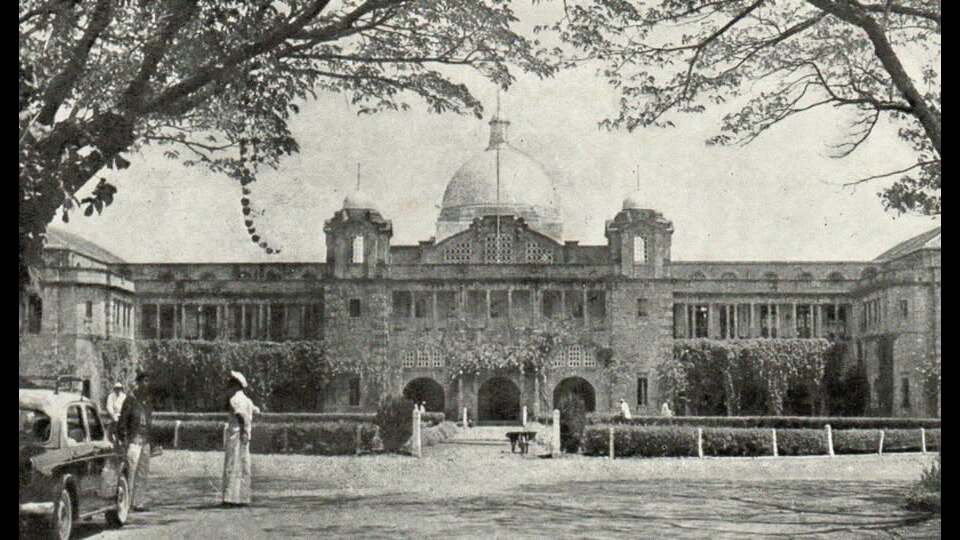
The Department of Agriculture was established in the Bombay Presidency in 1877. Two years later, the College of Science in Pune began teaching agriculture as a subject. Agricultural education formed the subject of an important resolution issued by the Government of India in March 1897 in connection with a general discussion on agricultural subjects. It hastened the formation of a separate College of Agriculture that was established in Pune in 1908. It was one of the first five agricultural colleges to be established in India.
In the early 1930s, several Agricultural Middle Schools were started, but had to be closed in a few months for “want of boys”. The schools and the agriculture colleges did not have enough students because it was believed that the graduates would not find ways and means of getting employed. The rural population believed in the father teaching his son the farming techniques. Colleges were supposed to offer employment in offices.
Language was also a barrier. The British believed that vernacular tuition in agriculture did not bring the students into close contact with the scientific aspect of the subject.
In 1919, a commission had been appointed to reform agricultural education in India, and its report observed that even the government itself tended to undervalue agricultural degrees and training. I wonder what stirred Rajubai to choose such a path that not only was a male preserve, but one held in low regard.
Pandurang Chimnaji Patil, the first Indian agricultural officer, provides invaluable insights in his autobiography into the workings of the agricultural department in those years. Agricultural education at the time was far from easy. There were no modern tools to rely on. Learning agriculture demanded physical endurance. Many students dropped out within the first few months.
Rajubai endured it all. The college in Pune, too, stood on the outskirts of the city. For several decades, there was no hostel for students. I often find myself wondering: where did Rajubai live, and where did she take her meals while pursuing her education?
After she left college, the trail grows faint. I have not been able to find further details about her later life. But even in fragments, her story stands complete, that of a young woman who asked for no favours, claimed no exemptions, and simply insisted on her right to learn.
In our society, it is customary for a woman to change her first name and surname after marriage and a large part of her identity is often erased. If the name under which Rajubai pursued her education was altered after marriage, how then are we to find her?
And if she chose to remain unmarried, her name does not appear in the government records I have searched. After earning her degree, did she take up a job or return to the land and farm? Did she remain in India or travel abroad in pursuit of higher learning?
A survey by the Indian Council of Agricultural Research (2024) reveals a powerful transformation in agricultural education. Women now account for nearly half of all enrollments in agriculture-related courses, up from 27% in 2017 to around 50% in 2023.
Kerala stands out, with women comprising 74% of students in its agricultural universities. Similar upward trends are visible in Himachal Pradesh, Tamil Nadu, Telangana, Manipur, Assam, Jammu and Kashmir, Uttarakhand, Nagaland and Odisha, where more women are entering the field than ever before.
It was intelligent and courageous women like Rajubai Gujjar who carved this path. And yet, it is troubling how little we know about her life. Until I learn what she chose to do with her hard-earned education, I will find no rest.
Chinmay Damle is a research scientist and food enthusiast. He writes here on Pune’s food culture. He can be contacted at chinmay.damle@gmail.com


