
 E-Paper



How Baba Adhav became the strongest voice of Pune’s unorganised sector
Born in Pune in 1930, Adhav grew into a figure who shaped labour movements in the state for more than six decades


Veteran social activist Baba Adhav, one of Maharashtra’s tallest voices for unorganised labour and social equality, passed away in Pune on Monday after a prolonged illness. He was 95.
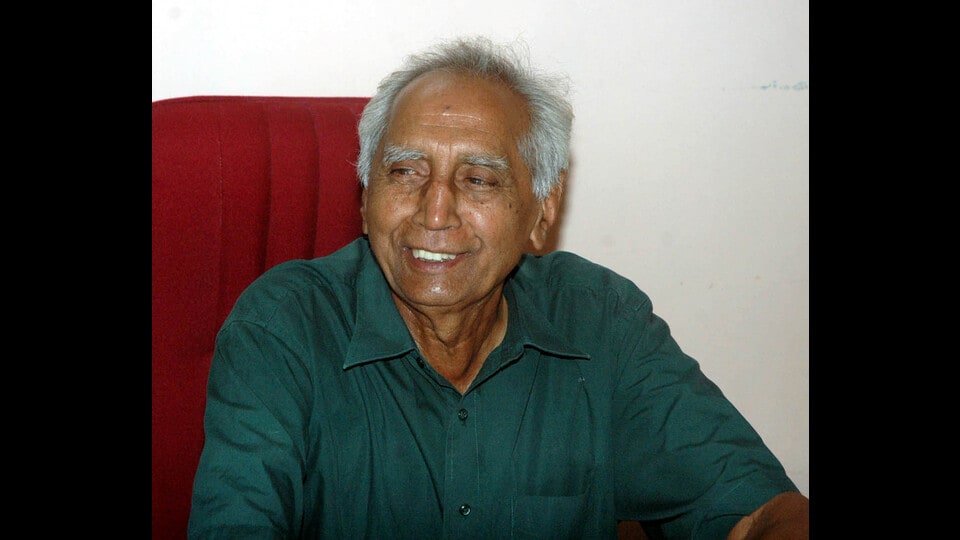
Adhav, who was battling cancer for the last four years, was hospitalised 12 days ago following a sudden deterioration in his health, was on life support at a private hospital. He died at 8.25 pm due to cardiac arrest, his aide Nitin Pawar said. He is survived by his sons Asim and Amber.
Born in Pune in 1930, Adhav grew into a figure who shaped labour movements in the state for more than six decades. For generations of headloaders, rickshaw drivers, market porters and other informal workers, “Baba”—as he was known across Pune’s working-class neighbourhoods—was both organiser and guardian, a man whose campaigns changed laws and redefined dignity for the most marginalised.
Trained as an ayurveda practitioner, Adhav began his clinic in Pune’s Nana Peth, where he first witnessed the brutal working and living conditions of hamals (head-loaders), from the economically downtrodden class, who carried heavy loads at market yards without any legal protection. Their wages were uncertain, their work unregulated, and most slept at the marketplace itself. Political parties engaged with organised labour, but the unorganised were invisible.
Adhav’s response was the Hamal Panchayat, which he built worker by worker across Pune and beyond. The union soon became a vehicle for demanding basic rights—dignified wages, regulated working hours and humane conditions. Their first strike in 1956 triggered satyagrahas and arrests, but it eventually forced recognition of the union and the fixing of minimum wages.
Prime Minister Narendra Modi on X posted, “Baba Adhav Ji will be remembered for his efforts to serve society through various causes, notably empowering the marginalised and furthering labour welfare. Pained by his passing away. My thoughts are with his family and admirers. Om Shanti.” (sic)
“Baba Adhav consistently fought for the rights of the deprived and unorganised sections. Initiatives like Hamal Panchayat and One Village–One Water Point were implemented by him. The battle he waged against social evils will be remembered forever,” said Chief Minister Devendra Fadnavis, in his condolence message.
His struggle culminated in the landmark Maharashtra Mathadi, Hamal and Other Manual Workers Act, 1969, the country’s first major legislation for the social security of unorganised labourers. It later inspired similar movements across sectors and states.
Over the decades, Adhav helped organise auto-rickshaw drivers, ragpickers, domestic workers, scrap collectors, construction labourers and street vendors into separate unions, each demanding rights long denied to them. He also championed ‘Kashtachi Bhakar’, a community kitchen system serving cheap, nutritious meals to 15,000–20,000 workers daily in Pune.
Under the Hamal Panchayat umbrella, he helped establish a free secondary school, clinics and a housing colony for labourers—projects sustained not by donations but by small worker contributions and collective economic activity.
Adhav’s activism was deeply rooted in the ideologies of Mahatma Gandhi, Jyotirao Phule and BR Ambedkar. He believed economic justice was inseparable from social reform and founded the Vishamta Nirmoolan Samiti (Society for the Eradication of Inequality). “Caste is the root of inequality in Indian society,” he often said, stressing that dismantling caste structures was as crucial as labour rights. His movement ‘Ek Gaon, Ek Panwatha’ (One Village, One Water Point) challenged caste-based segregation in access to water.
“In an era gripped by inequality and hatred, the absence of fearless luminaries like Baba Adhav, who remained unwavering in their ideals, will always be deeply felt,” said Nationalist Congress Party (SP) chief Sharad Pawar.
Deputy chief minister Ajit Pawar described him as “a symbol of detachment, fervour and the highest integrity in social work,” adding, “The warrior who struggled for the rights of labourers, the weak and the deprived has left us today.”
Adhav had been jailed 52 or 53 times, beginning with a 1952 satyagraha against soaring prices during a drought. His last incarceration, in 2008, was again for protesting rising prices. He never accepted more than thrice the salary of the lowest-paid worker, and owned no property.
For millions across Maharashtra, Adhav leaves behind not just a legacy but a framework of struggle—rooted in equality, solidarity and an unusual moral discipline that shaped some of the state’s most enduring social movements.
His mortal remains will be kept at Hamal Bhavan at Market Yard on Tuesday for the public to pay respects, and final rites will be carried out at Vaikunth crematorium at 5.30 pm without following any rituals.


