
 E-Paper



Indian astronomers discover rare double radio relic system in galaxy cluster Abell 2108
The discovery makes the cluster a rare double radio relic system, and provides crucial insights into the formation and evolution of galaxy clusters


A team of Indian astronomers, led by Swarna Chatterjee from the Indian Institute of Technology Indore, has discovered a faint radio emission spanning 2 million light-years in the low-mass galaxy cluster Abell 2108 (A2108) using the upgraded Giant Metrewave Radio Telescope (uGMRT) near Pune. The discovery makes the cluster a rare double radio relic system, and provides crucial insights into the formation and evolution of galaxy clusters.
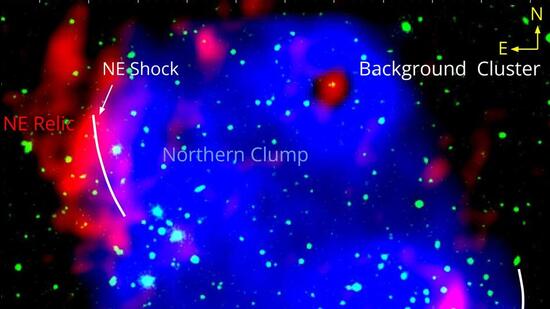
The study of low-mass galaxy clusters like A2108 is crucial, as they remain less explored despite their significance in understanding early universe cluster formation and the interaction between magnetic fields, cosmic rays, and intra-cluster medium.
The discovery provides valuable insights into the formation and evolution of galaxy clusters. GMRT, as one of the pathfinder telescopes, contributes to refining techniques for the Square Kilometre Array (SKA) telescope, an international mega science project. This finding is part of the broader and more ambitious survey initiative known as the uGMRT low-mass cluster survey (GLOMACS) by the team that focuses on the extremely challenging task of exploring diffuse radio emissions from low-mass galaxy clusters.
The research was led by Chatterjee, a PhD student, working with Abhirup Datta, both from the Indian Institute of Technology Indore in collaboration with Majidul Rahaman from the National Tsing Hua University, Taiwan; Ruta Kale from the National Centre for Radio Astrophysics (NCRA) Pune; and Surajit Paul from the Manipal Academy of Higher Education (MAHE). Surajit is the principal investigator (PI) for the GLOMACS project. The article is recently published in the Monthly Notices of the Royal Astronomical Society (MNRAS) journal of the Oxford University Press.
“Galaxy clusters are the largest bound structures holding galaxies together through gravitational pull and comprising 100 to 1,000 trillion times the mass of the Sun. The gaseous particles in the cluster medium get energised in collisions between clusters and emit synchrotron radiation in the radio band. Among these emissions, radio relics, often found on the outskirts of clusters, are evidence of powerful shock waves caused by cluster collisions,” said Chatterjee.
Abell 2108 is a low-mass cluster initially identified to host a radio relic in its southern region. The new observation by Chatterjee and team revealed another patchy and faint radio structure (termed as ‘NE relic’) in the north of the cluster, revealing it as a rare double radio relic system.
“The newly detected structure is twice the size of the southern relic (termed as ‘SW relic’) and is one of the faintest radio relics detected so far. The researchers further detected a weak shock at the relic’s location using X-ray observations from the XMM-Newton X-ray telescope. Remarkably, the morphology of the two relics suggests different origins, with the SW relic likely formed by shock passage. In contrast, the NE relic’s expanded structure and presence of multiple radio galaxies hints at fossil electrons from radio galaxies contributing to its formation,” said Chatterjee.
Photo caption: Representing a colour composite image of A2108 showing Pan-STARRS ‘r’ band optical image in green, XMM-Newton X-ray image of the intra-cluster gas medium in blue, and the uGMRT radio emissions in red. The radio relics are marked as NE and SW relics. The gas clumps visible in the X-ray image and the detected shocks in the cluster’s northern and southern periphery are marked as well.


