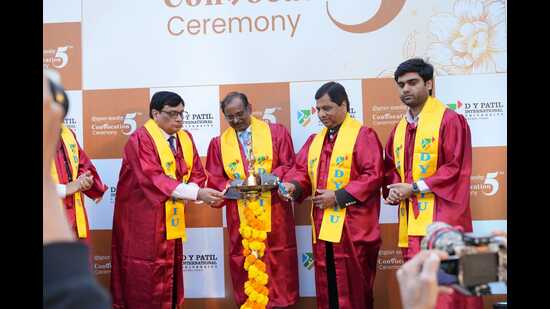
Indian Space Research Organisation (ISRO) chairman, V. Narayanan, said that ISRO, under the visionary leadership of the Prime Minister, is actively preparing for India’s ambitious Gaganyaan programme targeted for 2027 with three unmanned flights planned as precursors to the first human spaceflight. Narayanan said that 2026 and 2027 have been designated as dedicated ‘Gaganyaan years’, reflecting ISRO’s focused efforts. He also noted that Chandrayaan 4 and Chandrayaan 5 are progressing as scheduled and highlighted that ISRO continues to analyse data from the recent PSLV mission. Narayanan was addressing the fifth convocation ceremony of D Y Patil Vidyapeeth as chief guest on February 5.
Tracing the evolution of India’s space programme, Narayanan said, “Space activities began in 1962, with the first small rocket launched from Indian soil in 1963 with assistance from the United States. In 1975, satellite-based mass communication was demonstrated using the US-provided ATS-6 satellite, bringing television to 2,400 villages across six states. India’s first indigenously built satellite, Aryabhata, was launched later that year with support from the USSR. At that time, satellite components were transported on bicycles and bullock carts, a stark contrast to today’s advanced launch capabilities.”
From those humble beginnings, India has emerged as a global space leader, Narayanan said. “Chandrayaan-1 led to the discovery of water molecules on the Moon, Chandrayaan-2’s orbiter carries the world’s highest-resolution lunar camera, and the Mars Orbiter Mission made India the only country to reach Mars orbit successfully at its first attempt,” he said. Recalling India’s record-breaking launch of 104 satellites using a single rocket and its success in developing indigenous cryogenic engine technology after technology transfer was denied by other nations, Narayanan said that India is now among only six countries possessing this capability. He further noted that India is only the fourth country in the world to operate a satellite dedicated to studying the Sun, Aditya-L1.
Narayanan outlined recent historic milestones, including the commercial launch of a 6,100 kg satellite payload for the United States in December 2025, launch of the NASA-ISRO NISAR satellite in July 2024, and successful deployment of a 4,400-kg communication satellite in November 2025. He described January 16, 2025, as a landmark day when India became the fourth nation to successfully demonstrate satellite docking in space. Emphasising ISRO’s service to society, Narayanan said that 57 operational satellites currently support telecommunications, television broadcasting, disaster warning, Earth observation and real-time monitoring of nearly 10,000 trains daily. Looking ahead, Narayanan spoke about upcoming missions including Chandrayaan-4, Chandrayaan-5, LUPUS mission, and development of a next generation launch vehicle capable of carrying 30,000 kg to low Earth orbit. He confirmed that India’s human spaceflight mission, Gaganyaan, is targeted for 2027 and revealed plans for a future manned lunar mission supported by a massive rocket taller than a 40-storeyed building.
{{/usCountry}}Narayanan outlined recent historic milestones, including the commercial launch of a 6,100 kg satellite payload for the United States in December 2025, launch of the NASA-ISRO NISAR satellite in July 2024, and successful deployment of a 4,400-kg communication satellite in November 2025. He described January 16, 2025, as a landmark day when India became the fourth nation to successfully demonstrate satellite docking in space. Emphasising ISRO’s service to society, Narayanan said that 57 operational satellites currently support telecommunications, television broadcasting, disaster warning, Earth observation and real-time monitoring of nearly 10,000 trains daily. Looking ahead, Narayanan spoke about upcoming missions including Chandrayaan-4, Chandrayaan-5, LUPUS mission, and development of a next generation launch vehicle capable of carrying 30,000 kg to low Earth orbit. He confirmed that India’s human spaceflight mission, Gaganyaan, is targeted for 2027 and revealed plans for a future manned lunar mission supported by a massive rocket taller than a 40-storeyed building.
{{/usCountry}}Asked about the status of the G1 mission during a media interaction, he said, “Under the visionary leadership of the Prime Minister, ISRO is actively working on the Gaganyaan programme, which is targeted for execution in 2027.” He informed that three unmanned missions are planned prior to the human spaceflight and that preparations for these missions are currently underway. He added that the current year and the coming year have been declared as dedicated ‘Gaganyaan years’, reflecting the organisation’s focused efforts on the programme. He noted that the Chandrayaan-4 and Chandrayaan-5 programmes are progressing as per their planned schedules and reiterated that India’s space programme is designed primarily to serve national objectives. He also mentioned that ISRO is presently analysing data from recent PSLV missions.