
 E-Paper



IUCAA’s open campus day leaves visitors ‘science struck’
Inter-University Centre for Astronomy and Astrophysics (IUCAA) organised open campus day to celebrate National Science Day observed on February 28

 Prefer HTon Google


Pune: In celebration of the National Science Day observed on February 28, the open campus day at the Inter-University Centre for Astronomy and Astrophysics (IUCAA) turned into a lively celebration of ideas, experiments and imagination as students, parents and science enthusiasts spent time immersed in astronomy and physics.
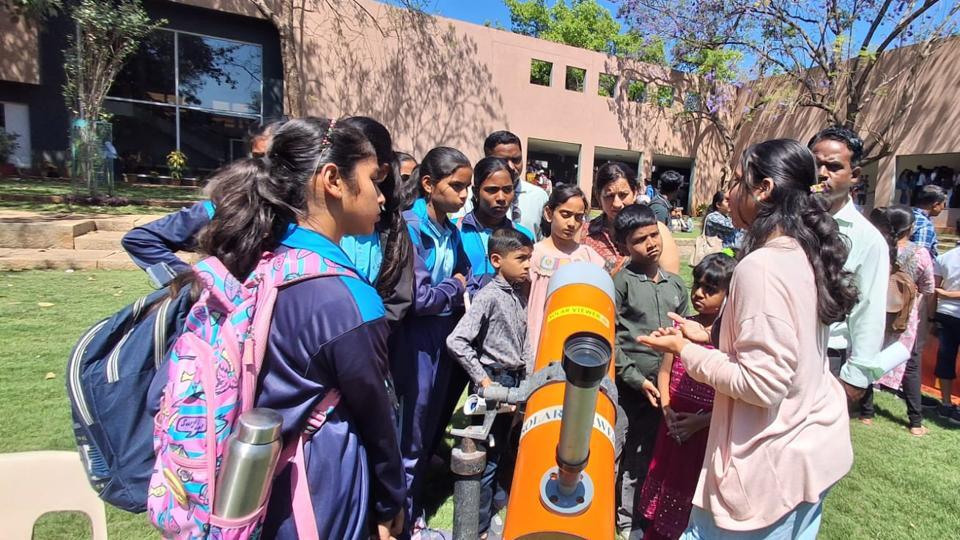
The day began with visitors gathering around the iconic Foucault Pendulum at Aryabhata and “Kund” (well-like space), where volunteers introduced statues of four great scientists — Aryabhata, Isaac Newton, Albert Einstein and Galileo Galilei — and explained their contributions. The live solar telescope gave many their first direct glimpse of the Sun. Children waited eagerly for their turn, adjusting the eyepiece carefully, while researchers explained sunspots and solar activity in simple language
Across Bhaskara halls, lecture and activity spaces, and open corners of the campus, science unfolded in multiple forms. Themed presentations on “Fundamental Physics with Gravitational Waves” drew curious audiences, while demonstrations in the foyer explained black holes and laser interferometers in simple terms.
A detailed section described how the LIGO (Laser Interferometer Gravitational-Wave Observatory) experiment detected gravitational waves. Students listened attentively as volunteers described how tiny ripples in spacetime are measured using highly sensitive laser systems.
The Chandrasekhar Auditorium remained packed throughout the day with back-to-back lectures in English, Hindi and Marathi. IUCAA’s researcher Shubham Sati opened with “The Cosmic Distance Ladder,” explaining how astronomers measure distances across the universe. Professor Gulab Dewangan presented a Hindi talk on multi-wavelength galaxy studies using India’s multi-wavelength space observatory AstroSat. Researcher Sourav Das addressed a common misconception in “Summer is not when Earth is closest to the Sun,” clarifying the science of seasons and solstices. Assistant professor Bhooshan Gadre delivered a Marathi lecture on the role of gravity in the life story of stars, while scientific officer Apratim Ganguly captivated audiences with “Locked in space: The cosmic dance of gravity”, using illustrations and everyday examples to explain tidal locking, tidal heating and the mysteries of black holes.
A special session highlighted the National Aeronautics and Space Administration (NASA)–Indian Space Research Organisation (ISRO) educational visits programme conducted in collaboration with Pune Zilla Parishad, where students shared their experiences.
Beyond the lectures and science sessions, visitors were actively engaged through a poster presentation and demonstration section on astrophysics.
Visitors also learned about the ten-year scientific legacy of AstroSat, including studies of accretion mechanisms and transient astronomical events that have expanded our understanding of high-energy astrophysics.
Students were also introduced to solar ultraviolet imaging telescopes, solar jets and plumes, and the dynamic phenomena of solar flares.
Visitors also witnessed powerful astronomical instruments designed at IUCAA and learned how measuring the polarisation of light reveals hidden properties of celestial objects.
Throughout the campus, from aeromodelling demonstrations to gravitational wave exhibits, science was presented as an exploration rather than a lecture.
Manavsingh Barar, a Class 10 student, said, “I used to think summers happen because Earth is closer to the Sun. Today I learned it is because of Earth’s tilt and orbit. The explanations were easy to understand. Watching through the telescope at IUCAA was an amazing experience.”
The excitement did not fade even after visitors left the campus. Instead, it lingered in the animated conversations of students carrying not just pamphlets and photographs, but new ways of thinking.


