
 E-Paper



Lt Gen Adosh Kumar calls for ‘quantum leap’ in India’s kinetic & non-kinetic military abilities
Instead, modern conflicts increasingly unfold in the shadows through proxy actors, cyberattacks, information operations and long-range precision strikes

 Prefer HTon Google


The nature of warfare is undergoing a profound transformation and India must urgently adapt its military doctrine, force structure, and industrial base to keep pace, lieutenant general Adosh Kumar, director general of artillery, said on Friday.
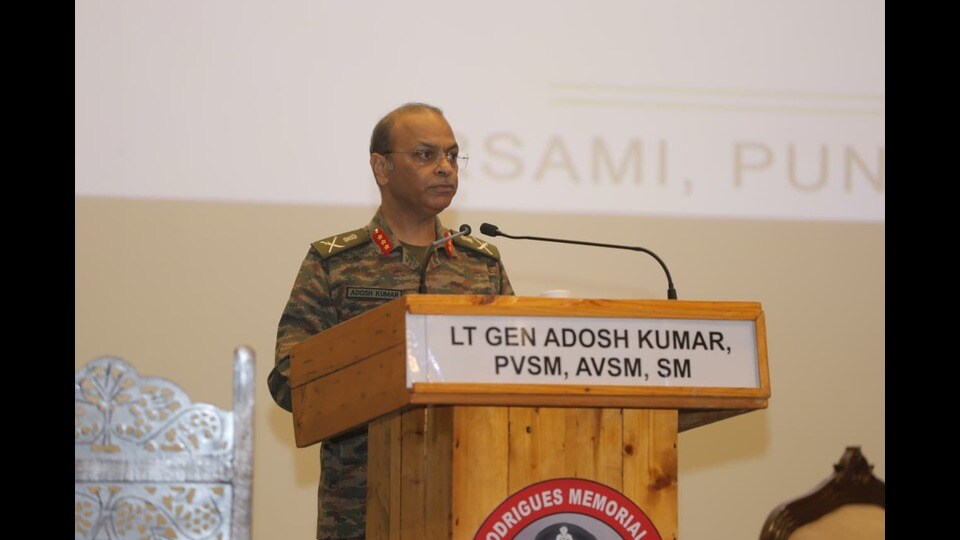
Delivering the ‘Gen S F Rodrigues Memorial Lecture on Non-Contact Warfare: Capability Building – Imperatives for the Indian Army’, lieutenant general Kumar argued that decisive military action no longer requires direct contact on the battlefield. Instead, modern conflicts increasingly unfold in the shadows through proxy actors, cyberattacks, information operations and long-range precision strikes.
“For decades, our western adversary has employed strategies short of open war, disinformation, and proxy warfare to impose costs on us. Today with emerging technologies, the spectrum of threats has expanded well beyond conventional battlefields,” lieutenant general Kumar said.
Citing ‘Operation Sindoor’ as a recent example of the effectiveness of non-contact operations, combining Space-based surveillance, real-time intelligence and long-range precision fires to create disproportionate impact, he said, “Our Space assets allowed us to anticipate, not just react. Our precision vectors delivered devastating effects at extended ranges.”
Calling for a “quantum leap” in both kinetic and non-kinetic capabilities, the senior officer stressed the need for integrated development across multiple domains particularly space, cyber, and the electromagnetic spectrum.
“Space is no longer a benign domain,” he said, underlining the need for indigenous, resilient, and survivable systems for wide-area imaging, electronic intelligence and navigation. He also described the electromagnetic spectrum as an ‘emergent battlefield’ where data corruption and network collapse can paralyse command structures.
On the cyber and information front, lieutenant general Kumar cautioned that AI-generated disinformation, social media manipulation, and targeted cyber intrusions can now destabilise societies and mislead decision-makers as effectively as missile strikes. “Cyber resilience and information dominance are just as critical as kinetic firepower,” he said.
He further emphasised that the advent of long-range precision artillery, hypersonic weapons, cruise and ballistic missiles, and armed unmanned systems has enabled modern militaries to neutralise traditional contact-heavy formations from a distance. “This requires rapid induction and seamless integration of these capabilities into our operational structures,” he said.
However, capability development cannot occur in isolation; the artillery chief warned. He called for a whole-of-nation approach that brings together uniformed personnel, researchers, academia, and private industry to co-develop and scale defence technologies.
“We must build a vibrant ecosystem of innovation, where ideas move swiftly from labs to the field,” he said, urging faster research and development cycles, closer civil-military collaboration, and accelerated transition from prototypes to mass production.
Lieutenant general Kumar concluded by stressing that victory in future wars will belong to the side that can integrate Space, cyber, electromagnetic, informational, and kinetic operations faster and more seamlessly. “Escalation will not always follow a linear path. A cyber strike may trigger kinetic retaliation,” he said, underlining the need to rethink strategic planning and the rules of engagement.


