
 E-Paper



Monday musing: When the rain is real, and the city still isn’t ready
Over the past few years, Pune and much of Maharashtra have seen a shift from steady, predictable monsoon showers to short, intense bursts of rain

 Prefer HTon Google


Last Thursday’s unseasonal rain in Pune once again brought the city to a halt. Waterlogged roads, traffic snarls, choked drains, and scattered power disruptions followed within hours. The images were familiar, almost routine.
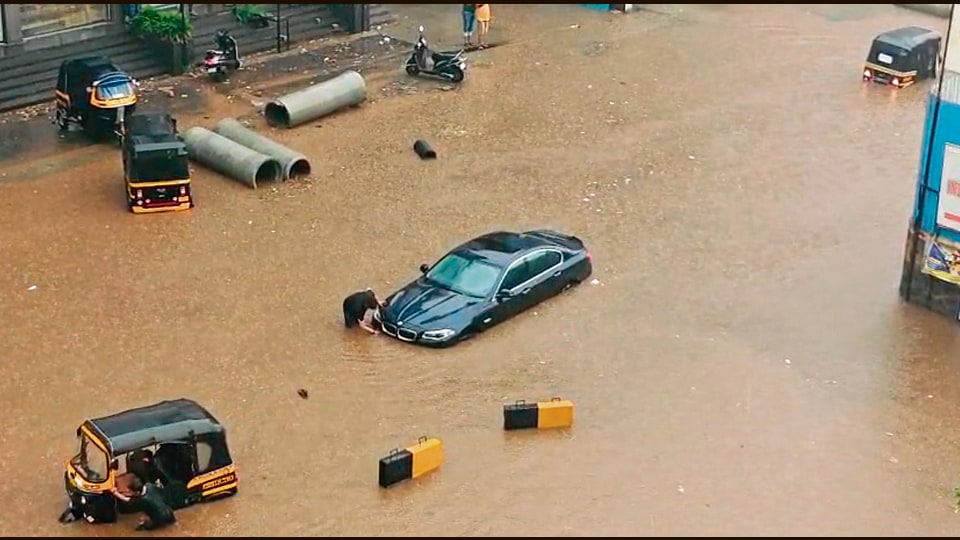
But this time, it is worth asking a harder question: is the city failing, or are we underestimating how rain itself has changed?
Because the nature of rainfall is no longer what it used to be.
Over the past few years, Pune and much of Maharashtra have seen a shift from steady, predictable monsoon showers to short, intense bursts of rain. These high-intensity spells dump large volumes of water in a very short time. Even well-designed urban systems can struggle under such a sudden load.
Last Thursday’s rain was not extraordinary in volume over the day. But its intensity over a brief window overwhelmed the city’s drainage capacity. This distinction matters. It is not just how much it rains, but how fast it falls.
Urban infrastructure, including stormwater drains, is typically designed based on historical rainfall patterns. When those patterns change, systems built for a different era begin to fail, not always because of neglect, but because of a mismatch.
That said, this is only half the story.
The other half lies in how cities respond to this shift—and here is where governance comes into play.
Pune’s recurring struggles during rain are not new. Over the past several years, key junctions have flooded repeatedly. Low-lying areas remain vulnerable. Garbage continues to clog drainage channels despite annual desilting exercises. Roads cave in with the first heavy spell.
These are not failures caused by rain alone.
They point to a deeper issue: the city has not adapted its planning to changing climate realities. While rainfall patterns have evolved, infrastructure design, maintenance practices and administrative response have largely remained the same.
There is also a tendency to treat each rain event as an isolated disruption rather than part of a larger trend.
After every such spell, there is immediate action: pumps are deployed, traffic is diverted, and officials visit affected spots. But long-term responses are slower. Drainage networks are rarely re-engineered. Flood-prone zones are not systematically redesigned. Encroachments along natural water channels continue.
In effect, the city reacts to rain but does not plan for it.
Politics, too, plays a role in shaping priorities. Visible projects, roads, bridges and beautification often take precedence over less visible but critical upgrades like underground drainage or stormwater mapping. These are long-term investments with limited immediate political returns.
As a result, preparedness remains surface-level.
Another challenge is coordination. Multiple agencies—municipal corporation, traffic police, disaster management units- respond during heavy rain, but often without a unified, pre-defined plan for extreme weather events. This leads to delays and confusion at the ground level.
Yet, it would be simplistic to place the entire burden on civic authorities.
Urban growth has also contributed to the problem. Rapid construction has reduced natural drainage areas. Open land that once absorbed rainwater has been replaced by concrete. Lakes, streams and nullahs have been altered or encroached upon, reducing the city’s natural ability to handle sudden rainfall.
In that sense, the city has made itself more vulnerable.
What last Thursday showed, once again, is the collision of two realities: changing climate patterns and slow-moving urban systems.
The rain is becoming more intense. The response is not keeping pace.
If Pune is to avoid repeating this cycle, the approach has to shift from seasonal preparedness to structural adaptation. This means redesigning drainage based on current rainfall data, protecting natural water channels, enforcing building norms more strictly, and improving coordination between agencies.
It also requires political attention to move beyond short-term fixes.
Unseasonal rain will no longer be an exception. It is becoming part of the new normal. The question is not whether the city can stop flooding entirely; it cannot, but whether it can reduce disruption and respond more effectively.
Last Thursday was a reminder, not an anomaly.
The rain did what it does. The city must now decide whether it will continue to react or finally adapt.


