
 E-Paper



Monday Musings: Disincentivise free parking to boost public transport in Pune
Last week, online videos and messages related to events being planned inside Pune Metro became a matter of ridicule for some people, who argued the mass transport system is to carry people and not organise programmes


Last week, online videos and messages related to events being planned inside Pune Metro became a matter of ridicule for some people, who argued the mass transport system is to carry people and not organise programmes. The fact is Maharashtra Metro Rail Corporation Limited (Maha-Metro) is merely trying to popularise the new transport mode in Pune where people prefer travelling in their private vehicles over public transport.
Metro trains on two stretches operationalised so far are mostly running empty because of the short distance they commute. The officials implementing the project are confident that once fully operational on a 31-km stretch on two lines and 14 km on the third line between Hinjewadi to Shivajinagar, the Metro will attract commuters.
Will this be so easy?
If Metro trains are to be flooded with commuters, people need to start disciplining themselves and various agencies such as the Pune Municipal Corporation (PMC) and police need to disincentivise private transportation. The pay-and-park policy can be the first step in the process.
Around four months ago when Pune municipal commissioner Vikram Kumar, also serving as an administrator in absence of the general body at PMC, sought to know status of the pay-and-park policy, hopes revived for many. However, it turned out to be yet another move that remained inconclusive.
It was in 2018, that the Pune civic body approved the parking policy that promised to introduce a pay-and-park facility on major city roads. However, there was no political consensus on the issue, forcing it to remain hanging without implementation.
When the PMC commissioner sought to know in May this year about streets where the policy was implemented, many thought this is the best chance to implement the decision considering the tenure of elected representatives was already over and civic polls had been delayed. However, there has been no progress on the proposal, which may die a quiet death and add to residents’ woes.
The proposal has been in the pipeline for around five years, but corporators opposed it to be implemented in their respective wards fearing backlash from voters.
As per the original policy approved by the standing committee of PMC in 2018, Pune was divided into three zones based on the level of congestion — central business district areas, mobility corridors and the rest. The parking charges would be different for periods from 8 am to 10 pm and from 10 pm to 8 am. For two-wheelers, the hourly charges would be a minimum of ₹2 per hour and a maximum of ₹4 for on-street parking while it would be a minimum of ₹1 and a maximum of ₹3 for off-street parking. For the night, the charges would be fixed and not on an hourly basis. The PMC general body gave its nod to the proposal, but corporators blocked it as none wanted those streets to be from the area they represent.
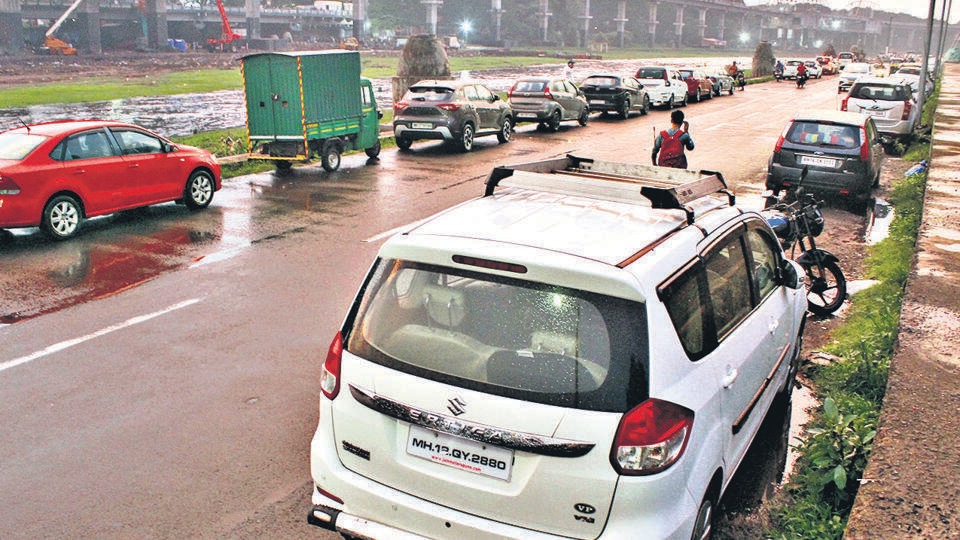
PMC administration could still push the proposal to ensure the project sees the light of the day. Traffic is among the biggest problem Pune faces. If this needs to be improved, paid parking is crucial to the strategy as the PMC parking policy is aimed to decongest city roads that are often cluttered with parked vehicles.
The policy, on one hand, can streamline parking and enable the efficient use of parking spaces, at the same time it will disincentivize citizens by forcing them to pay for parking to force them to shift to public transport which can be incentivised. The highlight of the policy is that parking charges are based on the demand for parking space in a particular area, as against the geographical divisions in other cities.
Pune is currently among the city having some of the lowest parking rates compared to other places. The city has over 40 lakh registered vehicles and sees an addition of 500 to 700 vehicles per day. The rising number of vehicles is causing traffic problems and contributing to pollution. Pune also witnesses around 160 accidental deaths on average every year. Even when roads are widened, it has little impact on the traffic woes, as large parts of the road are occupied by parked cars.


