
 E-Paper



Monday Musings: The political economy of the Marathas in Maharashtra
The community has over the decades retained its clout in Maharashtra’s politics, keeping its power share intact. If Maharashtra has had more than 60 per cent of its chief ministers from the Marathas, the community has a fair representation in the cabinet or in the state assembly


Last week when the Supreme Court quashed reservation in jobs and education to Maharashtra’s politically dominant Marathas, every political party came forward to position itself.
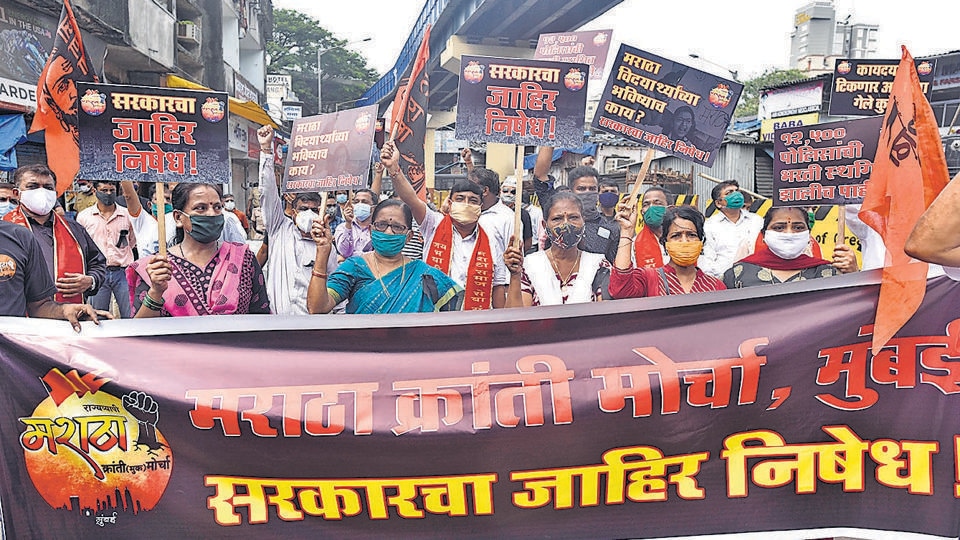
Understandably so, political outfits cannot afford to be seen against Marathas that constitute almost 33 per cent, including Kunbi-Marathas, of the overall population in the state.
For the community, the verdict by the five-member constitution bench is a setback as its finds itself fragmenting among various groups with loyalty to different political parties.
The community has over the decades retained its clout in Maharashtra’s politics, keeping its power share intact. If Maharashtra has had more than 60 per cent of its chief ministers from the Marathas, the community has a fair representation in the cabinet or in the state assembly. Over the years, its politics is shaped by identity where Hindutva and caste have been at the core.
On the economic front, Marathas are a stratified community. Dalit write Anand Teltumbde, who has written extensively on caste system in India, has observed in his Economic and Political weekly piece that Marathas have witnessed threea -fold stratification.
The lowest at the hierarchy are either land-less or marginal farmers. They are mostly from Maharashtra’s Marathwada and account for the largest number within the community. It’s for the same reason, the demand for reservation gained maximum traction in this region.
It is for this section many political parties have sought reservation, citing they account for a majority of the community. The same class, attracted towards caste- based outfits such as Maratha Mahasangh, Sambhaji brigade and Chhawa, has largely remained dissatisfied with those within the community holding on to power. This section is largely trapped in the agriculture sector without access to urban resources.
The Gaikwad Commission constituted by the then Devendra Fadnavis government in its report had highlighted that a large section of Marathas are economically and educationally backward. The Supreme Court, however, found no merit in exceeding the existing 50 per cent ceiling of quota, which could have accommodated Marathas.
In the middle are those having control over land and resources through various institutes like cooperatives and credit societies. Many in this category have control over rural credit and banking. There are many in this category whose next generation has migrated to bigger cities such as Pune and Mumbai for jobs. In the cities though, this section has not been able to dominate the economy. On the contrary, many have had to settle for a secondary position, not in consonance with Maratha pride.
The top category in the Maratha stratification is one that has direct control over power. This section, no matter which party is in government, has enjoyed the fruits of power. This has at times led to increasing gap between Maratha elite and the community, with the former using identity politics to gain power without ensuring the benefits reach the community at large.
Since 1950s till the 1980s, this class was with Congress party. However, as party’s political fortunes begun to change, the section within the community shifted to first Shiv Sena, then Nationalist Congress Party (NCP) and later to BJP. In 2014, many among Maratha-Kunbi voted for BJP.
In their paper, prominent political scientists Rajeshwari Deshpande and Suhas Palshikar observed: “The discursive space of backwardness on the one hand facilitates a suitable construction of caste ideology that covers up material deprivations at least in a tokenist manner and also keeps intact the consensus around the theme of social justice. On the other hand, the Mandal discourse legitimises caste as a political category and creates small openings within practices of democracy, for assertions of traditional caste dominance. This is what the Marathas attempted during the more recent times — despite, but also, because of their dominant political position in the state.”
Today, the community that assumed control of the state’s political apparatus seeks tag of backwardness as many within it couldn’t taste the benefits of post-globalisation economy. While the community draws its dominance from the caste cluster of Marathas and Kunbis, which makes its numerically strong, economically, a large section of it hasn’t been able to achieve material growth.
Yogesh Joshi can be contacted at yogesh.joshi@htlive.com


