In politics, grief is not just personal loss. It is also a vacuum, and vacuums invite movement.
Ajit Pawar’s sudden death has left Maharashtra politics unsettled in ways that go beyond emotion or sympathy. He was not merely a deputy chief minister or a party leader. He was a fulcrum around which alliances, negotiations and internal balances turned. When such a figure disappears overnight, politics does not stop to mourn but looks for anchors.
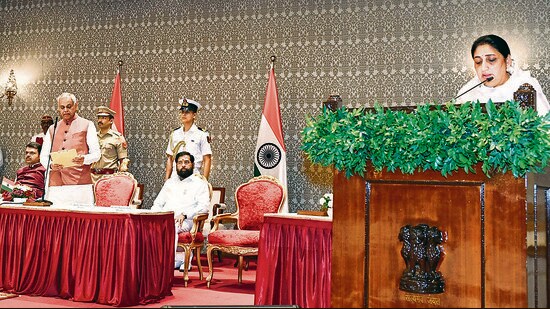
That search began almost immediately. Within days of the crash, Sunetra Pawar was sworn in as Maharashtra’s deputy chief minister. The speed of the transition has drawn criticism, largely centred on timing and propriety. Yet the haste is revealing, not because it is unprecedented, but because it reflects how political time now works.
For long, Maharashtra politics observed certain informal rules around death and succession.
Be it Bal of Thackeray’s demise or Vilasrao Deshmukh and Gopinath Munde. There were pauses, thirteen days of mourning, periods of symbolic restraint, quiet consultations before visible decisions. These were not written conventions, but they were widely understood. They allowed grief to coexist with politics without colliding openly.
That rhythm has changed.
Today’s politics is hyper-managed, constantly alert to perception, and deeply anxious about uncertainty. Rituals still exist, but they no longer slow decision-making; they run parallel to it. Sunetra Pawar’s oath, taken on the fourth day after Ajit Pawar’s passing, is not an aberration so much as a marker of this shift. Political authority was secured quickly, while mourning continued on a separate track.
This duality is visible elsewhere, too. Even as the Nationalist Congress Party has begun carrying Ajit Pawar’s asthi kalash to districts across Maharashtra, invoking emotion, memory and legacy, organisational decisions have moved ahead without pause.
{{/usCountry}}This duality is visible elsewhere, too. Even as the Nationalist Congress Party has begun carrying Ajit Pawar’s asthi kalash to districts across Maharashtra, invoking emotion, memory and legacy, organisational decisions have moved ahead without pause.
{{/usCountry}}At the same time, chief minister Devendra Fadnavis has also announced not to campaign for the February 7 Zilla Parishad and Panchayat Samiti polls, in which he was to address 22 public meetings in seven days. Ritual is being deployed to consolidate sentiment, not to delay power transitions. The two are no longer bound together.
This is not unique to one party. Across political formations, rituals have increasingly become tools rather than restraints. Leaders participate in mourning, memorials and symbolic acts, while negotiations, appointments and alignments proceed at full speed behind the scenes. Social time and political time have diverged.
Ajit Pawar’s absence has sharpened this divergence. He was a bridge figure, between two factions of the NCP, between the party and its allies, and within the Pawar family itself. His authority often lay in his ability to hold competing interests together. Without him, the vacuum has exposed unresolved questions that were earlier managed quietly.
One such question concerns the stalled merger talks between the Ajit Pawar-led NCP and the Sharad Pawar-led NCP (SP). Ajit Pawar was widely seen as the driver of reunification efforts. His death has not ended those conversations, but it has robbed them of momentum and clarity. What was once a negotiated process now looks uncertain, dependent on actors who do not command the same authority across camps.
Another question lies within the family itself. The fact that senior Pawar family members were not informed in advance about Sunetra Pawar’s swearing-in is less about protocol and more about altered decision-making. For decades, the Pawars were known for collective consultations, even amid disagreements. The recent events suggest that decisions are now being taken by smaller circles, driven by urgency rather than consensus.
This urgency is not hard to explain.
Power, when left unattended, invites challenge. The ruling alliance could ill afford ambiguity over leadership at a time when the state government is preparing for the budget and facing political churn. Installing Sunetra Pawar ensured continuity and sent a signal of stability, both within the government and to the party cadre.
At the same time, sentiment has not been ignored. The outreach through rituals, the invocation of Ajit Pawar’s legacy, and the visible expressions of grief serve a political purpose too. They humanise the transition and soften its sharp edges. In a media-driven environment, optics matter as much as outcomes.
There is also a practical layer to this moment. Sunetra Pawar, now a deputy chief minister, will eventually need electoral legitimacy in the state legislature. The Baramati assembly seat, long associated with the Pawar family, will become central to future calculations. Sympathy, legacy and organisational strength are already being quietly weighed, even as public discourse remains focused on mourning and propriety.
None of this is to suggest cynicism or insensitivity. It is simply how contemporary politics functions. Loss does not suspend ambition, and grief does not halt institutions. What has changed is the willingness to let rituals dictate the pace of political action.
In Maharashtra today, rituals still carry emotional weight, but they no longer impose political restraint. Authority is asserted quickly, narratives are managed simultaneously, and mourning is folded into governance rather than placed above it.