Amid Diwali festivities, a partial solar eclipse enthralled Punekars on Tuesday. As the city is a hub for science and research institutions, various programmes were organised and elderly and children were equally eager to witness the eclipse.
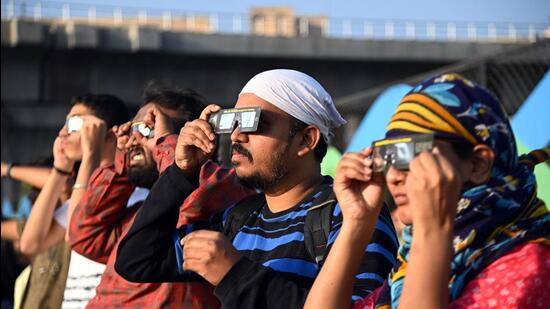
One such event was organised by Inter-University Centre for Astronomy and Astrophysics (IUCAA) and the Centre for Science Education and Communication (SCEC) at Savitribai Phule Pune University (SPPU) sports ground. Hundreds of people, especially parents came with their children to witness the eclipse through telescopes and specialised glasses made available by IUCAA and SCEC.
“We got a good response from people for the event,” said Somak Raychaudhury, director-professor of IUCAA.
“Last time a similar eclipse was in June 2020 when we were in a lockdown and so we had organised an online event, but now we decided to collaborate with SPPU. At least seven to eight telescopes were kept for people to see the partial solar eclipse and our volunteers guided them through the event,” he said.
“A few years back people used to close windows and draw the curtains to keep away from the solar eclipse. But things have changed now, as we see thousands of people in Pune at various spots witnessing the partial solar eclipse,” he added.
{{/usCountry}}“A few years back people used to close windows and draw the curtains to keep away from the solar eclipse. But things have changed now, as we see thousands of people in Pune at various spots witnessing the partial solar eclipse,” he added.
{{/usCountry}}The total duration of the solar eclipse was around 1.30 hours starting from 4.40 pm to 6.05 pm. While around 25 per cent of the partial solar eclipse was seen in Pune city and the maximum of the eclipse was seen at 5.45 pm.
“It was my first time seeing the partial solar eclipse with my family and I enjoyed the experience. It will be helpful for me while completing my science project,” said Sharveel Kenjale, a Class 5 student, who had come along with his parents to watch the solar eclipse at SPPU ground.
Harshada Babrekar, principal science communicator at SPPU’s Center for Science Education and Communication, said, “We got a good response for today’s event. We had got 250 specialised glasses but as more people came glasses had to be exchanged.”