A seminar on ‘Accessible Science: Fostering Collaboration’ was organised Friday at the Indian Institute of Science Education Research (IISER) Pune, kickstarting the precursor events of the fourth and final G20 Education Working Group (EDWG) Meeting and G20 Education Ministers Meeting. The seminar was inaugurated by union minister of state (MoS) for education, Subhas Sarkar, who also launched a report titled, ‘The status and relevance of research collaborations for development, considering G20 nations’ on the occasion.
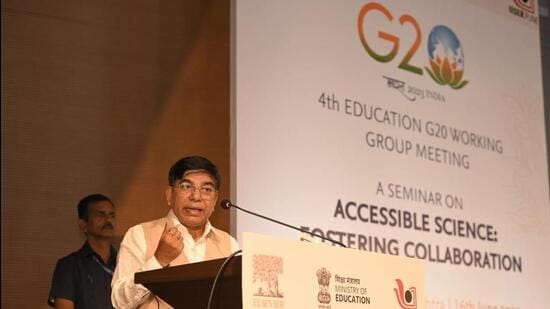
At the inaugural session, Sarkar said, “There is an importance of removing barriers to knowledge, promoting transparency, and fostering multi-disciplinary collaborations. Several ‘accessible science’ initiatives of the Government of India such as Vaccine Maitri, Genome India Project and BHUVAN by the Indian Space Research Organisation, e-Shodhganga, and SWAYAM and SWAYAM-NPTEL platforms are examples of successful collaborative efforts that have led to meaningful change and sustainable development. There is a potential for collaborative efforts to explore the multi-dimensional aspects of Indian knowledge systems including Ganita and Jyamiti (Mathematics and Geometry, respectively) and Vastu Vidya (Architecture).”
Also present at the seminar were the secretary, higher education, K Sanjay Murthy; director, IISER Pune, Sunil S Bhagwat; chair, International Association of STM Publishers, Dr Nick Fowler; and chief academic officer, Elsevier, Carlos Henrique de Brito Cruz among other dignitaries who engaged in fruitful discussions on best practices for accessible science in global development and provided a clear vision for G20 countries to follow.
Citing India’s stellar performance and remarkable achievements in scientific research, Fowler noted that the country’s scholarly output has been steadily increasing. “India is the third largest producer of scientific research, overtaking the United Kingdom (UK) in 2022. But India has not only succeeded in terms of the volume of research output, it also boasts achievements in academic quality. Field Weighted Citation Impact has risen from 0.85 in 2019 to 1.05 in 2021, putting India above the global average for publication citations,” Fowler said. He also appreciated the Indian government’s focus on driving qualitative research to strengthen the country’s competitiveness in global research and innovation, resulting in India climbing to the 40th rank in the WIPO’s Global Innovation Index 2022.
{{/usCountry}}Citing India’s stellar performance and remarkable achievements in scientific research, Fowler noted that the country’s scholarly output has been steadily increasing. “India is the third largest producer of scientific research, overtaking the United Kingdom (UK) in 2022. But India has not only succeeded in terms of the volume of research output, it also boasts achievements in academic quality. Field Weighted Citation Impact has risen from 0.85 in 2019 to 1.05 in 2021, putting India above the global average for publication citations,” Fowler said. He also appreciated the Indian government’s focus on driving qualitative research to strengthen the country’s competitiveness in global research and innovation, resulting in India climbing to the 40th rank in the WIPO’s Global Innovation Index 2022.
{{/usCountry}}Brito Cruz presented report highlights and noted that India is fast gaining traction in the global scientific community. He mentioned in his presentation that India is bound to become the second largest publisher in artificial intelligence (AI) related topics with the oldest AI article by Indian authors dating back to August 1968.
The seminar is part of the ongoing fourth and final EDWG meeting in Pune, Maharashtra, which takes place from June 19 to 21, 2023. The overarching theme of the meeting is ‘Ensuring Foundation Literacy and Numeracy, especially in the context of blended learning’. The EDWG meeting comprises various precursor events, seminars, exhibitions and heritage excursions, and will culminate with the G20 Education Ministers Meeting on June 22, 2023.