
 E-Paper



Rediscovering the lost Poona Cake and New Year traditions
By the mid-twentieth century, shops owned by Maharashtrians had started selling equipment like the egg-beater and cake pans

 Prefer HTon Google


One Saturday morning, a couple of years before the Covid-19 pandemic emerged, I was at the Nehru Memorial Museum and Library in Delhi, searching through old records. Before me, on the microfilm reader, flickered pages from a newspaper published in Bombay in the early twentieth century.
At the next table sat a gentleman in his fifties, Mr R. He held a senior post in “Prasar Bharati” and had decided to complete a PhD before retiring. Every Saturday, he came to the library to work on his research, something related to nineteenth-century Tamil theatre.
As I scanned through the recipes from the newspaper, mostly cakes and jellies for New Year’s Eve, he glanced at my screen and said, “My grandmother had a notebook with a newspaper clipping in it. It carried a recipe for Poona Cake. She baked it every New Year’s Eve, but without eggs. She is gone now, and so is the notebook, but I can still taste that cake. Do you know this recipe?”
I did not.
Over the years, countless recipes and their variations, like Poona Curry Paste, Poona Chutney, Poona Curry, and so many others, have quietly faded from our culinary memory. The Poona Cake baked by Mr R’s grandmother seemed to have slipped away in much the same way.
Baking a cake on New Year’s Eve was a familiar ritual. There were two different New Year’s cakes - the large ones, originally given by bakers to their patrons, and the smaller “biscuits” which were originally formed in wafer irons, but which by the mid-nineteenth century were also formed in smaller wooden cake boards. These smaller cookies were often donated to orphanages and schools in Poona.
Across the British Isles in the nineteenth century, cake played a central role in New Year traditions. In parts of England, families baked special New Year’s cakes or biscuits to share at midnight or give as small “handsel” gifts for luck. Scotland marked Hogmanay with the rich fruit-filled “black bun”, shared at midnight to welcome the New Year.
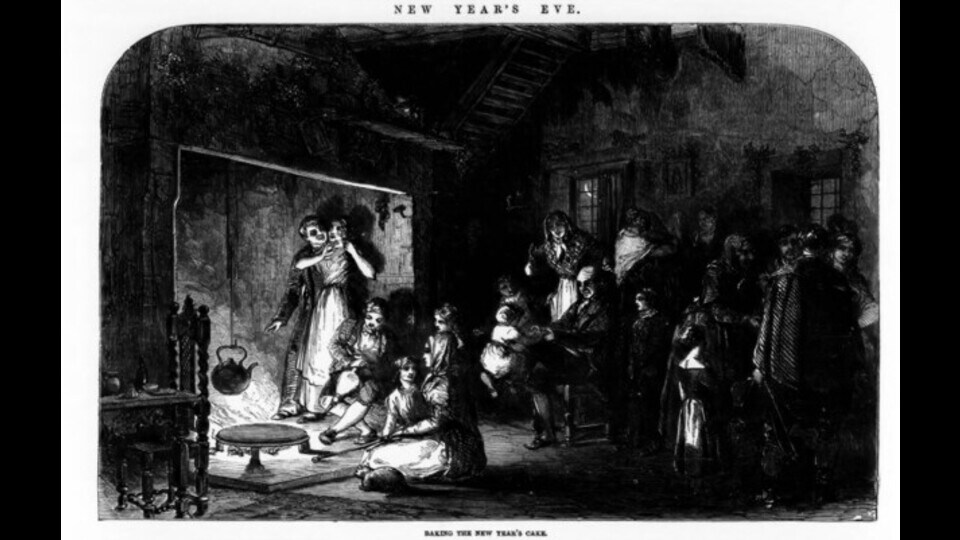
A Bombay newspaper reprinted an article in December 1853 from the “Illustrated London News” (January 3, 1852) describing an old New Year’s Eve festival whose origins, rooted in ancient pagan customs, had begun to fade from both practice and memory. Yet the tradition remained dear to many because it recalled the joys of childhood. People fondly remembered a time when the master of the house, whether in a grand home or a modest farmhouse, announced to friends and dependents that the “lady of the house” would be making the New Year’s Eve Cake. This quiet invitation always drew a cheerful crowd eager to watch the cake being prepared, enjoy the jokes of whoever acted as “high priest,” and hear the playful chants believed to ensure the cake’s success.
Once the cake was placed on the griddle, it became the centre of attention. Young women secretly added sprigs of holly or ivy to the fire after their sweethearts had done the same, hoping the two flames would burn together, an omen of shared happiness in the coming year.
These were simpler times, when a baron and a peasant gathered under the same roof. Even the travelling fiddler was invited to witness a young boy, on the threshold of manhood, lift the sturdy cake and smash it against the door. As it broke into pieces, those present silently prayed that cold, hunger, or hardship would not cross that doorway in the year ahead. The fragments were scrambled for, and whoever secured the first piece to touch the floor believed they would have a home and a New Year’s Cake before the next year ended.
What followed was a lively scene of eating, drinking, dancing, and singing, the sort of merriment for which Ireland was known, lasting until midnight. Then the company offered a prayer of thanks for being carried safely into another year.
The article urged the Irish expats in Bombay and Poona not to let the custom of baking and breaking the New Year’s cake die.
Every year, around Christmas, F Cornaglia, the famous Italian confectioner in Poona, baked the traditional Italian cake, the “pan pepato” of Ferrara, a brioche flavoured with cocoa, sweetened with honey, enriched with almonds and lemon zest, coated with chocolate and decorated with sugar candies. It was mostly bought to celebrate New Year’s Eve.
A Bûche de Noël was bought from bakers like James Pearse in Bombay or Cornaglia or was baked at home. The cake, baked to resemble the Yule log of ancient days, was served to friends and families during the Christmas holidays, but it always appeared on New Year’s Eve with the numbers of the New Year iced on the cake.
S Wyse & Co, located at Main Street, Poona, and purveyors to HE THE Governor of Bombay, were known for the cakes and pastries they baked for Christmas and New Year’s. Their cakes were marked with the date of the year. They also sold oranges, dates, figs, nuts, raisins, flowers, and candies during the festive season.
Cakes baked at home or at the baker’s sometimes included symbolic items like a button or ring to bring faithfulness, a coin to bring wealth, a bean or pea to bring wisdom, a thimble to bring patience, and a paper heart to bring devotion.
By the mid-twentieth century, shops owned by Maharashtrians had started selling equipment like the egg-beater and cake pans.
In March this year, while wandering through the old book market in Delhi, I came across a worn copy of the cookbook titled “The Wife’s Help to Indian Cookery: Being a Practical Manual for Housekeepers” on one of the stalls. It was published in 1888 and was compiled and edited by WH Dawe, who was the assistant-secretary to the Board of Revenue, North-Western Provinces in Allahabad (now Prayagraj). I stood there and flipped through its pages, and to my surprise, found a recipe for “Poona Cake”. I was unsure if this was the very recipe that appeared in the newspaper Mr R’s grandmother once kept, but it was still the “Poona Cake”. I was delighted. I bought the book. I messaged Mr R, who is now retired and living in Vellore, and sent him a photo of the recipe.
The recipe read as follows - Poona cake – Rub into a pound of dry flour half a pound of good butter; mix well with these a quarter of a pound of sifted sugar, add a cupful of boiling milk, and three well-beaten eggs, half a pound of currants, and some grated lemon-rind and nutmeg. Mix well and lightly together, stir in a teaspoonful of carbonate of soda, and bake immediately.
This morning, on December 31, he messaged me. His family had gathered and baked the Poona Cake, with eggs, together with the recipe I had sent. The taste wasn’t the same as the one he remembered from his grandmother’s kitchen, but the cake still carried him back into her embrace.
As we step into the New Year, may we rediscover old flavours and welcome new ones. And may the food we cook at home be shared freely, with friends, relatives, neighbours, acquaintances, strangers, and those who have less than we do.


