Researchers at the Indian Institute of Science Education and Research (IISER) Pune and CSIR-NCL (Council of Scientific and Industrial Research – National Chemical Laboratory) Pune have shown that the macroscopic deformation of amorphous solids is controlled by structural defects within the material.
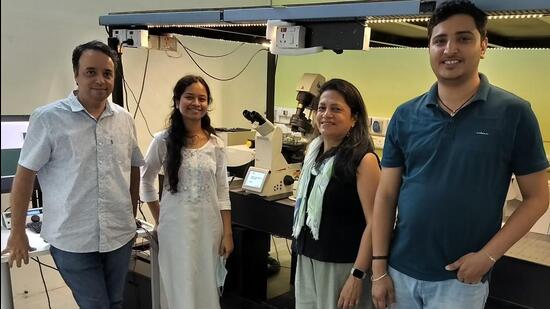
This joint effort, led by Dr Vijayakumar Chikkadi from IISER Pune and Dr Sarika Bhattacharyya from CSIR-NCL Pune, combines experimental studies on colloidal glasses—model systems for amorphous solids—with a theoretical framework based on the structural order parameter. Published in the journal, ‘Proceedings of the National Academy of Sciences USA’, the findings address a long-standing question in materials’ science and condensed matter physics. The work has received research grant support from the Department of Science and Technology - Science and Engineering Research Board.
Chikkadi said, “All materials deform when external stresses are applied. In 1934, G I Taylor, M Polanyi, and E Orowan independently explained that macroscopic deformation originates from the dynamics of defects within the material. In crystalline solids, identifying these defects is relatively straightforward due to lattice distortions. But in amorphous solids, the lack of long-range order makes detecting defect-like regions far more challenging. While several approaches have been proposed to identify soft, defect-like regions in disordered solids, direct observation in experimental systems has been difficult.”
Chikkadi and Ratimanasee Sahu from IISER Pune conducted experiments using dense colloidal suspensions, which serve as models of amorphous solids. By tracking the motion of nearly 100,000 individual colloidal particles in three dimensions over time using advanced microscopy techniques, the researchers obtained unprecedented access to microscopic information that is difficult to acquire in atomic systems.
{{/usCountry}}Chikkadi and Ratimanasee Sahu from IISER Pune conducted experiments using dense colloidal suspensions, which serve as models of amorphous solids. By tracking the motion of nearly 100,000 individual colloidal particles in three dimensions over time using advanced microscopy techniques, the researchers obtained unprecedented access to microscopic information that is difficult to acquire in atomic systems.
{{/usCountry}}These studies exploited the structural order parameter developed by Mohit Sharma and Bhattacharyya at CSIR-NCL Pune to quantify soft and hard regions in amorphous suspensions, leading to the identification of structural defects. Bhattacharya said, “A key advantage of this order parameter, which is developed from detailed microscopic theory, is its practical applicability in experimental settings, making it more accessible compared to other theoretical quantities.”
For the first time, the team experimentally demonstrated that macroscopic deformation in colloidal glasses originates from localised deformations, which occur preferentially in regions containing structural defects when subject to external stress.
On the future prospects of this work, Chikkadi said, “This breakthrough significantly deepens our understanding of how defects affect the mechanical properties of disordered solids. It also paves the way for developing improved rheological models based on structural aspects that are applicable to a wide range of materials, including soft matter like granular materials and emulsions, as well as metallic glasses.”