The NSF–DOE Vera C Rubin Observatory in Chile has officially begun the Legacy Survey of Space and Time (LSST), a landmark 10-year astronomical survey that is expected to transform the way scientists study the Universe.
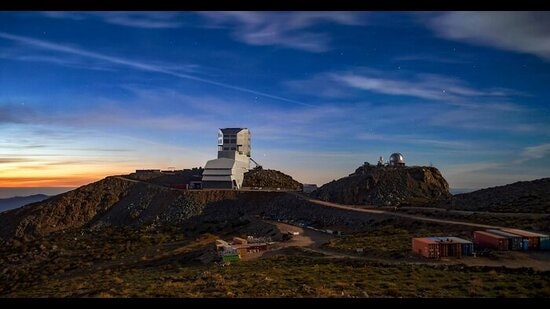
Scientists from India are among the key contributors to the international project, with researchers from the Inter-University Centre for Astronomy and Astrophysics (IUCAA), Pune, and the National Centre for Radio Astrophysics (NCRA-TIFR) involved in several major scientific collaborations.
Equipped with the world’s largest digital camera built for astronomy, the observatory will repeatedly scan the southern sky and create an unprecedented time-lapse record of cosmic changes. The data generated through the survey will help scientists study a wide range of phenomena — from nearby asteroids and exploding stars to distant galaxies, black holes and the mysterious dark matter that shapes the cosmos.
Prof Surhud More, Rubin IUCAA Program Manager, said the survey marks the beginning of a new phase in astronomy.
“The LSST will provide insights across a broad range of scientific fields, including the formation of the Solar System, exploding stars, black holes that tear apart stars, the distribution of dark matter across nearly half the sky, and the future evolution of the Universe. The observatory will deliver an unprecedented scientific resource for astronomers worldwide over the next decade,” More said in a release on Wednesday.
{{/usCountry}}“The LSST will provide insights across a broad range of scientific fields, including the formation of the Solar System, exploding stars, black holes that tear apart stars, the distribution of dark matter across nearly half the sky, and the future evolution of the Universe. The observatory will deliver an unprecedented scientific resource for astronomers worldwide over the next decade,” More said in a release on Wednesday.
{{/usCountry}}Researchers from Pune are also playing a key role in studying gravitational lensing — a phenomenon predicted by Albert Einstein, where the gravity of massive objects bends light from distant galaxies and creates multiple images of the same source.
Anupreeta More, co-chair of the LSST Strong Lensing Science Collaboration, said the survey is expected to discover thousands of such rare cosmic events.
“The survey is expected to discover more than 10,000 gravitational lenses. These rare cosmic alignments can also magnify transient events such as supernovae and kilonovae, sometimes making them appear brighter and allowing them to be observed more than once — a phenomenon often described as a cosmic ‘déjà vu’ experience. These observations will help astronomers measure the age of the Universe and refine estimates of its rate of expansion,” she said.
The survey is also expected to significantly advance the understanding of galaxies and their evolution.
Prof. Yogesh Wadadekar of NCRA-TIFR, a member of the LSST Galaxies Science Collaboration, said Rubin’s deep images would provide scientists with an unparalleled view of galaxies across the Universe.
“Rubin’s exceptionally deep images will enable scientists to study nearly 20 billion galaxies of different shapes and sizes. This massive dataset will help researchers understand how galaxies formed and evolved over billions of years, opening the door to thousands of new scientific discoveries during the coming decade,” he said.