
 E-Paper



Taste of Life: Freedom struggle, Hindu-Muslim unity and popularity of goat meat
Goats were not only purchased by peasants, goatherds, and butchers, but were also bought by families for milk and sacrifice

 Prefer HTon Google


Pune: On August 21, 1946, the Marathi newspaper “Dnyanaprakash” published a letter written by Mr Dinakar Sathaye who was an agriculturist trained in the UK and had been promoting innovative practices of farming in and around Saswad. In the letter, Sathaye urged the government to take immediate steps to ascertain that pastures were reserved for feeding of goats and sheep in and around Poona. He also complained that “good quality goats” had become unaffordable to poor farmers in the Bombay Presidency and that corrective measures had to be taken to supply them with breeds like “Surti” and “Savti”.
The nineteenth-century Poona mainly had four varieties of goats, viz “Khuri”, “Ghodsheli”, “Surti” or “Koi”, and “Savti”. The “Khuri” originated from Karnataka. They were small and had short ears. The “Ghodsheli” was a large goat whose meat was tough and had a strong flavour.
The “Surti” goat was the most common in Poona. It was a medium-sized, smooth-haired, white animal with small thick ears, a big udder, and a small head. It produced large quantity of milk and was kept and fed at home. It was a “city goat” because it tolerated confined conditions and stall-feeding well. It did not walk a long distance in search of food, as other goats did. It thrived best on all kinds of garbage, particularly vegetable and other green offal and grain sweepings.
The poor and middle-class Muslims of Poona in the nineteenth century kept this breed because of its good milking quality, combined with docility and quality to thrive under confined conditions. According to an article written by BB Jamaspjina in “Indian Farming” in July 1944, the breed owed its origin to the Arabian or Mesopotamian goats. At one time Surat was the most prosperous and important harbour on the west coast of India. All foreigners from the West called at this port. The Muslim traders always carried a large part of their food in the form of live goats and sheep. The Haji Muslims of India on their return followed the same practice. This is how some of the best goats, mostly bucks, were brought to Surat. The resultant breeding and crossbreeding between the Arab bucks and local does developed into the “Surti” goats. Bharuch and Cambay, which were also important ports at one time, possessed some good specimens of this breed.
Very fine “Surti” goats, or good milking Aden goats, were to be seen with the Hajis at the musafirkhanas near Crawford Market in Bombay in the late nineteenth century. These goats were brought to Poona and sold at the “Bakar Bazaar”, the goat market, located in Bhavani Peth.
The “Bakar Bazaar” was held twice a week, according to the sanitation report of the Bombay Presidency published in 1895. Goats were not only purchased by peasants, goatherds, and butchers, but were also bought by families for milk and sacrifice. Goats and sheep were both largely employed to manure the land by confining them on certain areas, on which they deposited their droppings.
The sheep and goat were offered as sacrifices to village gods and demons. The blood of the offered animal was spilt over the idol and the flesh was cooked and shared among the worshippers and members of the village community.
Goat’s milk was reckoned sweeter and finer than cow’s milk and preferred at the breakfast table by some Europeans. It was decidedly the best for tea. Chiefly used by poor Indians, it was used as a tonic for children and was sometimes made into butter. Several Ayurvedic doctors prescribed the milk for various ailments. It was not uncommon for Brahmin families to have a goat in their backyard. Later, after Mahatma Gandhi took a liking to goat’s milk, many of his disciples started consuming the same. Advertisements in “Dnyanaprakash”, published throughout March 1931, declared that goat’s milk would be delivered to households in the peths of Poona every morning. The goat was of course owned and milked by a Brahmin, the advertisement did not forget to mention.
The British in India took some time to take a liking to goat meat. They were used to relishing the meat of sheep. Even though goat meat was cheaper, it was tougher than sheep meat. Indians preferred goats because the hot climate of the subcontinent made farming of sheep difficult. However, the British never really cared for goat meat. Mrs Isabella Beeton noted in “Household Management” that goat meat was “anything but pleasant to English tastes”.
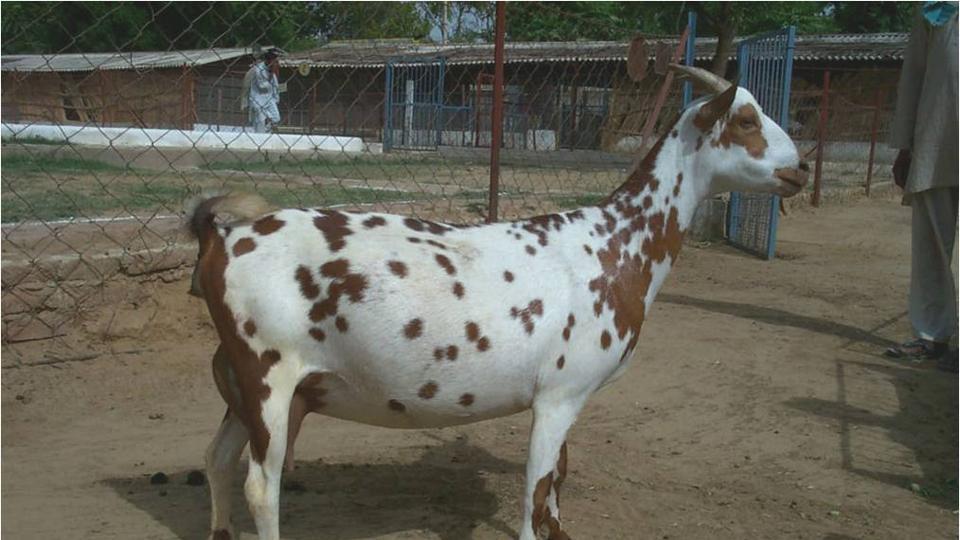
But goat’s flesh was relished in India. The “Barbari” goat was much sought after for its meat by wealthy Muslims in Poona. The small, short-haired and erect-horned “Barbari” goat was very popular in urban north India. It was believed that the breed had originated from the dwarf varieties of Central and West Africa. Its colour was generally white with red or tan spots. It was a good milch type. It could be stall-fed and could live in confined conditions in cities, yielding two to three pounds of milk a day. It also had a very tender flesh.
The “Surti” goat’s flesh was said to be hard and coarse. The “Savti” goat’s flesh was said to be tender, and it was generally kept for food. The “Savti” goats were taller and larger but gave less milk. They were usually bought to feed special guests or for sacrifice.
In Surat and Bombay, a superfine class of goats known as “Pateri”, a sub-breed of “Surti”, was found. The “Pateri” goat was sold at a higher cost than the “Savti” in the goat market of Poona. A picture of finesse and tenderness, it was much sought after around the festival of Eid al-Adha (Bakri Eid).
Rising voices calling for “Cow Protection” in the early twentieth century meant increased demand for goats and sheep for sacrifice during festivals.
Maulana Abdul Bari Ferangi Mahali was a freedom fighter who had participated in the Khilafat Movement. In 1919, he wrote to Mahatma Gandhi informing him that no cow slaughter would take place that year on the occasion of Eid al-Adha in the Ferangi Mahal. Bari was a very influential figure with a following that cut across various religions and castes. He desired Hindu-Muslim unity and campaigned against cow slaughter.
The All India Muslim League, in their session held at Amritsar in 1919, resolved that, to “respect the feelings of their Hindu brothers, Mohamadans would refrain from slaughtering cows at their religious sacrifices” and that goats and sheep be utilised instead. On May 20, 1920, “The Bombay Chronicle” reported that “having seen the force of the resolution of the League”, the Amir’s government in Kabul, in consultation with the leading and authoritative Moulvis and Ulemas, had issued orders to sacrifice goats and sheep instead of cows throughout Afghanistan.
These events resulted in a growing demand for goats in the “Bakar Bazaar” of Poona. But the “Surti” and “Savti” breeds had increasingly become out of reach of the poor in the mid-twentieth century.
Hence, agriculturists like Sathaye called for breeding propensities of the “Surti” breed to be fully utilised and developed further. The “Surti” was a favourite among the goat fanciers due to its economic character. But that meant that many refused to sell their stock, and whatever was offered for sale was always at a high price beyond the poor purchaser’s means. In 1944, a buck was sold in Poona for ₹25 and doe at ₹40 each.
The agriculture department took up goat farming in Poona in the early 1960s to make the animals affordable. This story is for some other time.
Chinmay Damle is a research scientist and food enthusiast. He writes here on Pune’s food culture. He can be contacted at chinmay.damle@gmail.com


