
 E-Paper



Taste of Life: Kids waited the whole year for Diwali and ‘faraal’
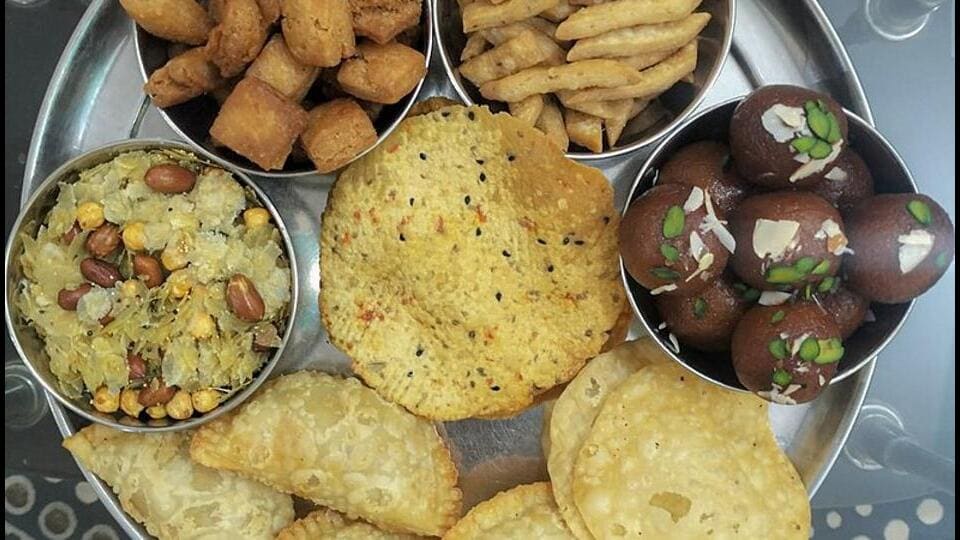
Food was an integral part of Diwali celebrations and ‘faraal’, the sweet and savoury fried snacks, were munched on throughout the holiday

 Prefer HTon Google


Pune: Festivals and rituals are known to foster social cohesion across diverse social and cultural niches. Humans are hypersocial species and gatherings during festivals are experienced as positive and contribute to feelings of social bonding.
In November 1937, Gopinath Talwalkar, editor, author, and translator, organised “Anand Balsammelan” in Pune. The event was a two-day gathering of children, aged eight and above, and was held at a wedding hall in the city during the Diwali vacation. “Anand”, the famous children’s magazine, was edited by Talwalkar and the “Balsammelan” was a convention of its young readers. Teachers from various schools were invited to entertain children with songs, stories, and skits. Authors who had contributed to the Diwali issue of the magazine attended the event to talk to the young readers. Talwalkar knew his readers well. He made sure to keep their interest in the events alive by arranging adequate supplies of Diwali “faraal”.
Food was an integral part of Diwali celebrations and “faraal”, the sweet and savoury fried snacks, were munched on throughout the holiday. They included crispy, crunchy chaklis, chivda, shev, kadboli, karanji, anarase, chirote, and laddoos. The “faraal” was shared with friends and family who visited. In the early twentieth century, when most families earned just enough to make ends meet, “faraal” was a novelty and children waited the whole year for Diwali to be able to enjoy delectable snacks and firecrackers.
Like food, Diwali in Maharashtra was also associated with special literary magazines in Marathi. The Diwali issues in the early twentieth century were considered a special treat and authors reserved their best writings for them. But amongst dozens of magazines that were published to celebrate the festival of lights, hardly any had a special section for children. A few magazines for children and youngsters tried to fill this lacuna.
Vinayak Kondadev Oak was a pioneer who published “Balbodh”, the first children’s magazine in Marathi, in 1881. “Pathashalapatrak” and “Shalapatrak”, edited by Krishnashastri Chiplunkar, had preceded “Balbodh” but they were not meant to “entertain” children. “Balbodh” was also the first children’s magazine to publish special Diwali issues.
Vasudev Govind Apte, a friend of Oak, started “Anand”, a magazine for children, in 1906. Apte was displeased with Oak’s vision while publishing “Balbodh”. He found it archaic and moralising and decided to make “Anand” entertaining for children by incorporating stories, songs, biographical sketches, skits, and puzzles. “Anand” was a huge hit among the children and several magazines like “Balodyan”, “Khelgadi”, “Mulanche Masik”, and “Balbodhmeva” followed its lead.
Apte passed away in 1930 after which Talwalkar took over the responsibility as editor of “Anand”. He was himself a writer of great repute and made efforts to keep the magazine contemporary. He considered literature for children as an important matter to be carefully dealt with. No wonder “Anand” featured some wonderful stories and poems and children waited every month for the issue. By then Pralhad Keshav Atre’s “Navayug Vachanmala” and Pandurang Sadashiv Sane’s novels had gained much popularity.
But despite efforts by the likes of Apte, Talwalkar, Atre, and Sane, children’s literature in Marathi was scarce. The educated middle class was oblivious to the role played by books in the development of a child’s intellectual and emotional abilities. Talwalkar’s “Balsammelan” during Diwali in 1937 was an effort directed at attracting more youngsters and their parents towards children’s literature. According to the Marathi newspaper “Dnyanaprakash”, Talwalkar’s initiative was aimed at creating a base of young customers for his Diwali issues, while “Kesari” commented that the “Balsammelan” was the right step towards inculcating religious values in children. In colonial times, Diwali holidays spanned less than a week. But such was the popularity of “Anand” that young readers enthusiastically participated in the “Balsammelan” for two days.
“Khelgadi”, a children’s magazine edited by Kashinath Palwankar and revived in 1927 after it shut down in 1920, was another popular children’s magazine. It was published in Mumbai and had a strong readership all over Maharashtra. Palwankar, impressed by Talwalkar’s first “Balsammelan”, organised a children’s gathering in 1938 in Pune. To attract readers, he placed an advertisement in Marathi newspapers and announced that the participants would enjoy a meal of “puranpoli” on the second day of the “sammelan”. Both “Anand” and “Khelgadi” continued the tradition of two-day conventions during Diwali vacation for at least four years and made sure that their dates did not clash. In 1939, one Mr Sahasrabudhe from Narayan Peth served “faraal” to children at the events organised by both magazines. The “Balsammelans” offered a rare chance for children to meet their favourite authors and teachers over Diwali “faraal”.
Newspapers are silent about these conventions after 1942. The Second World War had impacted the supply of paper which resulted in several publications reducing the number of pages or altogether ceasing the printing of magazines and rationing did not allow one to host gatherings that served food.
The early nineteenth-century Maharashtra was occupied by the emphasis on a new pan-Hindu religious identity while exhibiting an exegesis of “Western” materiality and consumption. The Maharashtrian “upper caste” middle class was busy navigating the renewed vigour of organised religion while wearing a badge of faith that it considered a symbol of patriotism. It constantly tried to define and create social norms it thought appropriate for its class and culture.
Kamshet, a picturesque village in Maval taluka near Pune, became a centre of activities for children during Diwali vacations in the early 1930s. The families of Kanetkar, Sardesai, Karmarkar, and Dalvi from Pune and Mumbai had made the village their home. Apart from campaigning for small dams and better irrigation facilities, the families had been trying to inculcate cultural norms and rituals that were in vogue in cities among the villagers.
In 1932, these families started organising residential camps for children from Pune and Mumbai for a week during Diwali vacations. Physical fitness, mental recreation, and accumulation of knowledge were considered important aspects of the project undertaken by the “upper caste” middle class to popularise “progressive” values. Accordingly, boys played badminton, deck tennis, and cricket while girls participated in races in the camp. A swimming competition was held for boys. Prominent educationists and thinkers addressed the children and stressed the importance of patriotism, sports and academic excellence for “nation-building”.
Mrs Savitribai Kanetkar was incharge of food. Breakfast, lunch, and dinner were served to the participants and the dishes adhered to “traditional knowledge” of dietetics. Grains, vegetables, and fruits thought to be fit for consumption in the month of “Kartik” were used and each child received a limited quantity of fried snacks. Sweets were served only during lunch and dinner and comprised “bhakari”, leafy vegetables, and rice. Mr Patil and Mr Shrirambhau, residents of Kamshet, donated vegetables and grains for the camp till 1939. Their generosity was praised by “Dnyanaprakash” in 1938.
Voluntary social work was considered an important aspect of “nation-building” and the middle class made sure that such efforts were lauded and made conspicuous. One Mr Gondhalekar had established a school for the deaf in Shukrawar Peth in the 1920s. The school housed around fifty boys and girls from Pune and other towns and villages, and it had a boarding house for students from outside Pune.
The school had vacations for two weeks during the summer and a week during Diwali. Some students had no families or guardians and stayed at the boarding house throughout the year. However, most students did not enjoy vacations since they were more at ease in the school among teachers and friends who were sympathetic to them. They returned to the school within a couple of days of the Diwali vacation.
Gondhalekar wanted the children to enjoy Diwali and the experience of course included the “faraal”. However, he found it difficult to manage the expenses since the school did not charge any fees. Students enjoyed the boarding facilities free of charge.
Gondhalekar, in 1932, appealed in ‘Dnyanaprakash’ to donate for the Diwali “faraal”. The next day, several families sent boxes full of snacks like chivda, chakali, and ladoo to the school for the children. This became an annual tradition where deaf children would be visited by families with “faraal”.
The belief that augmentation of personal religious practices was necessary to build a more ethical social being had taken root in the Maharashtrian psyche in the early twentieth century. The massification of celebrations was considered important for maintaining the purity of religious identity. While some social gatherings like the “Balsammelan” were inherently secular, they used certain rituals and food associated with festivals to attract an audience. This ritual renaissance constructed a new identity that suited an urban, middle-class way of life and fitted the exigencies of various new contexts like caste tensions.
Chinmay Damle is a research scientist and food enthusiast. He writes here on Pune’s food culture. He can be contacted at chinmay.damle@gmail.com


