
 E-Paper



Taste of Life: Swadeshi support to make arrowroot a familiar bite in Marathi kitchens
Gogate experimented with cultivating cotton, coffee, and arrowroot at his village land in Dapoli near Ratnagiri

 Prefer HTon Google


GG Agarkar and BG Tilak stressed the close interdependence between agricultural and industrial progress in their newspapers “Kesari” and “Mahratta” in the last decades of the 19th century. They reached the conclusion based on the problem of agriculture development and the economic condition of peasantry viewed in the wider context of the Indian economy.
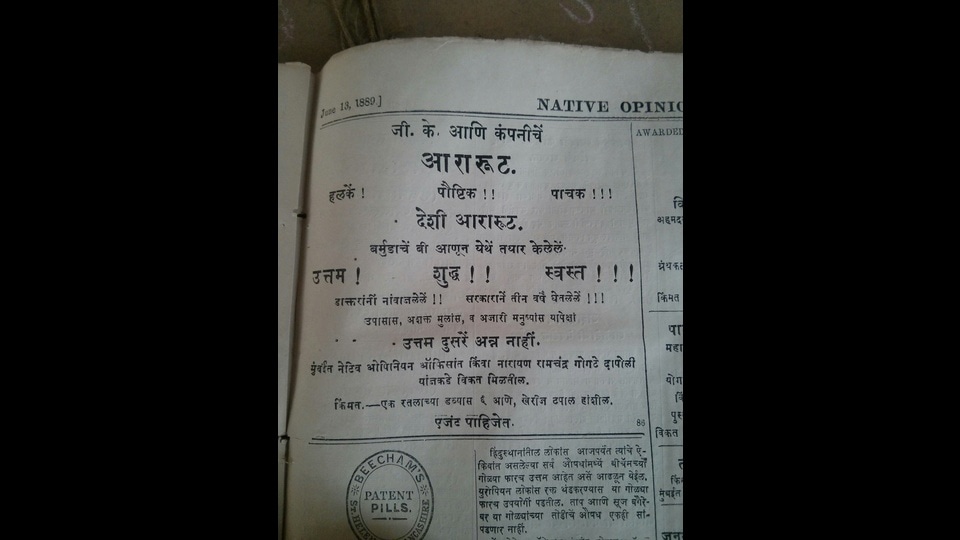
How comprehensive and radical Agarkar’s and Tilak’s conception of India’s agriculture and its improvement was may be gathered from the fact that they endorsed the cultivation of new foodgrains, novel foods and drinks, and innovative agricultural practices. One fine example of this was their endorsement of the cultivation of arrowroot by Narayan Ramchandra Gogate.
Gogate experimented with cultivating cotton, coffee, and arrowroot at his village land in Dapoli near Ratnagiri. “Kesari” and “Mahratta” took it upon themselves to introduce arrowroot to the citizens of Maharashtra.
That Gogate was an enterprising cultivator and entrepreneur is evident from a letter written by EC Ozanne, director of agriculture, Bombay, to the secretary to Government, revenue department, Bombay in May 1885. According to it, Gogate met Ozanne in Bombay and presented him with a few samples of arrowroot from his Dapoli farm. He also showed him a certificate from DS Kemp, the renowned pharmacist, to the effect that the “sample was the species known as Bermuda arrowroot”, and another from Dr Anna Moreshwar Kunte, demonstrator of anatomy, Grant Medical College, to the same effect, but with the addition that it was the best species of arrowroot available.
Another certificate granted by the chief medical officer, Baroda state, had reiterated the same. Gogate had then been experimenting for five years with arrowroot cultivation. According to Ozanne, Gogate had obtained 350 lb (pound) of prepared arrowroot that year and had put down enough land that year to produce 3,000 lb.
Ozanne appealed to the government to grant Gogate a contract to supply arrowroot in compliance with its policy of encouraging native agriculture and industry.
Both Gogate and Agarkar’s “Kesari” had assured customers that the arrowroot from Dapoli was of the “finest kind”, Maranta arundinacea, the species found in Bermuda, and was much better than the indigenous variety found in Mahabaleshwar and Travancore.
Curcuma caunlina, known as “Chowar”, is a plant confined to Mahabaleshwar. It is very abundant during rains everywhere, especially on the tableland. It was first described by Graham of the Bombay Civil Service. For many years the Chinese ticket-of-leave men used to manufacture arrowroot from it and sell it to the commissariat, and in the markets at Bombay. In 1878, a European cultivator prepared a few hundred pounds of it, and sent samples to be tried by Messrs Treacher & Co., Phillips & Co., and Kemp & Co., but it was found wanting in nutritive properties, though no objection was made to the colour and taste. That it was inferior to West Indian arrowroot might be gathered from its less market value than the latter variety. During the famine of 1877, it was recommended to the suffering poor, but they never used it except in extreme scarcity.
Dr John August Voelcker, the great chemist, was requested by the secretary of state for India to examine improvements in Indian agriculture. He spent more than a year travelling around India and produced a 450–page report for recommendations. In his report, he wrote – “At the Poona farm, I saw arrowroot being grown, but though it flourished well, there was the objection that there was no sale for the produce. It may be said, of course, that, though a crop or even an implement may not be immediately available, a use for it may be found later on; such a case is that of the potato, a crop first despised, but now largely grown.”
Quality was a minor concern for Gogate because arrowroot then did not have many buyers. The government largely imported it for its troops. After the revolt of 1857, it encouraged European cultivators to plant potatoes and arrowroot to fulfil the needs of the armed forces. On May 30, 1864, “The Bombay Gazette” reported that the cultivation of arrowroot and potatoes was slowly progressing in the Central Provinces at Jabalpur and that potatoes were more popular than arrowroot. According to the report, “arrowroot was not universally appreciated by the natives”.
By 1886, Woodrow on the College of Science Farm, Poona, and Gogate in Dapoli had improved their area under arrowroot and the preparation of the starch, as well as the cost. The previous year, Gogate had sold arrowroot in Poona at 12 annas per lb. The commissariat department procured its supplies at 4.5 annas on average, and could not afford to encourage a more costly article. Later, Gogate made an offer for commissariat supplies at 6 annas per lb. The loss which would be incurred by accepting Gogate’s offer would amount to ₹868. The government declined to encourage the local industry at this cost. Gogate, undaunted, offered to supply the amount required by the commissariat at 4.5 annas per lb, delivered to Poona on the condition that he should be guaranteed the supply for five years. Gogate won the contract.
In February 1888, “Kesari” reported that Gogate had secured permits and permissions to export his arrowroot to Britain. It also added that Dajisaheb Khare, Tilak’s childhood friend, and an accomplished lawyer from Bombay, had invested a large sum of money in Gogate’s business. The new venture was named “GK and Co.”. It manufactured arrowroot powder and biscuits.
The first set of advertisements for GK and Co.’s arrowroot biscuits started appearing in the newspaper “Native Opinion” in June 1889. More such ads appeared in “Kesari” and Agarkar’s “Sudharak” till 1902. All of them mentioned that Gogate was the largest manufacturer and exporter of arrowroot and that his biscuits were approved by the British government. They were “light and nutritious” and exported to Europe.
Strangely, Gogate’s obituary published in “Kesari” on February 6, 1923, does not mention arrowroot.
It was generally believed that to make the arrowroot of the best colour, it should be washed thrice; if the water was impure, had the least taste or taint, it was likely to impart the same to the arrowroot. At Natal, river water, which was considered very pure, was used, and in Bermuda where the best quality of arrowroot was produced, it was reported that rainwater, specially collected for this purpose in covered tanks, was used. To this chiefly, the superior quality of Bermuda arrowroot was attributed. “Kesari”, in 1889, mentioned that Gogate had constructed tanks in Dapoli to “cultivate arrowroot”. The purpose of these tanks might be to collect rainwater. Did the famine of 1897 affect the quality of Gogate’s arrowroot which made him abandon his venture?
In the early 20th century, several advertisements featuring “crisp biscuit made of finest arrowroot floor, strongly recommended for grown-ups of all ages” started appearing in Indian newspapers. Many claimed that their product was “swadeshi” and could be eaten by Hindus during their fasts.
It is due to Gogate’s efforts and the endorsement by Tilak, and Agarkar, that arrowroot became a familiar food in Marathi kitchens.
Chinmay Damle is a research scientist and food enthusiast. He writes here on Pune’s food culture. He can be contacted at chinmay.damle@gmail.com


