
 E-Paper



Taste of Life: The tales of utensils
The emergence of a new middle class in the twentieth century resulted in a demand for ‘modern’ kitchenware, like enamelled utensils


Pune: Almost ten years ago, while in Puducherry, I visited my favourite shops selling vintage utensils. I never missed a chance to have a look at the beautiful kitchenware whenever I was in town. This time around, the shops were full of century-old enamel ironware. Many of the pieces had beautiful designs painted on them. “The White Town is shrinking, people are selling their furniture and utensils and moving out”, the shopkeepers explained. The utensils were once mostly owned by the French or the Francophiles. However, there were few buyers for the enamelled ironware now. “The locals do not like to use these,” I was told.
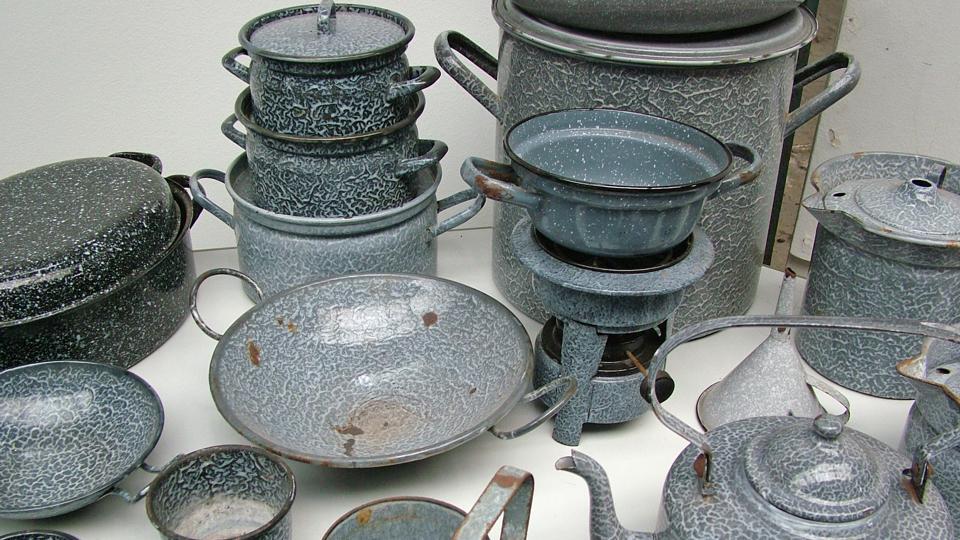
Enamelled ironware arrived in India in the early twentieth century. It quickly became a popular substitute for the distinctive Indian vessels of copper and brass. Enamel was a coating of colour fused onto glass, pottery, metal, or whatever mineral substance would stand the heat enough to fuse it. The colour upon glass or glazed earthenware was also, in the strictest sense, “enamel”, because it was vitreous, and burnt on; and the phrase “enamel colour” was expressly employed to indicate colour that was not in the glaze or under the glaze, but annealed to its surface. But enamel was generally understood to mean enamel on metal. Enamels were used chiefly as a protective coating, which resisted the action of alkalis, acids or other chemicals, and which withstood rapid temperature changes. They were also used for decorative purposes. The biggest use of enamel was for coating ironware, used in cooking and hospital utensils and bathroom fixtures.
In the early twentieth century, copper and brass utensils began to be displaced in the Bombay Presidency by other materials. Some of the workers were then making vessels out of imported German silver sheets, and these were often preferred to brass or copper, especially among the wealthier classes.
A remarkable increase in the imports of German and Austrian cutlery took place in the first decade of the twentieth century since its use in place of the usual domestic articles of brass and copper had been making headway in the country, especially among wealthy Parsees, Muslims, and Christians. There were several brands of cheap German penknives, scissors, and razors in the markets in the Bombay Presidency. However, German cutlery – soup plates, tumblers, cups and saucers, kettles, teapots, and tiffin carriers - was the most in-demand, even though, Austrian enamelled ware, known as the “Gun” brand, manufactured by B Furst, Vienna, was of the best quality in the market. British enamelled ware was slightly cheaper than Furst’s “Gun” brand, but the latter was preferred, owing to its superior shape and better polish. The demand for Furst’s “Gun” brand soup plates was not so large in Poona as that for the cheaper German and Austrian makes. The “Gun” brand soup plates were heavier and more substantial and cost about half a rupee more per dozen. Another brand popular in the Bombay Presidency, and the Poona markets, was the German “Tally-ho” brand of soup plates.
Enamelled ware from Germany was imported in three colours, viz blue-white, white, and marble-white. Bowls were sold in Poona markets ranging from 5 to 28 cm in diameter. Rice dishes were sold by the piece as well as in sets of four assorted sizes, viz 24, 26, 28, and 30 cm in diameter. The price of Furst’s “Gun” brand was ₹4 per dozen of assorted sizes. These utensils were popular because of the excellent quality, very reasonable prices, and the effort to have them designed to meet the requirements of the trade.
Most of the domestic vessels used by Indians in the nineteenth century were made of copper and brass, and departure from this usage was rendered difficult owing to certain ritual observances of cleanliness. Bombay and Poona were the chief centres for the manufacture of copper and brass, and large quantities of these products were sent to almost every part of the Presidency, nearby Provinces, and native states. The raw products – copper and brass sheets – were cheaper there compared with other manufacturing cities removed from the sea, and there was a ready market for these goods in the country. The industry was helped considerably by the immigration of the better class of workers from the rural districts.
The emergence of a new middle class in the twentieth century resulted in a demand for “modern” kitchenware. Substitutes for brass and copper vessels were actively sought. Enamelled ironware turned out to be the most popular choice. Another substitute was tinned ware. The importation of kerosene in tins gave rise to a new industry. Enterprising artisans in Poona bought the empty tins and fashioned them into all kinds of domestic utensils.
However, a section of the society was sceptical of using the enamelled ironware. The enamelled utensils were also being used in some hospitals in big cities. People would be greeted with the sight of enamelled bedpans and tubs during a visit to a “modern” medical facility. They seemed to have associated enamelled ironware with dirt and disease and did not want to use the utensils at home. They did not consider them “pure” enough.
Those promoting “swadeshi” were also against the import of utensils from Europe. They wanted enamelled ironware out of Indian kitchens. While desiring a revival of India’s brass industry in the household, they criticised the wearing qualities of enamelled iron utensils. It was claimed that after a time the enamel began to chip off, and that when these particles got into food, they caused dangerous illness.
But the young Indian middle-class housewife, setting up her kitchen in cities like Bombay and Poona, away from her in-laws, found the traditional brass and copperware cumbersome to use. The great need for a cheaper substitute for brass and copper vessels created a large demand for aluminium goods, and some of the workers started using the metal to make household utensils. Aluminium vessels were especially popular in European kitchens in the Bombay Presidency. Bazaar prices for aluminium utensils were not high; some of the more popular articles were polished stew pans and soup plates.
Innovative designs, bright colours, and shine characterised the modern utensils. The traditional kitchenware offered comfort. They were larger and heavier. They sometimes carried a great sentimental value. But the nativistic value of the superiority of things “Indian” could not hold its turf for long. Iron, German silver, tin, and aluminium replaced copper and brass, and were soon ousted by stainless steel.
Enamelled ironware continued to be popular for several decades owing to its superior aesthetic design. During the years when the prices of copper were high, the importation of enamelled ironware made good progress. But on the return of copper prices to normal levels, and the rising popularity of aluminium and stainless steel, the importation of enamelled ironware declined.
“Stainless steel utensils are sturdy, but not beautiful; this is beautiful,” the shopkeeper had said with a Brunswick green tiffin carrier in his hand. It had white and yellow flowers painted on it. “I will only sell it to someone appreciating beauty,” he declared.
The next year, I asked the shopkeeper who he sold the tiffin carrier to. He did not remember. I hope the owner appreciated its beauty.
Chinmay Damle is a research scientist and food enthusiast. He writes here on Pune’s food culture. He can be contacted at chinmay.damle@gmail.com


