Pune: Food travels across cultures perhaps more often and with more ease than any other tradition. Sometimes food carries with it related culinary practices, and sometimes foods mix with existing culinary traditions to form new syncretic cuisines.
In the early 1940s, Greens Restaurant in front of the Sir Parashurambhau College (SP College) was famous for its “wazwaan” cuisine. It was perhaps the first restaurant in Pune to serve Kashmiri dishes. The restaurateur had hired cooks from northern state to cater to the connoisseurs of the city. Since it was taboo to eat out at a restaurant and consume non-vegetarian food, most of the customers would sneak in after it was dark.
Many well-to-do college students would save some money and eat once a month at Greens. VN Natu, the chronicler of Pune, told me a few years ago that the piece de resistance on the menu was the lamb Rogan Josh.
The Rogan Josh boasts of a heady combination of intense spices, onions, and sometimes, yoghurt. It is a staple of Kashmiri cuisine which was originally brought to the state by the Mughals, whose cuisine was, in turn, influenced by the Persians. The cooks at Greens used a secret ingredient which imparted a special flavour to the dish - the lamb would be marinated with pomegranate molasses.
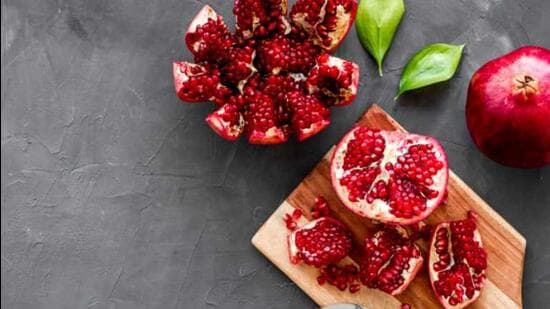
Pomegranate molasses is a Middle Eastern seasoning consisting of pomegranate juice. It usually does not contain any added sugar and is made by naturally reducing pomegranate juice to thick syrup. Both the natural sweetness and the pomegranate’s tartness are heightened during this process, producing intensely flavoured syrup that can be used in the kitchen in a myriad of ways.
{{/usCountry}}Pomegranate molasses is a Middle Eastern seasoning consisting of pomegranate juice. It usually does not contain any added sugar and is made by naturally reducing pomegranate juice to thick syrup. Both the natural sweetness and the pomegranate’s tartness are heightened during this process, producing intensely flavoured syrup that can be used in the kitchen in a myriad of ways.
{{/usCountry}}Even though pomegranates and their juice have been essential to Mediterranean and Middle Eastern cuisines for millennia, a few ancient and medieval Sanskrit manuscripts mention vegetarian and non-vegetarian dishes cooked with pomegranate seeds and juice. Cookbooks like “Nimatnama” (15th century AD), “Nuskha–e-Shahjehani” (17th century AD), and “Khwan-e-Nemat” (18th century AD) also feature recipes which employ the pomegranate fruit.
The modern name “pomegranate” (punicam granatum) derives from the Latin “Pomus” (apple) and “granatum” (grained, seeded). Pomegranates are believed to have originated in Persia and the Himalayan region and have been cultivated and held in high regard for thousands of years.
Pomegranates spread across Europe and by the 14th century were included in a recipe in one of the earliest medieval cookbooks “Liber de Coquina”. It is believed that the pomegranate arrived in England in the mid-16th century during the reign of Henry VIII, and Henry and Katherine of Aragon combined the Tudor rose with the pomegranate of Granada as a sign of their union. By Victorian times, it was primarily regarded as an ornamental tree or a medicinal plant, with remedies using pulp and bark.
When British housewives started living in India in the nineteenth century, the pomegranate was one fruit they found agreeable. However, since the pomegranate grown in the Bombay Presidency did not compare to the fruit cultivated in Afghanistan, they had to rely on fruit sellers from Kabul to arrive during the winter and summer months.
Advertisements featuring pomegranate molasses or syrup published in several English newspapers in the Bombay presidency in the 1890s and 1900s tell us that it was a prized commodity. Shops like Treacher & Co., Cursetjee’s, and Phillips sold bottled molasses. It was claimed that the molasses was of the “highest quality” and was made from the best pomegranate brought from Kabul, and sometimes, Muscat. The bottled pomegranate molasses would stay fresh for a month.
Pomegranate molasses was not readily available in the UK then and British housewives in India had to innovate and design recipes to use the ingredient. They did so enthusiastically since the use of exotic foodstuffs like pomegranate molasses was considered the height of sophistication.
Mildly acidic pomegranate married beautifully with rich meats. Grilled lamb’s subtle gaminess was perfectly tempered by the astringency of the pom. It was a flavourful addition to drinks. It paired surprisingly well with ginger ale. The molasses could be used for all kinds of other things, including salad dressings.
The Parsees of Poona marinated lamb shanks or tenderloins in pomegranate molasses, black pepper, and some spice mix. Lamb tenderloins were a luxury since each lamb had only two. The meat was cooked quickly and the molasses along with the spices stayed on the surface rather than being drawn into the flesh.
Naturally braised lamb shank was a favourite winter dish for many since it combined sweet, spicy, and tart elements very well. The dish employed both pomegranate juice and molasses.
At E Muratore, the famous Italian restaurant, mutton fillet with pomegranate reduction was served with salad. The “pomegranate reduction” in the dish was in all probability the fresh pomegranate vinaigrette which was made from pomegranate juice, olive oil, lemon juice, and herbs.
Dr WF Ainsworth, an English surgeon, traveller, and geologist, wrote briefly about the dinner served to Anglo-Indians by Muslims in the Bombay Presidency in the mid-nineteenth century in his article “Food and Cookery in India”, published in the magazine “Diet and Hygiene” – “The first dish is almost constantly soup and the ‘pilau’, the intermediate courses consisting of a variety of dishes. Among the more common and characteristic are mutton, in small pieces, smeared with pomegranate molasses, roasted on iron skewers, with slices of apple, and onion between pieces, mutton minced small, and beaten up with spices into balls, and roasted on skewers; mutton, or lamb, stewed with gourd, roots, or herbs; fowls, pigeons, and sometimes quails, or other birds, boiled or roast, but more frequently made into ragouts. A favourite dish consists of mutton, rice, pistachios, currants, almonds, spice, and garlic, which are enveloped in a cucumber or gourd; in the absence of either of these vegetables, the savoury mess is wrapped in the leaves of beet. Sometimes a lamb is stuffed in the same way, and roasted whole. Minced meat, generally mutton, with pomegranate seeds, is spread on thin cakes, and baked on an iron plate. A great variety of pies, and sweet dishes made of honey, or the juice of pomegranate or grapes, and pastry help to fill up the banquet.” This menu is a fine example of a hybrid cuisine with Persian, Indian, and European influences.
Displaced food cultures often blend with local food traditions to culminate into edible syncretism. The rich encounter between various traditions and customs of many kinds of people living on the subcontinent has made cultural diffusion a complex process. No wonder understanding and acknowledging cultural mixing is closely related to coexistence and intercultural solidarity.
Chinmay Damle is a research scientist and food enthusiast. He writes here on Pune’s food culture. He can be contacted at chinmay.damle@gmail.com