
 E-Paper



‘Yantra Raj’ BORI’s Astrolabe machine prototype soon to be ready, Students can have hands-on training
In BORI’s manuscript department, there is an ‘Astrolabe’ machine which is also called as ‘Yantra Raj’ and it is from 1639 AD


Pune - The Bhandarkar Oriental Research Institute (BORI) is always doing new research and studies, while now BORI is working on an interesting project specially for the students. BORI has a 1639 ‘Astrolabe’ machine in their manuscript department which is based on ancient Vedic technology. While there are plans to roll out it’s prototype into school education through which students can have hands-on training of it and can easily navigate various things like latitude and altitude, distances, and many other aspects of geometry and trigonometry.
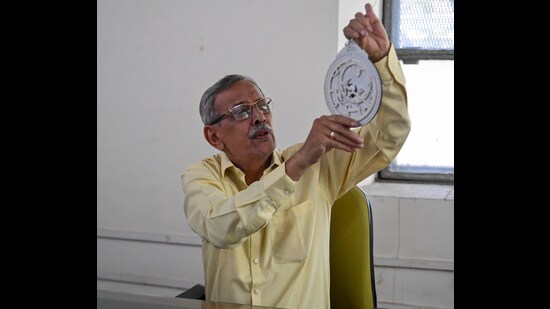
In BORI’s manuscript department, there is an ‘Astrolabe’ machine which is also called as ‘Yantra Raj’ and it is from 1639 AD. An Astrolabe machine is used for identifying directions or locating the planets, timings of sunrise and sunset, trigonometry is involved in this machine. In ancient Indian culture, this machine was extensively used for various purposes like to find out a Muhurat which is based on Sunrise and sunset, to check and study all these things the mathematics used in it is vast. So for this purpose, these Astrolabe machines were made, similarly, observatories were made in the past which we can today experience at Jaipur and Ujjain.
“This specific Astrolabe machine ‘Yantra Raj’ is based on our cosmology which is circular in shape, it is in 3 dimensions and so for its 3D projections and geometrical mapping, this Astrolabe was made. Also today we can locate anyone through GPS mapping and internet services, similarly through this machine in ancient times to do location mapping these machines were used. Specially for the Arabic people who wanted to locate Holly Mecca for their prayers, so it was used to identify the directions and its orientations,” said Prof Sudhir Vaishampayan, BORI honorary secretary.
“BORI researchers have studied this ancient Astrolabe machine, how it was made, how it is been used in those days and most importantly how it is relevant in today’s world. This subject related to the Astrolabe machine is given in the state board’s class 11 and 12 Physics book, about its geometry and how the distances and directions can be measured. So we have plans to make more models of this Astrolabe machine which will be given to students for hands-on training and to actually study directions and various other aspects of geometry and trigonometry,” he added.
“Currently, we are making the working prototype manual of this Astrolabe machine for students, then it will be made it large numbers when we get funds. Certainly, this machine is useful and interesting to study for students, we have made the first prototype through 3D printing technology at BORI. Our aim is to make these machines easily available to students which makes their learning experience a joy to study difficult mathematics and geometry easy. In fact, a student can also measure the height of our Parvati Hill through this machine after studying it,” said Prof Vaishampayan.


