
 E-Paper



Zoological Survey of India gets ‘in-principle’ approval to establish Western Ghat Faunal Repository in Pune
The WRC has also proposed to the central government that a Wildlife Forensic Laboratory be established at WRC, Pune and the same is under active consideration by the Ministry of Environment, Forests and Climate Change

 Prefer HTon Google


While the Zoological Survey of India’s (ZSI’s) Western Regional Centre (WRC) has documented over 30,000 species of fauna found in the western ghats over the past 65 years, samples of these species will now be made available in the public domain through the Western Ghat Faunal Repository to be established at the WRC premises in Pune.
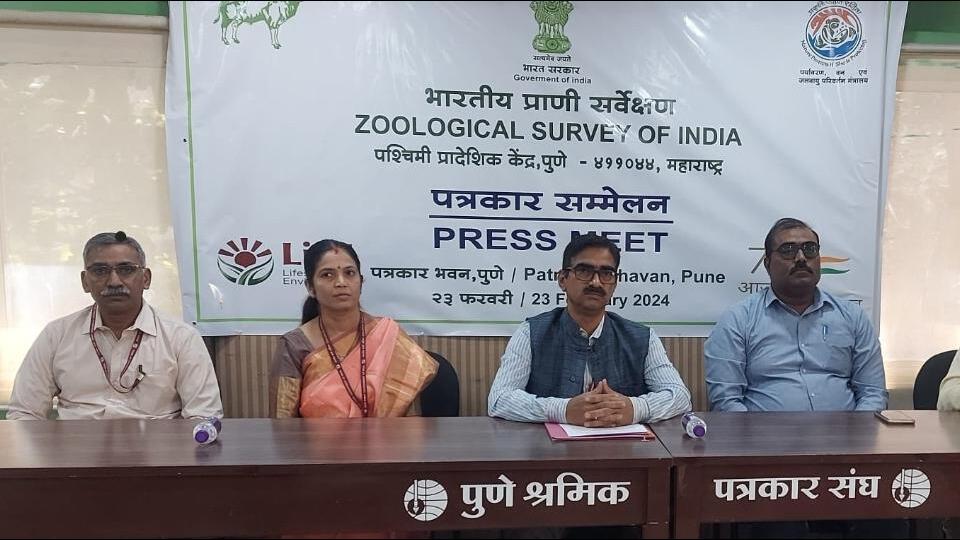
The WRC has received ‘in-principle’ approval from the Ministry of Environment, Forests and Climate Change, Government of India, and the new building will come up soon. This was announced by Basudev Tripathy, officer in charge, WRC, ZSI, at a press conference held on Friday. Scientists from the ZSI namely Aparna Kalawte, Satish Talmale and Sachin Patil were present on the occasion.
Tripathy said, “ZSI’s WRC was established in 1959 at Pune. It has completed 65 years of its existence in the city. This centre has so far carried out surveys of animal life and wildlife in major ecosystems and protected areas covering the states of Maharashtra and Goa; parts of Gujarat and Karnataka; and union territories of Dadra and Nagar Haveli, and Daman and Diu as part of its jurisdiction and documented more than 30,000 species of fauna. These include mammals, birds, reptiles, amphibians, fish, shellfish, crabs, scorpions, spiders, butterflies, weevils, moths, dragonflies, damselflies, gall midges, ants and bees. The research work is going on through ZSI regarding all these species, and the work of preparing the DNA report of all of them is also going on at a fast pace. Meanwhile, the centre decided to establish a repository of the samples collected and in the initial phase, we will be displaying 10,000 samples at the repository.”
“While we have received ‘in-principle’ approval for setting up the repository, the funds are yet to be made available. We are expecting to receive the funds within a year after which the actual work will start. Currently, the centre houses a museum with over 750 specimens of around 375 species of animals to educate students and create awareness among the public about biodiversity and its conservation,” said Tripathy.
The WRC has also proposed to the central government that a Wildlife Forensic Laboratory be established at WRC, Pune and the same is under active consideration by the Ministry of Environment, Forests and Climate Change.
Tripathy said, “WRC Pune is providing identification and advisory services on various animal taxa, including confiscated wildlife materials received for confirmation, from enforcement agencies such as the Maharashtra police, forest department, crime branch, central excise and customs department. The centre receives at least two to three such cases every month. While external analysis can be provided within our current capacity, more detailed analysis requires an equipped laboratory. Hence, we have to send those samples to our head office laboratory in Kolkata. It requires at least one to two months to get results from them. To reduce this waiting period and fast-track this process, we are proposing that the government establish a forensic laboratory in Pune which will cater to the needs of the entire western region.”
The WRC, as part of a DNA barcoding task, has generated more than 100 sequences of animals in the western ghats and the Deccan region through its DNA laboratory and it also provides various training programmes and extension activities on animal taxonomy and conservation, said Kalawte.


