Even as pollution monitoring bodies claim that incidents of paddy straw burning are higher this year as compared to the last four years, data by Punjab Agricultural University’s (PAU) states that the area under stubble burning in the state has declined by 5.23%.
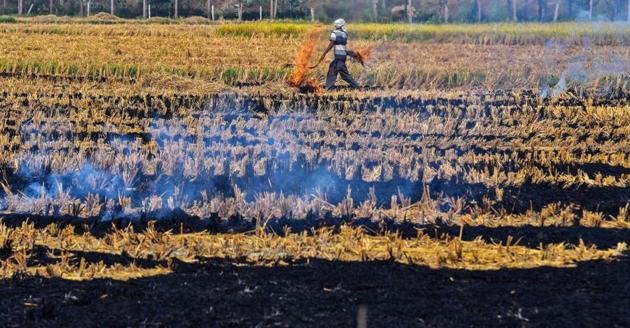
“The Punjab Remote Sensing Centre data shows the area under paddy straw burning (which is more reliable parameter than a number of fire incidents) during this year as 749.43 thousand hectares as compared to 790.77 thousand hectares last year, clearly showing a decline of 5.23%,” claimed GS Manes, additional director of research (farm mechanisation and bioenergy).
He said that this decline in the paddy straw burnt area despite early harvesting clearly showed improvement in the adoption of paddy straw management technologies as compared to last year.
Manes added that the harvesting of paddy had just crossed its peak in Punjab with 62.5% area harvested on October 30. The arrival of paddy during the same period this year was higher than last year by 32.46% for parmal and 29.47% for parmal and basmati combined, indicating early harvest.
Elaborating this, Manes said, “Some farmers, who have adopted in-situ straw management technologies over the past few years, will complete three or more years of this practice this year. It will be interesting to see whether there is an improvement in wheat yield as shown in experiments conducted by PAU, Ludhiana, which is observed in farmers’ fields. Such a trend of yield enhancement and a further possibility of a reduction in fertiliser use can become a major incentive for the adoption of paddy straw management technologies on a large scale.”
{{/usCountry}}Elaborating this, Manes said, “Some farmers, who have adopted in-situ straw management technologies over the past few years, will complete three or more years of this practice this year. It will be interesting to see whether there is an improvement in wheat yield as shown in experiments conducted by PAU, Ludhiana, which is observed in farmers’ fields. Such a trend of yield enhancement and a further possibility of a reduction in fertiliser use can become a major incentive for the adoption of paddy straw management technologies on a large scale.”
{{/usCountry}}As many as 2,799, stubble burning incidents were reported on October 30, the second-highest in a day in the ongoing season. As many as 2,989 cases were recorded on October 28.
In the Malwa belt, Sangrur, Patiala, Ferozepur, Bathinda, Mansa and Barnala, notorious for using long-duration PUSA-44 varieties of rice seed, recorded a high number of cases.