I have often heard people saying that the origins of toxic masculinity are to be found in the sense of entitlement or misogynistic notions inculcated in men when they are boys. No doubt, they are influenced by their surroundings, the discourse they are privy to, the relationship between the genders within the family. But, for the most part, it would seem that young boys and adolescents are completely left out of the gender discourse while there are so many policies and programmes for young women.
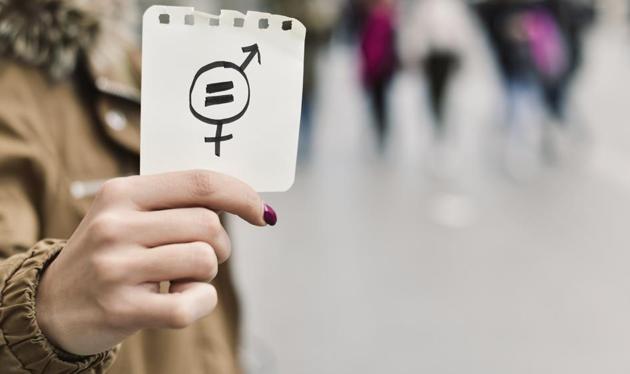
The scales are tilted very heavily against women in the field of gender relations but this cannot change substantially if men are to go along without even realising that their behaviour is unacceptable, offensive, even dangerous. Many have no sense of wrong as seen from the sentiments expressed by one of the men who participated in the Delhi gangrape. He simply felt that the victim was to blame for wandering around at night and that he had every right to attack her. In many ways, while women’s rights have moved ahead, men’s rights and, with that, their emotional growth has stood still.
If we can approach issues like Swacch Bharat on a war footing, we can also address the issue of including the boy child in the gender framework from an early age. It is only if the idea of an equal relationship between the sexes is discussed at an early age that men will stop feeling the pressure to be aggressive and the need to exert their power in ugly ways. This is not to make any excuses for unacceptable male behaviour but to say that no one has even thought it fit to discuss their behaviour at an early age, by, for example, bringing this discourse into value education at the school level.
The boy’s passage into adolescence in India is a lonely process. There is no one to explain what changes he is going through, be they physical and emotional. He is not aware of how to adopt healthy practices, beyond the pervasive gym culture which has spread across small town India. He often feels that alcohol and tobacco are signs that he is now a man and can indulge in adult pursuits. His role models are men who grew up in the same, largely ignorant milieu. And he has no positive way of channelling the emotional changes he is undergoing. Often his perceptions are moulded by violent and misogynistic movies and the all too easily available pornography on tap.
{{/usCountry}}The boy’s passage into adolescence in India is a lonely process. There is no one to explain what changes he is going through, be they physical and emotional. He is not aware of how to adopt healthy practices, beyond the pervasive gym culture which has spread across small town India. He often feels that alcohol and tobacco are signs that he is now a man and can indulge in adult pursuits. His role models are men who grew up in the same, largely ignorant milieu. And he has no positive way of channelling the emotional changes he is undergoing. Often his perceptions are moulded by violent and misogynistic movies and the all too easily available pornography on tap.
{{/usCountry}}Across the world, several studies have shown that boys are more prone to violence and mental problems than girls. In many schools, and I am speaking of urban ones, schools do have sex education, but it rarely looks at the unique problems that boys face. For one, they are not encouraged to seek help because that is seen as a sign of weakness. I have friends who have told me that they are glad they had boy children because they had to worry less in a violent world. This is to diminish the needs of boys who are as vulnerable and emotional and need the same nurturing as girls.
The government ought to have a programme specifically aimed at young boys and men. Surely, that should not be difficult if it is done at the school level. The boy should be told that it is all right to be weak at times, that it is not unmanly to confess to emotions. We rejoice in a few enlightened ads in which the men are not afraid to take on traditionally feminine roles, are not afraid to cry. But in reality, there is no attempt to deal with the pressures young men face.
The young boy and adolescent must be given the tools to handle aspects of life other than just education and job skills. It is incorrect to assume that young men from the urban English-speaking elite are not vulnerable. The pressure on them to succeed is huge and failure is not really an option. Most NGOs, perhaps out of conviction or ease of funds, find it easier to gravitate towards the girl child to adolescent to woman. But if such an effort were made for the other sex, many problems which afflict gender relations would be less and we would be able to live in a safer environment.
lalita.panicker@hindustantimes.com