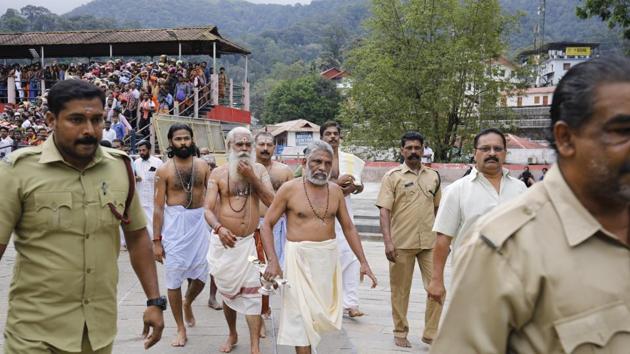
The battle that ensued this week over the Supreme Court’s verdict allowing women of all ages to worship in Kerala’s Sabarimala temple demonstrated the power that religious tradition still has to resist change. The court’s verdicts banning instant triple talaq , and decriminalising homosexuality and adultery, also defy tradition.
All three verdicts can also be seen as victories for the women’s rights movement in that they give women greater control over their lives and their bodies. But at the Kasauli festival earlier this month, three doughty fighters in the women’s movement poured scorn on religious leaders who opposed reforms.
Zakia Soman, co-founder of the 70,000-plus strong Bharatiya Muslim Mahila Andolan, attacked the Muslim Personal Law Board for its opposition to reforms in Muslim personal law. She was a petitioner in the triple talaq matter in the Supreme Court . Shayara Bano was the original petitioner in that case who received her notice of triple talaq by speed post. She attacked traditionalists who were still preventing her from seeing her children.
The third champion of women’s rights at Kasauli was Masooma Ranalvi who described how, as a seven-year-old Bohra Muslim girl, her genitals had been cut. She explained that the traditional justification for this female genital mutilation was “to curb women’s sexual desires ”. Masooma Ranalvi has now started a debate in the Bohra community on this practice. But the Syedna, the spiritual head of the Bohras, was rigidly opposing its abolition.
{{/usCountry}}The third champion of women’s rights at Kasauli was Masooma Ranalvi who described how, as a seven-year-old Bohra Muslim girl, her genitals had been cut. She explained that the traditional justification for this female genital mutilation was “to curb women’s sexual desires ”. Masooma Ranalvi has now started a debate in the Bohra community on this practice. But the Syedna, the spiritual head of the Bohras, was rigidly opposing its abolition.
{{/usCountry}}It is not surprising that those who claim to have religious authority like the Syedna and the Muslim Personal Law Board are the ones who are blocking reforms in India’s Muslim communities. The same is so often true in other religious communities. An obvious example is the Vatican refusing to allow the clergy to marry, or women to be ordained as priests. Among the orthodox Hindu leaders of the opposition to Nehru and Ambedkars ’s Hindu code bill were Rajendra Prasad, President of the Constituent Assembly and then President of India, the Shankaracharya of Dwarka, and the leadership of the RSS.
When a call for reform comes from the laity, it is almost inevitably seen by orthodox religious leaders as a challenge to their authority, and hence to be resisted. So Zakia Soman’s Muslim women’s movement for reform of their personal law is bound to meet with stiff resistance and the orthodox Muslim leadership will carry a large section of the community with them. Can it be argued that Nehru avoided a head-on collision with the Hindu orthodox leadership and by compromising achieved most of the reform he had planned.
When Robert Runcie was consecrated Archbishop of Canterbury in 1980, he became the leader of the Church of England on the verge of a schism between those who wanted women priests and those who opposed this. He insisted he had not become Archbishop to split the Church and refused to come down on either side. Abuse was heaped on him by a press which could only see the issue in black and white terms, but he famously said, “I do wish the press would realise it sometimes takes courage to sit on the fence.” As a result of Robert Runcie’s courage a schism has been averted, the Church of England now has women priests, and the Bishop of London is a woman.
At the Sabarimala temple, there was literally a head-on collision between religious reformers and traditionalists. But do such differences always have to collide? Obviously there can be no compromise on genital mutilation. But is there no room for compromise on others? Compromise is not necessarily a dirty word. A peacemaker who sits on the fence can play a constructive role in reaching a settlement of religious controversies without a head-on collision and bitterness.
(The views expressed are personal.)