The Economic and Political Weekly (EPW) is not only an extraordinary journal but also a truly remarkable institution. Launched in 1966, it enjoys a unique reputation of being amongst the most well-known academic journals in India that enjoy international recognition. Tracking through its astounding intellectual journey over the past five decades is like going straight into the “deep state” of India’s interconnected world of academia, politics, ideologies, journalism and grassroots activism. It is not a story that can be told in a single breath.
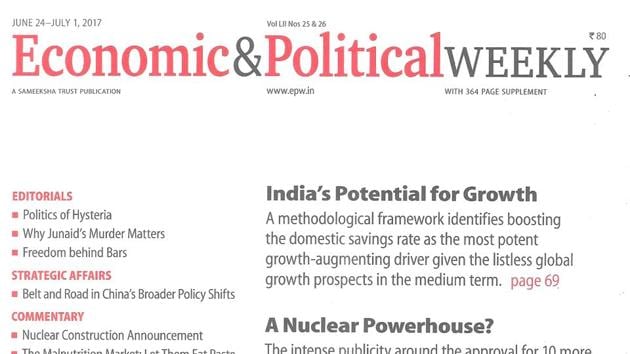
Understandably, therefore, when the editor of the journal, Paranjoy Guha Thakurta, had to quit earlier this month amidst a cloud of controversy, it sent shockwaves across the intellectual community. What made it worse was that the distinguished members of the Sameeksha Trust – which actually publishes EPW – also ended up covering themselves in mud. According to the bare bones version of the story, the editor was asked by the board to take down an article, published online, that was critical of a prominent business house – the Adani Group.
This unprecedented demand/request/instruction from the board was apparently intended to pre-empt a potentially expensive and debilitating legal suit from the said business house. In its 50-year history, the EPW had to withdraw an article only once. It was found to be plagiarised.
What also makes this seeming retreat from editorial conscience and courage equally galling is that the decision was brought on by an implosion within the EPW. A self-inflicted wound, in other words, caused by the fact that the just resigned editor was equally guilty of shifting the EPW increasingly towards the less-than-virtuous world of covering financial scandal and sleaze rather than sustaining the journal for its much-appreciated forte of encouraging sturdy scholarship and committed reportage. It also emerges, from a letter the staff at the EPW has written to the managing trustee, that the said editor repeatedly undermined the editorial review process at the journal, including pushing his own articles without any oversight.
{{/usCountry}}What also makes this seeming retreat from editorial conscience and courage equally galling is that the decision was brought on by an implosion within the EPW. A self-inflicted wound, in other words, caused by the fact that the just resigned editor was equally guilty of shifting the EPW increasingly towards the less-than-virtuous world of covering financial scandal and sleaze rather than sustaining the journal for its much-appreciated forte of encouraging sturdy scholarship and committed reportage. It also emerges, from a letter the staff at the EPW has written to the managing trustee, that the said editor repeatedly undermined the editorial review process at the journal, including pushing his own articles without any oversight.
{{/usCountry}}This is, however, not the place to detail or weigh in on the many charges and counter claims over what and who has let down and brought this remarkable institution to such a sorry pass. There is a now already a fair amount of documentation on the subject that needs no repeating.
Instead, what requires reiteration is that the EPW and the Sameeksha Trust need to urgently douse the flames and get its house in order at the earliest. The fate of many budding scholars, future thinkers and the efforts to understand our current challenges greatly depend on how the journal restores its credibility and its rightful place as Asia’s most significant intellectual voice.
To restore and correct the wrongs of the recent months, however, begs another question: was the EPW’s implosion brought on by acts of commission or omission, or is it a crisis caused by something more profound? It is important to ask if ther EPW’s spectacular success from the late 1960s to well into the first decade of the new millennium is also the source of some of its current problems.
In other words, should there be a rethink on what it means to intellectually straddle the centre-left spectrum in India and world politics today? Is the EPW – which fearlessly built much of its standing on a critique of the establishment and an advocacy for the cause of the marginalised – losing sight of who is and what comprises its conceptual enemies of today?
The dramatic restructuring of our political and economic realities through the extraordinary power of digital technologies calls for a careful rethink of the simple right-left political economy context. As a colleague put it, the next editor of the EPW as also the trustees will do well to heed Italian writer Tomasi Di Lampedusa’s clarity in his much-celebrated novel The Leopard: “If we want things to stay as they are, things will have to change.”
Rajesh Mahapatra is the Chief Content Officer, Hindustan Times.
Follow him on Twitter @RajeshMahapatra