The Unnao rape case, as an editorial in this newspaper put it, is now a test of both humanity and law. The nature of the tragedy has brought forth the infirmities in India’s political, investigative, and legal systems. Each element of this tragedy merits detailed scrutiny.
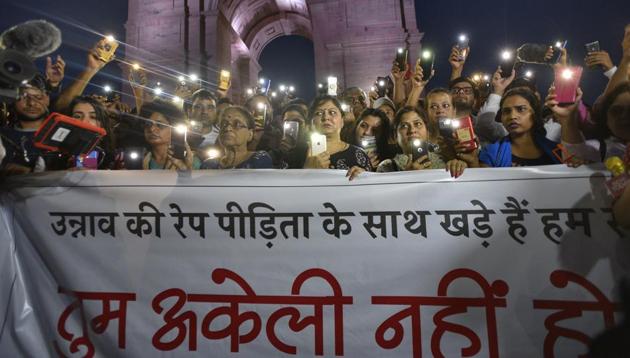
Take the politics first.
Kuldeep Singh Sengar, the rape accused, has been a member of the Bahujan Samaj Party, the Samajwadi Party and is now a Member of the Legislative Assembly from the Bharatiya Janata Party (BJP) in Uttar Pradesh from Unnao, near Lucknow. He belongs to the influential, and currently politically dominant, Thakur caste. The survivor had first sought to register a case against him in June 2017, when the rape took place. But he was not named. In 2018, it was only after the survivor’s father had died in police custody, and she attempted to immolate herself, that a public outcry followed, and a First Information Report was registered against Sengar. The case was then transferred to the Central Bureau of Investigation. Sengar continued to remain a member of the BJP. He was arrested, but all reports indicate that this did little to diminish his influence as he continued to operate with all facilities from inside prison. Even after he was suspected to have engineered an accident last week — an accident in which the survivor’s aunts died, and the survivor and her lawyer were left in critical conditions — he continued to remain a member of the BJP. The party finally expelled him on Thursday, after public outrage and after a Supreme Court order directing the completion of investigation in the case within a fortnight and trial within 45 days.
There is little doubt that the delay at each step in this case, the struggle the young woman went through to even file a complaint, the suffering and devastation her family has undergone, and her inability to get justice so far stems from one reason: Sengar’s political power. It is a reflection of India’s party system, the nature of local politics on the ground, and how there is often little correlation between what constitutes civilised and lawful behaviour and electoral success that a mere MLA, admittedly one who has won four times from different parties, wields so much influence. It has shown that political parties — and all of UP’s major parties are guilty here — open their doors to elements with questionable antecedents. That stems from their hold over a particular assembly segment, or a particular caste group, within a particular geographical area. For the supporters of such leaders, it does not matter whether they have a distinguished record of public service; it does not matter if they follow the law. What matters is their ability to get things done, or the fact that they are from the community. As the political scientist, Milan Vaishnav, has persuasively argued in his book, When Crime Pays, the electoral prospects of such candidates is bright.
{{/usCountry}}There is little doubt that the delay at each step in this case, the struggle the young woman went through to even file a complaint, the suffering and devastation her family has undergone, and her inability to get justice so far stems from one reason: Sengar’s political power. It is a reflection of India’s party system, the nature of local politics on the ground, and how there is often little correlation between what constitutes civilised and lawful behaviour and electoral success that a mere MLA, admittedly one who has won four times from different parties, wields so much influence. It has shown that political parties — and all of UP’s major parties are guilty here — open their doors to elements with questionable antecedents. That stems from their hold over a particular assembly segment, or a particular caste group, within a particular geographical area. For the supporters of such leaders, it does not matter whether they have a distinguished record of public service; it does not matter if they follow the law. What matters is their ability to get things done, or the fact that they are from the community. As the political scientist, Milan Vaishnav, has persuasively argued in his book, When Crime Pays, the electoral prospects of such candidates is bright.
{{/usCountry}}The BJP initially did not want to antagonise Sengar’s supporters in his local constituency, or a segment of Thakurs. Hence the party kept sitting on a decision on his fate. The state unit, in fact, merely suspended him. And the central leadership — after assessing that the costs of keeping Sengar in terms of loss of moral authority, including among its own supporters at the national level, outweighed the benefits he brought in terms of local influence — expelled him. This speaks poorly of not just the BJP but the nature of India’s party system and political culture.
But the problem is not merely politics. It is law too, and the various ways in which the legal process can be systematically undermined. In the Unnao case, this began at the very basic level, that of the local thana which refused to name Sengar as an accused when the survivor first went to lodge a complaint. In April 2018, the local police then arrested her father, who had just been assaulted by Sengar’s brother and associates. They are alleged to have tortured him, eventually leading to his death. It was only after the issue gained public traction and sympathy for the survivor grew that an FIR was eventually registered naming Sengar. Contrast this with the alacrity with which the investigative arms of the UP state arrested the survivor’s uncle on a two-decade-old case.
This rot then extended to the legal apparatus. On paper, the rape case was meant to have a fast trial. The survivor was a minor when the incident took place, and so the case fell under the Protection of Children from Sexual Offences (Pocso) Act, and the accused was a legislator. Both these factors warrant a quick trial. But as an Economic Times report, based on the records of the Lucknow district court, showed, the trial in the case has not yet begun, 13 months after the FIR was registered. And finally, over three dozen letters were written by the survivor and her family to political, administrative and legal authorities, including to the Chief Justice of the Supreme Court just 10 days before the accident, highlighting the threats they faced from Sengar and his associates. None of that was heeded. The security guards meant to protect the survivor were not with her when the accident took place; instead, they are reported to have kept Sengar informed of her movements.
Add it all up, and it shows that the basic assumptions on which the legal system is founded are flawed. The investigate arms of the state are meant to be autonomous of political influence and follow the rule of the law. In this case, the UP police have acted as a mere appendage of the political authorities, throwing the rulebook aside and showing enthusiasm not to protect the survivor but instead harass her. Special courts have been designed for cases like these, but even that did not result in a speedy trial in this instance.
The case must trigger a debate on the wide ranging reforms needed in India. There have to be more stringent norms because of which political parties cannot offer protection to an accused, at least in heinous crimes like rape. There have to be police reforms to enable them to work independently of pressure. There has to be quicker disposal of justice. There has to be greater responsiveness when a vulnerable survivor flags threats. India owes it to the Unnao survivor to not only deliver immediate justice but also launch meaningful political and legal reforms.
letters@hindustantimes.com