


 Live Score
 Cricket Teams
 Cricket Players
A final ticket worth INR 12.66 crore: Shubman Gill makes GT's record 215 chase a playoff asset class vs RR
Shubman Gill's explosive 104 guided the Gujarat Titans to a historic chase of 215 in IPL Qualifier 2, marking the highest chase in IPL playoff history.

 Prefer HTon Google


Rajasthan Royals had done their part. A 214 on the board at New Chandigarh, Vaibhav Sooryavanshi's blazing 96, against a bowling attack that had been the tournament's most feared. This was not a soft target. This was a dare.
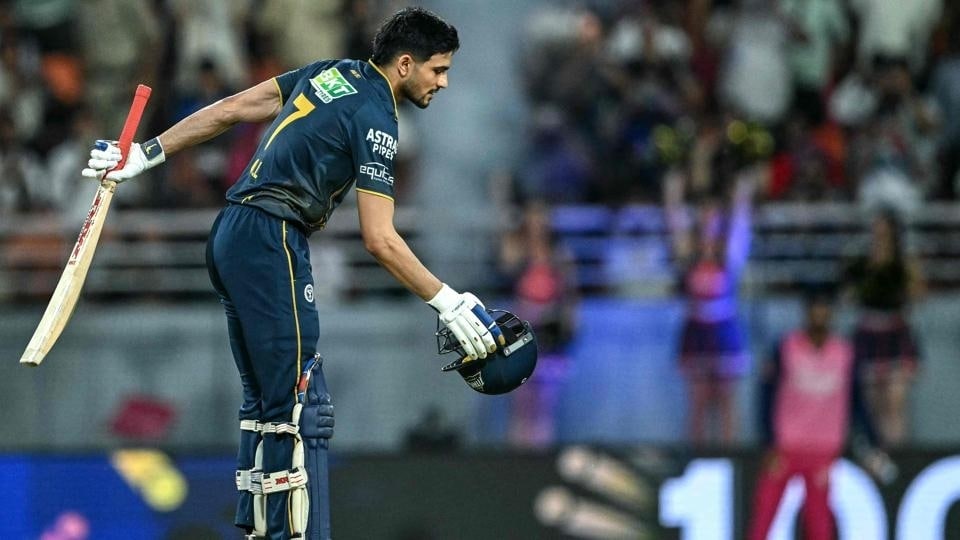
Shubman Gill accepted it in the first over.
By the time Jofra Archer pinned him lbw for 104 off 53 balls, 15 fours, three sixes, strike rate 196.22, the Gujarat Titans needed only 33 off 30. Gill had not left GT with a chase. He had left them with just the formalities.
The season that led here
Gill entered Qualifier 2 having scored six half-centuries in IPL 2026 without converting a single one. His highest score in the season was 86. There was no century to his name all tournament. The knock at New Chandigarh, then, was not just about sending GT to their third final in five seasons. It was the delayed detonation of a season spent in the near misses.
He got to fifty in 30 balls. The century came in 47, the fastest by any Gujarat Titans batter in IPL history. His 104 became the third-highest individual score in an IPL playoff chase, and he became the first batter in IPL history to score multiple hundreds in knockout matches. The first was a 129 against the Mumbai Indians in Qualifier 2, 2023. Gill, it turns out, saves his best hundreds for the matches GT cannot afford to lose.
The opening stand with Sai Sudharsan was 167, the highest partnership by any pair in IPL playoff history, beating the 159 by Michael Hussey and M Vijay in the 2011 final. GT's successful chase of 215 is now the highest in IPL playoff history, and the second-highest in any T20 knockout match anywhere in the world.
RR had entered on a three-match winning streak. None of that mattered after the 13th over.
What the ledger says
Gujarat Titans paid ₹16.50 crore to retain Shubman Gill for IPL 2026. Spread across 16 matches, his allocation for Qualifier 2 alone comes to ₹1.03 crore, the match cost for one night of cricket.
Our impact model, built on win probability tracking and historical IPL ball-by-ball data, valued his performance in Qualifier 2 at ₹12.66 crore in total modelled worth. Net profit: ₹11.62 crore. Recovery multiple: 12.27 times his match cost.
In one playoff night, Shubman Gill recovered 76.7% of his entire season price in modelled value.
The per-delivery numbers are harder to ignore: every ball Gill faced was worth ₹23.88 lakh to Gujarat's ledger. Every run he scored carried ₹12.17 lakh in modelled value. At his match cost, Gujarat paid just ₹1.95 lakh per ball faced.
Where the model saw more than a century
The more layered finding from the model is in how it split his value.
Gill's batting performance alone was valued at ₹5.05 crore, strong by any measure. But the captaincy component was valued higher: ₹7.61 crore. It is a reflection of what actually happened on the pitch.
Gill did not merely score runs. He built the chase from the top of the order as captain, controlled the required run rate from the first over, took the match's pressure overs on himself against Archer and Jadeja, hitting Jadeja for 24 off 8 balls in the middle overs, and was dismissed only when the equation had already been defused. A captain walking in to chase 215 in a knockout and walking off with 33 required off 30 is not a batter who scored a hundred. It is an architect who handed his team a blueprint with the hard work already done.
The model saw that. The captaincy premium was not decoration. It was the match.
For comparison: Vaibhav Sooryavanshi's 96 was valued at ₹4.75 crore against a match cost of just ₹0.07 crore, exceptional value by any standard. But Gill was the match's monetary king because he fused elite batting, chase control, and the premium that comes with leading from the front in a knockout.
This was GT's third successful 200-plus chase in IPL history. It also happens to be the first IPL final Gill will lead as captain. The ledger closed with a profit of ₹11.62 crore.
Method Note
Match value figures are derived from a Win Probability Added (WPA) model designed exclusively by the author and trained on historical IPL ball-by-ball data. Each player's performance is scored against their match-day cost (season auction price ÷ matches played). The model outputs an Impact Index (0–100) and converts it to a rupee value using a multiplier formula. Captaincy value is modelled separately from batting performance. These are modelled estimates, not official IPL or franchise valuations. All rupee figures are illustrative and intended for analytical storytelling only.


