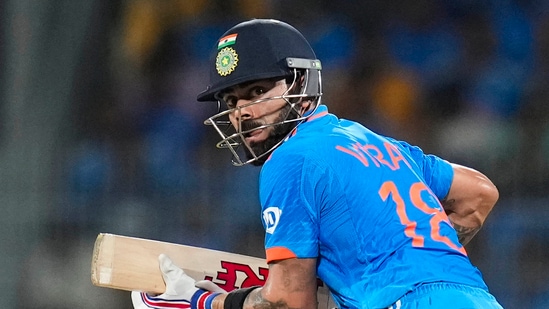
Virat Kohli can move. And not just between the wickets. Anytime he hears the drums in the stands, the 34-year-old invariably breaks into a jig... a little bhangra or a gentle sway. We saw it during the game against Australia too when he found time during the drinks break to take it all in. It’s there and it’s a natural rhythm.
Indian batter Virat Kohli in action. (PTI)
This sense of rhythm helps in cricket too. So much of sport is about the flow, when athletes are fully focused on what they are doing, and this heightened attention is associated with a number of positive factors.
At the same time, every sport demands a different rhythm. In cricket, that rhythm can be dictated by the venue, the pitch, the opposition and the weather. So, any batter or bowler has to find a way to adapt their natural rhythm to what the demand is. Those who do that, succeed. Those who don't…
There is often talk about how red-ball and white-ball cricket require a different approach. The experts talk about bat speed, mindset and fitness being the big points of divergence. But ODIs are overlooked in this debate – they are clubbed with T20s under white-ball cricket, disregarding the fact that they too need the players to adapt.
Everyone swings for the boundary these days... and well, why shouldn't they, but that doesn't mean they should keep doing it all day and in all conditions. In the match between India and Australia at Chennai, with Test match lengths being bowled, the need of the hour was to bide your time.
But Ishan Kishan and Shreyas Iyer failed to do that. Throwing their hands at the delivery and paying the price. It was a very small window but, as later events showed, they overplayed their hand. In T20 cricket, one wouldn't have found cause to complain but in ODIs, with 50 overs to be played, they could have waited.
As KL Rahul walked out to bat, Kohli told him there’s a bit in the wicket: “So, play like Test cricket for a while.”
Red-ball technique and mindset in the white-ball game. Rarely, if ever, does this happen in T20 cricket. But the best bowlers have the option to bowl longer spells if needed in ODIs and that means sometimes you have no option but to wait.
And this is an approach that comes very naturally to Kohli, Rohit Sharma, Steve Smith and David Warner – these are all batters who took their initial steps in cricket before T20s became the go-to format in the game. So, their most natural rhythm is either the Test pace or ODIs. They have been trying hard to play T20s with the freedom that comes so easily to the youngsters but in the 50-over arena, the others can learn but these guys are the masters.
No one wants to be an ODI specialist these days. It just doesn't pay. But when you have played the format for as long as these guys have, this rhythm... this sense of what to do with the extra overs comes naturally. It also factors in the kind of wicket the match is being played on.
“Rhythm is nothing else but the factor that decides the speed, strength, smoothness, looseness and the order and time of each part of a complete movement,” the famous athletics coach George Gemer wrote in his book ‘Role of rhythm in track and field’ in 1965.
And so much of what we see on the field is dictated by the comfort level of the player. Suryakumar Yadav, despite his success in T20 cricket, found it difficult to initially adjust to the ODI format. So, it’s white-ball cricket alright but it’s different.
“We have played a lot of T20Is, so it’s become a habit. We play T20 regularly, and all we need to do is express ourselves,” said Suryakumar in August. “But we do not play a lot of one-dayers, and ODI is a challenging format. This is because you have to bat as per the situation. For example, if wickets fall early, then you need to spend time in the middle (play like Test cricket), then in the middle play run-a-ball and then towards the end approach it like a T20 game.”
If the Chennai wicket was like the one we saw during the South Africa versus Sri Lanka match at the Arun Jaitley Stadium in Delhi, then shots would have been in order. In those situations, the T20 tilt helps. But you won't always get that. Not in India.
“There was a bit of help for the pacers with the new ball, and then the spinners also,” said KL Rahul after the game against Australia. “In the last 15-20 overs, dew played a part and that helped quite a bit. The ball also skidded on better. However, it was a bit two-paced, it wasn't the easiest of wickets to bat on and it wasn’t flat as well. It was a good cricket wicket, a bit for the batters and the bowlers. That’s what you get in the south of India, especially Chennai."
On some flat tracks, ODIs can become an extended T20 match, but in India where the spinners usually come into play, being one-dimensional will not help. It requires a bit of nuance, like the late cuts played by KL Rahul against Adam Zampa, and that might be a lost art in the T20 age.


 Live Score
 Cricket Teams
 Cricket Players