


 Live Score
 Cricket Teams
 Cricket Players
For the cricketing world, T20 leagues are the great leveller
The big nations have a packed calendar but T20 leagues are bringing the rest of the world up to speed

 Prefer HTon Google


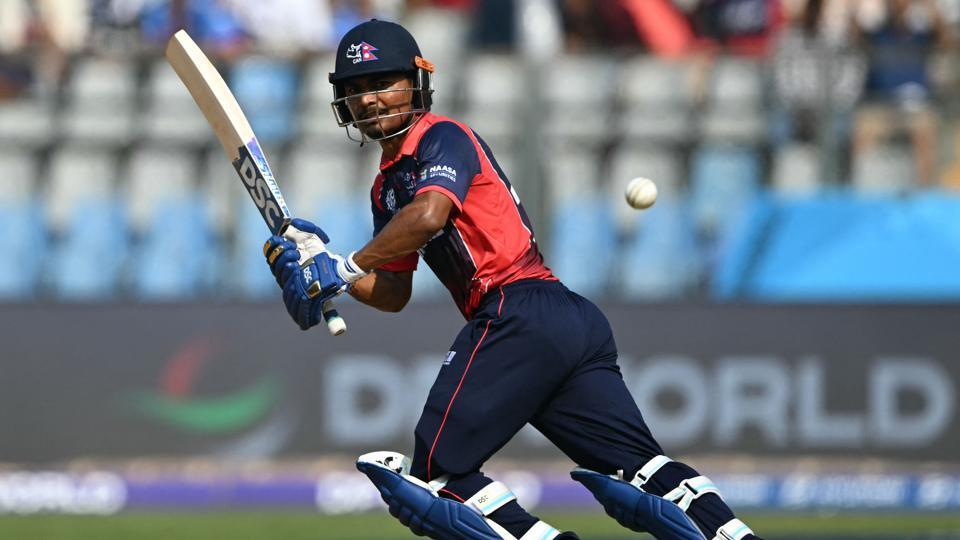
Mumbai: You wouldn’t have guessed Dipendra Singh Airee’s nationality watching him reverse sweep Adil Rashid with such deftness at the grandest stage until you saw half the stadium full of Nepalese support at Indian cricket’s stadium of dreams in Mumbai.

Brendon McMullen hitting Jason Holder through the line could have been any mainstream frontline batter. Look closer and you realise he wore the white saltire over a blue field in Scotland’s purple jersey.
Who would have thought Shadley van Schalkwyk from the USA would be the tournament’s leading wicket-taker late into the first week?
Like a spring breeze, the Associates have added a refreshing flavour to the T20 World Cup. They may not have staged an upset yet like the USA springing a surprise on Pakistan in 2024, but it can easily be said that the smaller nations have been much more competitive in the 20-team event. This World Cup has had none of the sub-100 totals seen in the last edition. Nepal came within a boundary stroke of upsetting England, the Netherlands came within touching distance of beating Pakistan, and the USA stretched India to the limit.
Associate players hate being tagged as minnows. But in their hearts, they know that to shed that tag, they require exposure. Of course, the Associate nations would like more opportunities to challenge the established teams outside ICC events. Give them a chance and they, as Nepal and Namibia showed against West Indies and South Africa, can win.
But achieving an egalitarian world has become such a pipedream in a cricket calendar filled to the brim with strong undercurrents of club versus country. If the Associates are catching up, it is largely due to the alternate growth vehicle that franchise leagues provide around the year.
“Think of the time when Ireland were an Associate nation and two things they really struggled against were extreme pace and X factor mystery spin. One of the reasons people are better prepared for that now is they’re getting more exposure to it,” Andrew Leonard, a cricket pundit on the Associate circuit and part of the global commentary team in the World Cup, told HT.
The ILT20 held in the UAE has emerged as a useful outlet of opportunity. Squad regulations mandate a minimum of four players from the UAE, one each from Kuwait and Saudi Arabia, and two from other Associate Nations. Scotland’s George Munsey and McMullen, Netherlands’ Bas de Leede and Namibia’s Gerhard Erasmus have derived learnings from the league.
A whole set of players from the UAE have got a chance to brush shoulders with leading T20 global stars. However, the growth of the national team has been slow. “Sadly, for me, they’re not picking the best teams. And I can say that with authority, having seen the players they are leaving out. As an associate, you’ve got to do the basics right,” said Leonard.
“But if I was an IPL team, I would sign all-rounder Dipendra Singh Airee tomorrow before anyone else does. He would add value to your squad. He’s the best-ground fielder in the world by a distance. Even the England players said to me, they’ve never seen anyone as fast between the wickets. And what he would bring is 30 million Nepal fans to the IPL.”
Nepal’s flashes of brilliance in the match against England lit up the tournament. Their talent is yet to be embraced by global T20 leagues. Only Sandeep Lamichhane has played in the IPL before. If that’s the way to growth, let’s build on the franchise model ourselves, said Nepal. Their IPL-modelled Nepal Premier League (NPL) fast tracked pacer Nandan Yadav, batter Lokesh Bam and spinner Sher Malla to the national team.
While the NPL, on the back of growing local popularity for cricket is taking baby steps, Major League Cricket (MLC), thanks to the heft of sports marketing in America, is the most promising. A 19-member MLC squad comprises 10 locals.
A good example of USA players being better for the franchise experience was seen in their World Cup league match against Pakistan when Usman Tariq, talk-of-the-town for his unusual action came out to bowl. “We have faced Usman in the USA, both against him and in the team. We didn’t think much about his bowling. We just kept on playing with a positive intent,” USA’s Shubham Ranjane recently observed in a press conference.
USA batter Sanjay Krishnamurthi hailed the MLC experience, having got a chance to face some of the best T20 bowlers in Sunil Narine, Noor Ahmed and Rashid Khan.
“T20 is the format that we play the most in the USA. We have major and minor league and some other private tournaments, all T20,” said Mohammed Mohsin, USA spin bowler. “And I think not playing against these Test-playing nations or the big boys is actually a loss for them because they don’t know what’s coming in front of them.”
Many of the Dutch players play professional cricket in the UK. Colin Ackermann and De Leede play for Durham. Roelof van der Merwe for Somerset. One of their leading former players Ryan ten Doeschate is part of Gautam Gambhir’s support staff with the Indian team.
Namibian captain Erasmus does not approve of being called an Associate. “All the teams that have qualified for the World Cup have just qualified as normal nations, through rankings and positioning in their regions. Associate nation is just a tag,” he said. “The first four games showed that it wasn’t any fluke that those teams competed. They competed on very good conditions and good wickets. They competed with skill, with mental skill.”
In those early matches where they were competitive, Erasmus argued, matches were lost in the last five overs. Results would change with more exposure.
“All the associate nations have caught up with the T20 format. With the help of franchise cricket as well, a lot of those cricketers do find franchise gigs here and there. And they take those lessons and learnings back home, sharing with the guys who maybe didn’t manage to get that gig,” said Zimbabwe’s Sikander Raza.
Beyond assistance provided by the global franchise leagues, experts like Leonard call for structured efforts by full member nations to lend a helping hand. He argues that if it is thought through, achieving it will not remain impractical.
“The great thing about T20 cricket is that you can put on a little three-match series across the course of four or five days and run it reasonably cost efficiently, without taking a gigantic chunk out of the already squeezed international and domestic calendar,” he opined. “Maybe not India and Australia, but some of the lower-ranked full members, I promise you, if they play any of the best Associates, these will be competitive games.”


