


 Live Score
 Cricket Teams
 Cricket Players
How an India ODI low point spurred a T20 revolution
The format that has got its 10th World Cup rolling in India and Sri Lanka started off very differently in 2007

 Prefer HTon Google


New Delhi: It was a rainy January day in 1971 at the Melbourne Cricket Ground that gave birth to one-day cricket, but the global game owes its white-ball revolution to India. June 25, 1983 at Lord’s and September 24, 2007 at the Wanderers in Johannesburg – dates of India’s first World Cup wins in the two international limited-over formats has transformed the game commercially and in terms of drawing in the fans.
However, it was the travails of India in ODI cricket in 2007 that sowed the seeds for a Twenty20 influence that is acknowledged as the perfect vision for cricket – win-win sponsorship deals and fans flocking in for a three-hour sporting entertainment.
The format that has got its 10th World Cup rolling in India and Sri Lanka, and is headed to the 2028 Los Angeles Olympics, barely registered in India 19 years ago. England had introduced T20 cricket professionally at County level as it hoped the compressed format of the game would shore up sponsorship as well as the dwindling spectator count at its stadiums.
The Indian cricket board, BCCI, didn’t seem too enthusiastic even after the International Cricket Council (ICC) announced plans for the inaugural World T20 in South Africa in 2007. It may well have continued to regard T20 as a non-serious format if Rahul Dravid’s India had not been knocked out in the group stage of the ODI World Cup in the West Indies.
The outpouring of anger among millions of Indian fans after the team was upstaged by Bangladesh and then lost to Sri Lanka in Port-of-Spain to exit the World Cup also meant a commercial disaster for the Caribbean organisers. At home, as furious discussions on the need to find younger replacements for batting stalwarts Sachin Tendulkar, Sourav Ganguly and Dravid in white-ball cricket continued, Dilip Vengsarkar, credited with nurturing young talent as chairman of selectors, seemed to be the right man at the right place.
Dravid, having held his hand up after the 2007 World Cup disaster, rang up Vengsarkar to convey that the three seniors had asked not to be considered for the inaugural World T20 in South Africa. “I think that is the way forward for Indian cricket,” said Dravid, who was leading the team in England at that time. “We thought it would be better if the younger guys played that tournament. Twenty20 is a game for youngsters. I think it was a proper decision and the way forward for Indian cricket.”
It was a journey into the unknown in more ways. If Mahendra Singh Dhoni’s choice as skipper found support from Tendulkar, who was impressed with the young wicketkeeper’s astuteness while fielding in the slip cordon, teams had barely played T20 cricket going into the World Cup. India had played one game on their 2006 tour of South Africa. Today, India’s 268 T20Is going into the current edition is only next to Pakistan’s 292 games. England, the fountainhead of T20 cricket have only 218 and Australia 222. The numbers for West Indies (246) and New Zealand (252) show how their players have taken to what has effectively become the sole career format for numerous players.
The Yuvi stamp
A rain-abandoned opening game against Scotland and an exciting tie against Pakistan after Misbah-ul-Haq was run out going for the winning single – India won the bowl-out – set the stage for the single biggest advertisement. A 10-run defeat to New Zealand followed, and an Indian team with an average age of less than 24 resembled very much the reluctant starters in the tournament.
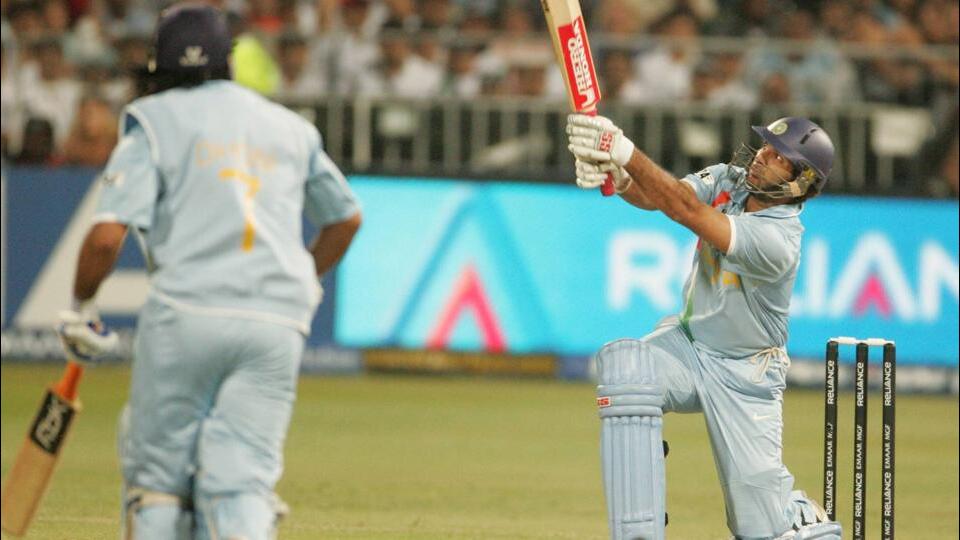
Enter Yuvraj Singh. The game against England on September 19, 2007 will be a landmark day for the tournament as well as how T20 cricket rapidly found takers among fans and administrators. Gautam Gambhir and Virender Sehwag had a century opening partnership, but then came the 19th over from Stuart Broad and Yuvraj produced the high-profile knock T20 cricket could have asked for. In a whirlwind 16-ball 58, Yuvi smashed Broad for six sixes in the over. He joined elite company as only three men before him had achieved the ‘perfect 36’ in senior cricket before him – Garry Sobers, Ravi Shastri and Herschelle Gibbs.
The fastest T20 fifty – off just 12 balls with three fours and six sixes – and talk of a largely untested squad had gone. In its place, hopes were rising. India had electrified the World Cup. Yuvraj, who would become the player of the 2011 World Cup, had stamped his game as the perfect fit for this shortest format. “I just went in to slog,” the vice-captain said. “With just two overs to go I just thought I would use the crease and timed it well.” Just like that.
India still needed to beat hosts South Africa next to avoid elimination, and the 37-run win set up the semi-final against Australia. The ODI World Cup champions too felt the fury of Yuvraj’s bat – 70 off 30 balls – despite Brett Lee and Mitchell Johnson in their ranks.
All this nicely set up the dramatic finale against Pakistan. Apart from the traditional rivalry, India had only managed to tie their early meeting. Gambhir again delivered (75) and Rohit Sharma’s vital 30 not out off 16 balls at No.6 took the score past 150. Pakistan seemed on course to complete the chase. That is until Dhoni’s inspired choice of bringing on Joginder Sharma to bowl the final over with Pakistan needing 13 runs to win.
Joginder began with a wide. Misbah faced a dot ball and hit the next delivery for six. Now, Pakistan had to get six runs off 4 balls. Near impossible for India to defend? But Misbah went for the scoop off the next ball, only for it to nicely loop to Sreesanth stationed at short leg. Catch taken, and all hell broke loose.
Six months after that low point in the Caribbean, India had risen again. Thousands came on Mumbai’s roads to cheer the open-top bus parade. New heroes had been minted. The IPL would follow and world cricket would never be the same again.


