India's safety net: How Abhishek Sharma's early onslaught protects the innings when middle order begins to unravel
Abhishek Sharma's early onslaught gives India scoring insurance, cushioning middle-over collapses and keeping 200-plus totals alive despite later momentum dips.
61 runs off 28 balls with seven sixes, a 20-ball half-century - That is what Abhishek Sharma did against Pakistan in the Asian Games 2026 Gold Medal match. This often gives way to the temptation of analysing his impact by how violent he was. But the true effect of an Abhishek Sharma inning is often realised after he has left the crease.
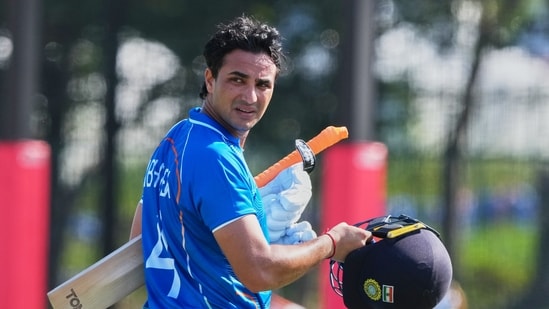
Abhishek Sharma scored 61 off 28 balls against Pakistan. (AP Photo/AP Photo/Mark Baker))
{{^htLoading}} {{/htLoading}}
When Abhishek was dismissed in the match, India were stationed at 93/3 in 7.5 overs. But after this, Pakistan staged a small comeback. The bowlers began to identify areas that could restrict the batters. India lost wickets in chunks, after which the defending champions endured a mini middle-over collapse. However, Abhishek had already paid the tax for this exact drop at the start.
{{^usCountry}}{{/usCountry}}
To give you an idea, India scored 56 runs between overs seven and 15, while losing three wickets. Overs 11 to 15 produced just 15 runs. Ishan Kishan and Shreyas Iyer combined for just 41 runs off 42 deliveries. Yet, after all this, India were 137/5 after 15 overs and finished with a daunting 211/6 at the end of the 20 overs.
Abhishek Sharma is buying time for India before they need it
{{^htLoading}} {{/htLoading}}
Deep Dive
How did Abhishek Sharma's innings impact India's overall performance in the Asian Games final against Pakistan?
Abhishek Sharma's explosive innings laid a strong foundation for India, scoring 61 runs which allowed the team to reach 81/2 in the first six overs. His aggressive start helped India recover after losing wickets, ultimately setting up a formidable total of 211/6.
Why is Tilak Varma's role often considered thankless in the Indian T20I team?
Tilak Varma's role is seen as thankless because he often comes in during challenging situations, needing to stabilize the innings rather than play aggressively. His contributions can be overlooked despite being crucial in high-pressure moments, such as his crucial performance in the Asian Games final.
What strategies did India employ to secure their victory against Pakistan in the Asian Games 2026 gold medal match?
India employed strategies such as a strong start with aggressive batting from Abhishek Sharma and effective middle-order contributions from players like Tilak Varma, coupled with solid bowling performance, particularly in the crucial overs that restricted Pakistan's chase.
Powered ByAsk HT
{{^usCountry}}
For starters, Abhishek’s assault took India to 81/2 in the first six overs. The opener was responsible for 61 of the first 93 runs scored by the team. After this, Pakistan gained back a bit of control and reduced India’s scoring rate to just 6.22 in the following nine overs. The deceleration was long enough to generally wreck a 200-plus total. However, in this case, it came off just as a stutter in the middle of a formidable innings.
{{/usCountry}}
{{#usCountry}}
For starters, Abhishek’s assault took India to 81/2 in the first six overs. The opener was responsible for 61 of the first 93 runs scored by the team. After this, Pakistan gained back a bit of control and reduced India’s scoring rate to just 6.22 in the following nine overs. The deceleration was long enough to generally wreck a 200-plus total. However, in this case, it came off just as a stutter in the middle of a formidable innings.
{{/usCountry}}
Now, just imagine Abhishek had scored around 40-42 runs off the same 28 deliveries. It would still look like a decent T20 innings, but going into the final phase, Tilak Varma and Shivam Dube’s aggression would just mean repair rather than building on the platform already laid.
{{^htLoading}} {{/htLoading}}
Conventional T20 cricket asks a batter to respond to a crisis even before it develops. But Abhishek’s aggression has a peculiarity. He looks to pay the tax even before a crisis develops.
For every extra run that Abhishek adds in the first six overs, India gets the tax that could be paid later during a quiet over or the loss of a few quick wickets. Basically, he launches India into a better position. Any team would prefer to be at 80/3 after the first six overs than 55/1, especially on a pitch like the one for the Asian Games final.
Abhishek’s aggression also defines the roles of the batters who come in later. He buys the time for batters like Shreyas Iyer or Tilak Varma to assess the condition and then prepare for the final launch. His method comes with volatility, but whenever it pays off, India are left in a position of command.
Abhishek is not a typical builder for India or their anti-wreckage resource. He is the asset who ensures that India have so much before the collapse even arrives that there is more than substantial left after it.
Probuddha Bhattacharjee is a sports writer and analyst with expertise spanning cricket, football, and multi-sport events, with a strong emphasis on data-driven journalism and tactical storytelling. He currently focuses on international cricket, the Indian Premier League, global tournaments, and emerging trends shaping modern sport, blending advanced statistics with strong narrative context to explain performance, strategy, and decision-making. His work aims to bridge the gap between numbers and storytelling, helping readers understand not just what happened on the field, but the tactical and structural reasons behind it.
Trained in data journalism through the Google News Initiative (GNI) Data Journalism Lab, Probuddha works extensively with ball-by-ball datasets, performance metrics, and trend-based modelling to produce evidence-backed reports, explainers, and long-form features. His analytical approach focuses not only on outcomes but also on process—selection strategies, phase-wise tactics, workload management, and the influence of preparation and planning on match results. He is particularly interested in how statistical patterns reshape conventional cricketing narratives and provide clearer tactical insight for modern audiences.
Beyond cricket, Probuddha has written analytical and news-driven pieces on football and other major sporting events, with a growing interest in sports governance, scheduling dynamics, and the economics of elite competitions. He also tracks how rule changes, franchise structures, and broadcast pressures influence the evolution of contemporary sport.
He has previously contributed to platforms such as OneCricket, Sportskeeda, and CrickTracker, and continues to specialise in analytical storytelling, live coverage, and audience-focused reporting. His work prioritises clarity, context, and credibility, while consistently exploring innovative ways to present data through accessible narratives and structured match analysis.
Get live cricket scores, match updates, schedules, results and ICC rankings. Follow the latest news, statistics and performances of top teams, players update on Hindustan Times.
Get live cricket scores, match updates, schedules, results and ICC rankings. Follow the latest news, statistics and performances of top teams, players update on Hindustan Times.
Home/Cricket/India's safety net: How Abhishek Sharma's early onslaught protects the innings when middle order begins to unravel
{{^htLoading}}
Advertisement
{{/htLoading}}
SHARE THIS ARTICLE ON
{{#usCountry}}{{/usCountry}}
Notifications
Get breaking alerts directly from the newsroom
Notifications are on!You'll be notified when news breaks