


 Live Score
 Teams
Teams Players
Mumbai Indians incur INR 73.58 lakh loss in batting; Hardik Pandya’s painful stay costs INR 3.20 lakh per ball vs CSK
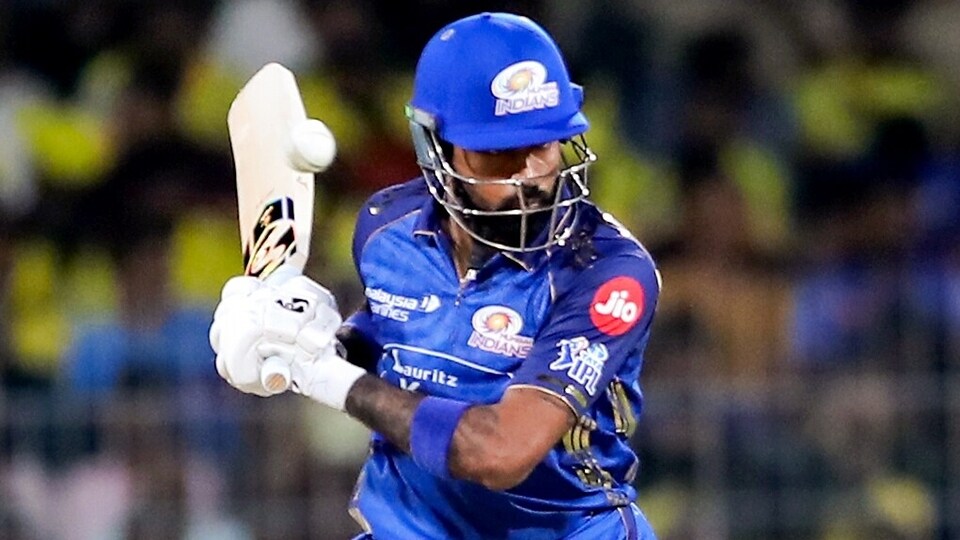
Hardik Pandya's 18 off 23 deliveries hindered the Mumbai Indians' innings, resulting in a total of 159 against the Chennai Super Kings.

 Prefer HTon Google


The Mumbai Indians were still in the match when Hardik Pandya walked in. They were not flying, but they had a platform. At one stage, MI were placed well enough to think of a total in the 180-190 range, the kind of score that could have asked a serious question of Chennai Super Kings.
Instead, the innings lost its shape. The middle overs slowed, the final push never fully arrived, and MI finished at 159. Chennai Super Kings chased it down with eight wickets in hand, turning what should have been a competitive contest into a fairly comfortable finish.
Hardik’s innings sat at the centre of that slowdown. His 18 off 23 did not merely hurt MI’s run rate. In our match-value model, it created an immediate ₹82.65 lakh batting gap relative to his player-performance match cost.
That number works out to nearly ₹3.59 lakh in losses per ball he occupied. But the sharper explanation sits one layer deeper: once his cost is separated by discipline, the batting-specific deficit comes to ₹73.58 lakh, or roughly ₹3.20 lakh per ball.
How Hardik Pandya’s 23-ball stay became a ₹82.65 lakh batting hole
MI needed Hardik Pandya to move the innings forward. They got containment instead.
His 18 off 23 came at a strike rate of 78.26. It was not a low-score rescue act. It was not a difficult surface survival act that later unlocked a finish. It was a stalled middle-over stay in a 159-run innings that left CSK with a target they could control.
The raw ledger shows why the innings hurt so badly.
Hardik’s player match cost for this game was ₹94.33 lakh. His batting return from the innings was only ₹11.68 lakh. The difference between those two numbers creates the headline figure: ₹82.65 lakh.
That is the stress-test number. It asks a simple question: if Hardik’s batting was tested against his player-performance match price, how much value did the innings fail to recover?
The answer is brutal. ₹82.65 lakh across 23 balls. ₹3.59 lakh per ball.
This is not saying MI literally paid ₹3.59 lakh every time he faced a delivery. It is saying that, in value terms, every ball he consumed while producing only 18 runs deepened the gap between expected match value and actual batting return.
For a high-priced all-rounder, that is the danger zone. The innings does not have to look catastrophic on the scorecard to become expensive in the ledger. A 23-ball 18 can quietly behave like a financial drag because it eats deliveries, limits acceleration and transfers pressure to the rest of the innings.
The cleaner discipline-split calculation
There is also a more precise way to frame the same failure. Hardik did not play only as a batter. He also bowled two overs. So his entire player-performance cost should not be loaded onto batting alone. A cleaner analytical method separates the cost by discipline.
In this match, Hardik’s raw on-field contribution split heavily toward batting because he faced 23 balls and bowled only 12. His impact profile was:
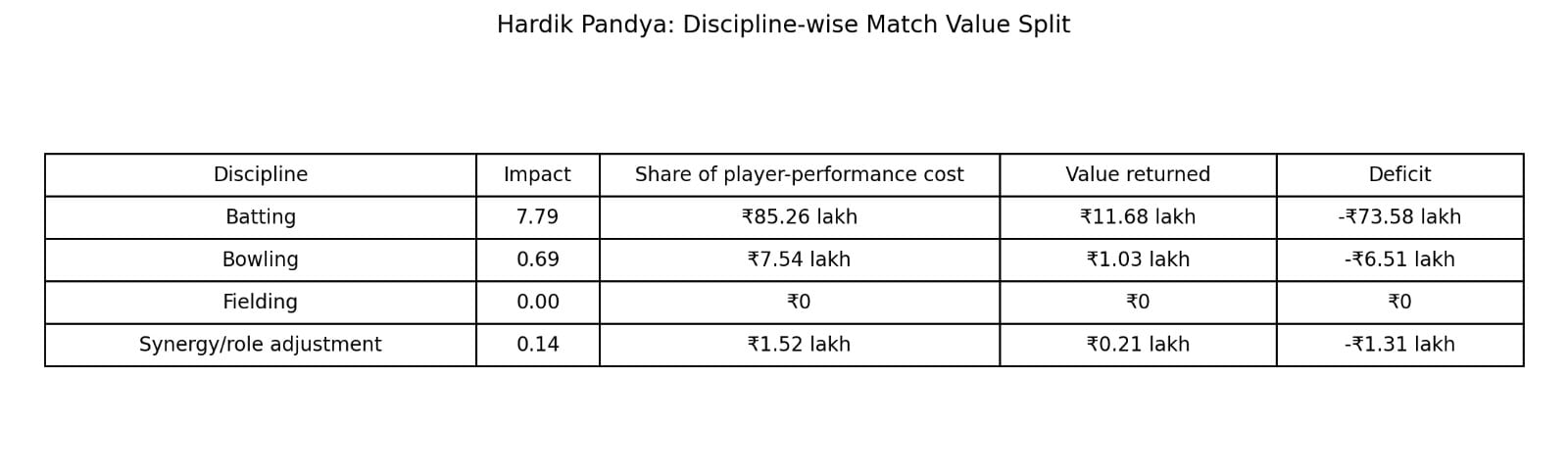
This version is more defensible because it does not pretend that Hardik’s whole match cost belonged to batting.
Under the discipline-separated method, his batting-specific cost base was ₹85.26 lakh. His batting returned only ₹11.68 lakh. That leaves a true batting deficit of ₹73.58 lakh.
Spread across 23 balls, that becomes: ₹73.58 lakh ÷ 23 = ₹3.20 lakh per ball. The raw ₹82.65 lakh figure stands. However, the discipline-split figure of ₹73.58 lakh is the more rigorous accounting figure.
The first number shows how damaging the batting innings looks when measured against Hardik’s total player-performance match expectation. The second number shows how damaging it remains even after giving him proper cost credit for his bowling role.
Even after the model separates bowling from batting, the innings still leaves a massive hole.
Hardik’s bowling did not repair much either. His bowling return was only around ₹1.03 lakh against a bowling-assigned cost of ₹7.54 lakh, leaving a ₹6.51 lakh bowling deficit. The bowling figure is not the headline, but it explains why his overall player-performance ledger stayed deep in the red.
His total player-performance deficit finished at ₹81.40 lakh.
Then, the captaincy made the ledger worse. With a negative captaincy rating in a heavy defeat, his captaincy ledger added another ₹59.57 lakh loss. That pushed his full match ledger to - ₹1.41 crore.
But the cricketing centre of the story remains the batting.
An 18 off 23 from a premium all-rounder is not just a slow innings. It is a resource misallocation. It takes balls from the innings bank and returns too little value. It forces the rest of the line-up to overcorrect. It converts a batting position into a liability.
That is why the per-ball number reveals a lot. The innings cost MI either ₹3.59 lakh per ball on the raw stress-test frame or ₹3.20 lakh per ball on the discipline-separated frame.
Both figures say the same thing in different accounting languages. Hardik Pandya’s stay in the middle was very expensive for his team.
Method note
This valuation is based on a cricket impact model developed by the author. The model studies batting, bowling, fielding, match situation, phase pressure, role difficulty, manual performance rating and captaincy impact, then converts that contribution into a rupee value using the player’s auction/retention price and expected season usage. It is not an official IPL metric, salary calculation or franchise accounting figure.


