


 Live Score
 Cricket Teams
 Cricket Players
Jacob Duffy's four overs were worth a Honda City, nine iPhones and a serious opening-night statement for IPL 2026
Jacob Duffy's stellar 3-wicket haul for RCB proved invaluable, achieving a 47.55 times Return on Investment.

 Prefer HTon Google


The M. Chinnaswamy Stadium is not a place where bowlers come to feel good about themselves. It is a venue built for batters, beloved by sixes, and notorious for turning bowling figures into abstract horror. As the IPL 2026 season opened under its lights, it confirmed everything the ground's reputation promised - with one notable, conspicuous exception.
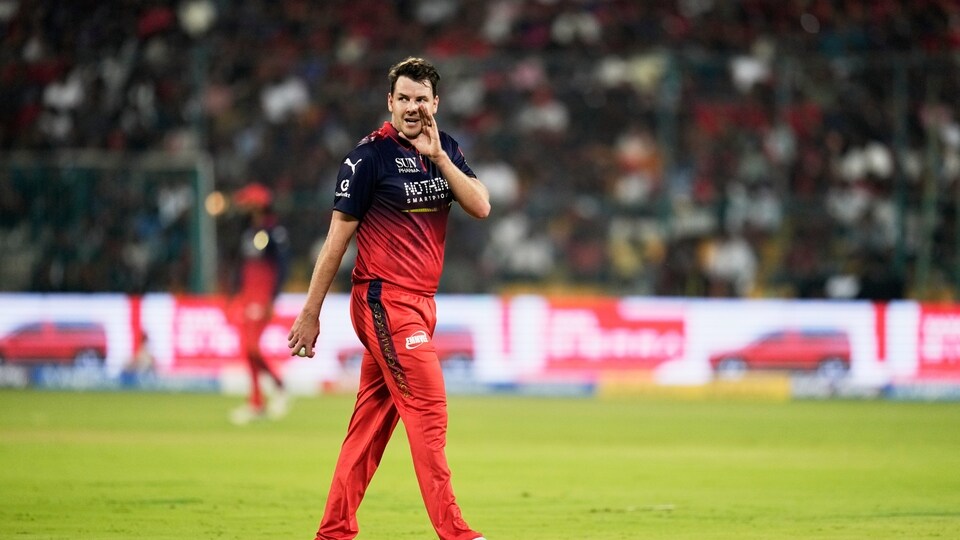
Jacob Duffy. Four overs. 3 wickets for 22 runs. Impact Index: 95.1.
Elite, by any measure. But here is the number that tells the full story - 47.55x ROI.
Nearly paying his own bills
For a franchise that spent ₹10.75 crore for Bhuvneshwar Kumar and ₹5.75 crore on Krunal Pandya, the New Zealander they picked up at auction for a modest ₹2 crore produced the only bowling performance that registered on the right side of the ledger. His per-match cost works out to ₹14.29 lakh. Against that, he returned ₹12.89 lakh in impact profit - covering nearly 90% of his own game-day tab in a single outing.

To put that in terms that require no spreadsheet: Jacob Duffy's four overs were worth nearly a Honda City. A brand-new one, base variant, with ₹84,000 left over for insurance and a full tank. Or, if you prefer your comparisons in smaller boxes - nine iPhone 16 Pro Maxes, give or take. Or 87 grams of 24-karat gold at (28th March) today's rate of ₹14,809 per gram. One bowler. One match. Nearly self-funding.
What the other bowlers were doing meanwhile
Now look at what surrounded him. Bhuvneshwar Kumar, the ₹10.75 crore centrepiece of RCB's seam attack, conceded 33 from 4 overs and took 1 wicket - but his phased impact score bottomed out at 1.7. Match Profit and Loss equation: - ₹74.18 lakh. That is five Honda Cities, driven off the lot and into a wall.
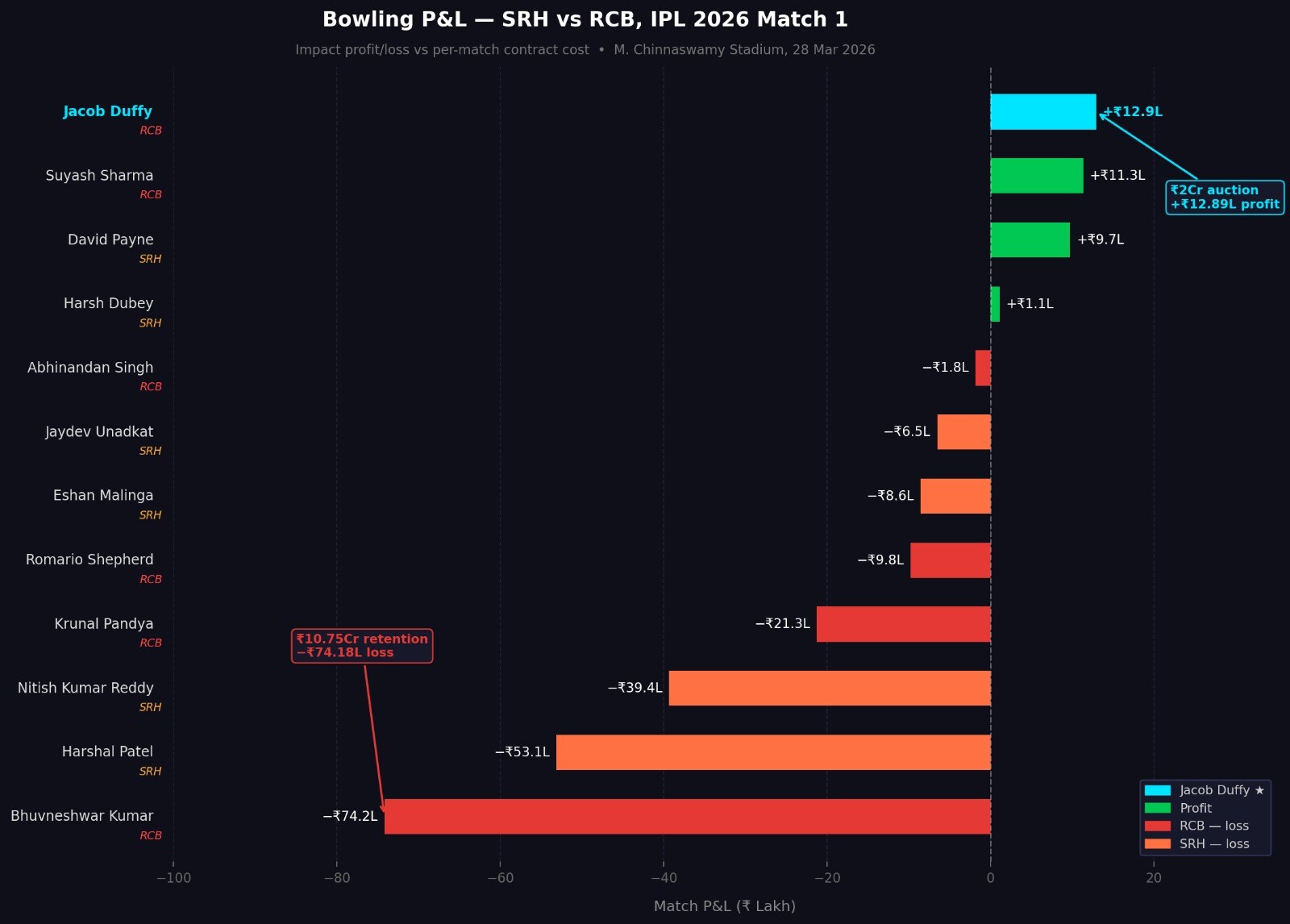
Krunal Pandya sent down 2 overs for 26 runs and no wickets - a ₹21.27 lakh evening. Romario Shepherd took 3 wickets but haemorrhaged 54 runs from 4 overs; his impact index of 4.3 classified him as Poor, costing the franchise - ₹9.79 lakh despite the wicket column looking respectable.
The combined PNL of RCB's three other bowlers: - ₹109.24 lakh. The auction pick: + ₹12.89 lakh. The math is uncomfortable.
Why the Powerplay Made All the Difference
What made Duffy's performance particularly valuable was when he did his damage. His powerplay impact score was +0.1682 - the highest of any bowler in the match across both sides. In T20 cricket's most volatile phase, on the most batter-friendly ground in the competition, he strangled SRH's top order when the game was still shapeless, and the runs were still cheap to take.
His middle-overs contribution was negligible, and he didn't bowl in the death - but that is the point. RCB used him correctly. He is a powerplay weapon, not a 20-over solution, and on opening night, someone in the dressing room understood that distinction.
The Auction Room Was Right
The efficiency leaderboard for this match tells its own story. Four of the top five ROI performers- Duffy included - were bought for ₹2.6 crore or less. The auction room, it seems, was paying attention.
At ₹2 crore, Jacob Duffy is not the flashiest name in RCB's XI. He will not be the face on the billboard or the name in the chant. But through 24 deliveries on opening night, he came closer than anyone else in red and gold to earning his keep - and at Chinnaswamy, in this economy, that is nothing.


