


 Live Score
 Cricket Teams
 Cricket Players
Mastering the chase: What to expect at T20 World Cup in Australia
Five of the seven T20 World Cup finals being won by the team batting second indicates that setting targets isn’t a safe tactic anymore


Out of the seven T20 World Cup finals, five have been won by the team batting second. The last edition in the UAE saw Australia emulate West Indies’ feat of lifting the title in 2016 without winning a game batting first (they won six games batting second while their only loss came against England while batting first). The final too was a record affair as Australia chased down 173—the second highest successful chase in a T20I final—at Dubai where all 10 World Cup matches under lights had been won by teams chasing. But that was in the UAE, in warm, humid conditions on flat pitches. Australia could warrant a different approach.
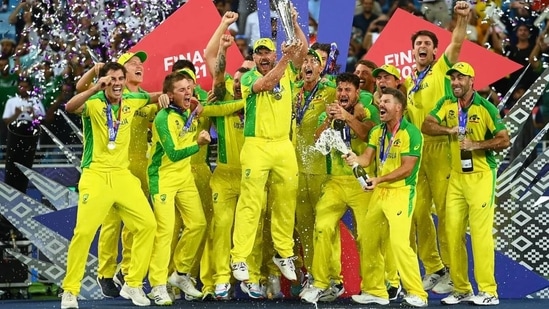
Dew negates the spinner’s grip, thereby handing an advantage to the batter in the second half of a night match. Winning the toss too plays a vital part. But these are uncontrollable factors and outcomes. The only aspect of chasing in limited-overs cricket independent of these factors is a team’s unflinching belief in its batting potential. Australia were convincing in that aspect even though the coin toss played a huge part—they won six out of seven tosses—in their campaign. “It did play a big factor, to be honest,” Finch had said after winning the T20 World Cup. “I tried to play it down as much as I could because I thought, ‘at some point in the tournament, I’m going to lose a toss and we’ll have to bat first’. But it did play a big part. I don’t know how I did it. Maybe it was just fate.”
Win the toss, score big and put the opposition under pressure—this was for years a template most teams had fallen back on in white-ball cricket. T20 cricket too began espousing that thumb rule. Only thrice (out of 29 matches) in the first season of Australia’s Big Bash League, for example, did teams win the toss and choose to bowl first. But the brevity of the format forced constant tweaking of strategy. Once-crucial factors like nature of the pitch and hardness of the ball were taken out of the equation while the pressure of staying on top of the multiplying asking rate compounded every over. From the openers dropping anchor to blasting away without caring about wickets, batting strategy too underwent several makeovers. No target is safe now as batters are backing themselves to chase even 30-40 runs in the last two overs. Setting targets wasn’t a safe tactic anymore.
So when Australia had the opportunity of setting Pakistan a target during the 2021 T20 World Cup semi-final, Finch—encouraged by the statistics that every night game in Dubai during the World Cup had been won by the chasing team—stuck to his guns. He saw no need to change his mind during the final as well. “In T20 cricket, you need a bit of luck, don’t get me wrong. We won six out of seven tosses, which goes a long way. But we’ve played some really good cricket. We played cricket where we put teams on the back foot because we were aggressive.”
Chasing in Asia has traditionally been easier because of dew. But with the new order of batting setting in, the difference has been widening of late. Consider this: In the last one year, the top 11 teams won 51 out of 74 matches fielding first, a more than two-fold increase in win/loss ratio from 2017. The trend is yet to catch on in Europe and Africa but in Australia, where dew isn’t as pronounced a factor as in Asia, teams have won more (13) chasing than losing (9) in the last five years.
The penchant for chasing is now evidently no longer dependent on external factors. It stems from the effort teams now put in to achieve greater batting depths. Bowlers have turned all-rounders by adding lower-order six-hitting skill to their games while more batters are being asked to take up part-time bowling. Australia, Sri Lanka and Pakistan have been the biggest benefactors of this approach in the last year, aggregating the most lopsided win/loss ratios while chasing. India and England too are trying to cram in as many batting options as possible. Point is there is no right or wrong approach as long as the wins are coming. And that is what could make this T20 World Cup an interesting watch.


