


 Live Score
 Cricket Teams
 Cricket Players
Two overs from Pandya and Bumrah that rocked Pakistan
India's disciplined pace bowling led by Pandya and Bumrah secured a quick victory over Pakistan in the T20 World Cup, taking three wickets early on.

 Prefer HTon Google


Kolkata: For all the attacking verve and gusto they bring to every contest, you have got to give it to India for refusing to be straitjacketed by what seemed obvious, even when conditions and matchups heavily suggested that in the high-voltage T20 World Cup clash in Colombo on Sunday night.
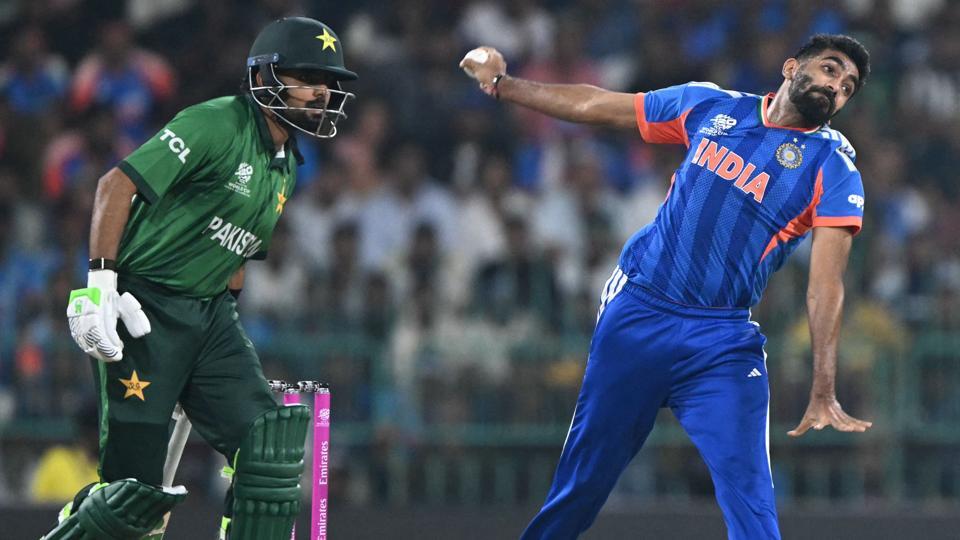
Spin was to have the final say, but not necessarily the first word, as India exhibited through two opening overs of disciplined pace bowling from Hardik Pandya and Jasprit Bumrah. This, when Pakistan chose to open with Salman Ali Agha’s off-breaks, and were handsomely rewarded by the wicket of Abhishek Sharma as well. India stuck to their plans though. Result? Two overs, three wickets, game virtually won.
Pandya, often the spearhead for India, summoned lines and lengths that only he could have bowled in a match like this. It can be tricky in the first place because Arshdeep Singh has normally been opening the bowling of late, but Pandya slipped into the role seamlessly. It was also a clever matchup against Sahibzada Farhan, who has for long been billed as someone who plays pace well but not always against its medium version. Off-putting especially was the seam, which Shaheen Afridi incidentally didn’t even come close to extracting with the new ball. But Pandya was straightaway at it.
A gentle away swing in the first delivery, followed by one that was pulled back a bit, and another genuine short ball moving away from Farhan—Pandya was just not allowing him to get under the ball. The frustration bubbled over in the fourth ball. Having found his line early, Pandya dug one short making it move away, but Farhan anyway went for a pull that he just couldn’t connect properly. And when it comes to skiers, Rinku Singh doesn’t miss many.
That wicket maiden set up Bumrah’s over beautifully. The first-ball six was misleading in every way, not in the least because Saim Ayub had no clue which way the ball was moving, but also because of the considerably short length Bumrah chose. Slogging it closed-eye was the best option for Ayub, but the top edge wasn’t assuring. Maybe it was an elaborate trap, because what Bumrah did next can be seen nowadays only in the realm of the fast bowler. This was an inswinger, so full and quick that the ball crashed into his back pad before the bat could come down properly. Ayub had no clue about this one as well, but Bumrah knew he had his man even before the finger went up.
To get Agha in the same over was like putting Pakistan on the mat even before the innings took off. While Bumrah was exemplary, Agha was also to blame for an atrocious shot. Seeing his fuller ball get mishit for four, Bumrah dragged the length on his next ball, which Agha thought was the cue to get his aggressive cap on. He wanted to flick it over midwicket but was in no shape to do, giving a leading edge that Pandya had no problem catching at mid-on.
On the face of it, India did nothing extraordinary with the ball apart from sticking to their plans and executing their lengths. Which says something about the conviction of a team in a game where the slowness of the Premadasa Stadium pitch was influencing strategy.
So obsessed were Pakistan with getting their spin bowling right that Afridi became the weak link before a ball was bowled. And when he eventually did, Afridi conceded 31 runs in two overs. Compare that with India’s pace bowling—four overs, one maiden, three wickets for 25 runs. The contrast couldn’t be clearer.


