


 Live Score
 Teams
Teams Players
A home audit disguised as an away tour: Shubman Gill's India confront their biggest Test flaw in Sri Lanka
The Test tour highlights a shift in cricket dynamics, with India's vulnerability to spin contrasting Sri Lanka's resurgence, making it a revealing series.

 Prefer HTon Google


For much of the past two decades, India’s Test tour of Sri Lanka used to occupy a curious space in the calendar. It was technically an overseas assignment, but rarely felt like one. India used to land with the confidence of a side that knew both the conditions and the opposition. Sri Lanka, meanwhile, struggled through a difficult post-golden-generation existence, their decline was laid bare every time India visited.
The last tour, in 2017, was almost embarrassingly one-sided. India won by 304 runs in Galle, an innings and 53 runs in Colombo, and an innings and 171 runs in Pallekele. Three emphatic victories, each Test feeling less like a contest and more like a demonstration of the widening gulf between two neighbours.
Through those years it felt like Sri Lanka’s decline mirrored India’s rise, but few imagined that less than a decade later the balance of intrigue would shift so dramatically. Not because Sri Lanka have suddenly become world beaters. Rather, India are now carrying a vulnerability that has become increasingly difficult to ignore — they no longer play spin with the authority that once defined them.
The timing is ominous too since home advantage in Sri Lanka has become tangible again. Four victories from six home Tests over the last three years isn’t a great sample size but at least it suggests a side rediscovering the value of familiar conditions. At the heart of that revival stands Prabath Jayasuriya, a slow left-arm orthodox spinner whose greatest strength is not mystery but conviction. Forty-one wickets in 13 innings exemplify the skill of a bowler who understands exactly what surfaces at home demand. He bowls patiently, attacks relentlessly and waits for uncertainty to arrive.
Which, against this Indian batting line-up, doesn’t take long to make itself known. There was a time when India’s greatest batters negotiated spin with casual confidence, feet moving instinctively and soft hands smothering turn. Singles were accumulated almost unnoticed before the boundaries inevitably followed. That certainty has faded, and fast.
India’s home series defeat to New Zealand in 2024 was startling not merely because they lost, but because of the manner of their loss. Ajaz Patel, another left-arm orthodox spinner, repeatedly exposed technical hesitations that would once have been unthinkable for an Indian batting order in India even a decade ago. Then in 2025, Simon Harmer enjoyed similar success by asking uncomplicated questions of batters with his off-breaks as South Africa romped to a 2-0 win. The pattern is difficult to dismiss as coincidence.
There is no doubt that India’s relationship with spin has changed. Patience as a ploy isn’t in vogue anymore. The decisive stride down the pitch has been replaced by a tentative shuffle. The confidence of playing late has given way to indecision between front foot and back foot. Sweeps have become rescue shots rather than scoring options. There are moments when Indian batters appear to be negotiating spin as though they are visitors to conditions they once owned.
The reasons are complex. Domestic competitions’ pitches have evolved. White-ball cricket has altered technique. Preparation has increasingly revolved around overseas fast bowling because that remains the final frontier of Test success. Somewhere along the way, the old guard against spin began to erode. Which makes this series one of the more fascinating paradoxes in recent Indian cricket.
Officially, India are touring. In reality, they are taking an examination in conditions that have always formed part of their cricketing identity. This is an away series that feels strangely like a home audit. That reality lends unusual weight to a contest lasting only two Tests.
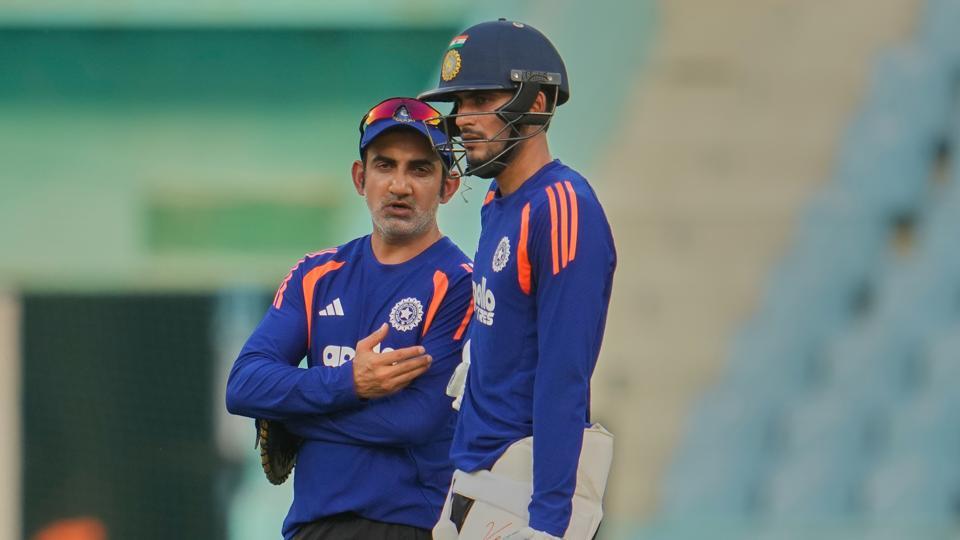
For Shubman Gill, still defining himself as India’s Test captain, Sri Lanka represents more than another assignment. Every new captain eventually encounters a series that reveals not simply tactical instincts but emotional authority. Gill inherits a team caught between generations and identities. The challenge is not merely replacing great players but rebuilding certainty where doubt has begun to settle.
Runs will matter, of course. But so will the manner in which his side responds if Jayasuriya begins to dictate sessions as Patel has in the past. Gautam Gambhir faces an equally revealing fortnight. With India’s performance review seemingly pushed back, the head coach enters the series under an extended spotlight. In the absence of official assessments, performances become the only available evidence.
This is not pressure born of crisis. India remain one of the world’s strongest Test sides. It is pressure born of expectation—and of an increasingly uncomfortable question. Have India quietly become vulnerable in the one department that once guaranteed their supremacy? Sri Lanka would like to believe so. Hence expect an approach no longer burdened by the inferiority complex that defined much of the previous decade.
Sri Lanka possess the surfaces, the bowlers and, perhaps most importantly, the evidence. India’s recent record against quality spin has offered encouragement that would scarcely have existed five years ago. That changes everything. Two Tests may be enough to confirm that India’s struggles against spin were temporary. They may equally reinforce the suspicion that something deeper has shifted. The destination remains unchanged. The backdrop, however, has unquestionably altered. And that may make this India’s most revealing tour of Sri Lanka in a generation.


