


 Live Score
 Cricket Teams
 Cricket Players
‘We lost to a man called Sachin’: When Australia surrendered to Tendulkar – The story behind today’s quote of the day
In 1998, Sachin Tendulkar's remarkable innings against Australia in Sharjah exemplified his unmatched talent, guiding India to qualification and victory.

 Prefer HTon Google


“We did not lose to a team, we lost to a man called Sachin.”
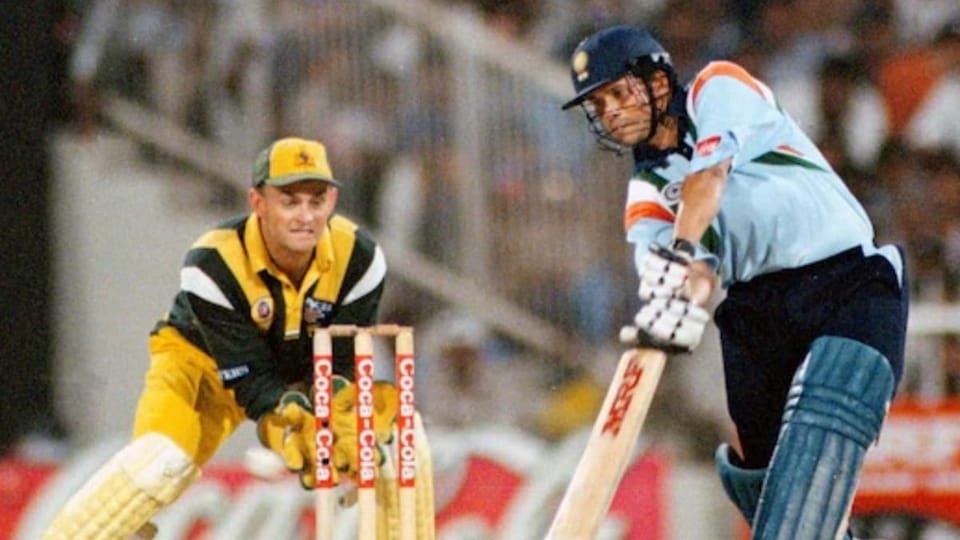
There are quotes that praise. There are quotes that exaggerate. And then there are quotes that sound like a captain surrendering to the only honest confession left in the room. Mark Taylor’s line lives because it doesn’t try to be clever. It tries to be accurate. It is the kind of admission you make when your dressing room has run out of explanations, when the post-match debrief feels useless because the match didn’t behave like a match. It behaved like a one-man show.
And in April 1998, at the Sharjah Cricket Stadium, cricket actually got a one-man show. Twice.
Desert Storm I - The night he batted like a calculator with a heartbeat
Australia made 284/7, courtesy of Michael Bevan’s 101* and Mark Waugh’s 81. So, the chase began as a normal ODI demand: big total, early stability, then acceleration. Except it didn’t stay normal. A sandstorm stopped play for roughly 25 minutes, overs were cut to 46, and the chase demanded two things at once:
· 276 in 46 overs to win, or
· 237 in 46 overs to qualify for the final
That second number is the key to understanding what Sachin Tendulkar did. He wasn’t only hitting for pride or a target. He was fighting to cross a qualification line that existed in the background like a second scoreboard. India lost early wickets – and this is where his innings stops being only a great hundred and enters the folklore of Indian cricket.
India lost the first wicket of Sourav Ganguly at 38. Nayan Mongia joined him and the two stitched together a partnership to take India to 107, when Mongia fell. The chase wobbled again, and wickets kept tumbling with the pressure spiking. But the innings did not collapse because Tendulkar refused to let Australia bully.
The Australian attack had names that normally shrank chases: Shane Warne, Michael Kasprowicz, Damein Fleming.
Sachin’s method wasn’t just strokeplay; it was a refusal to let any bowler set a mood. When the storm revised the equation, he responded by revising it: taking the aerial option when the required rate demanded it, taking on the reputation of the bowlers instead of merely surviving them. The biggest victim of the night was Shane Warne, who was thrashed all over the ground.
And that is why this innings is so feared in memory: because it wasn't bravery in a chase, it was authority over one of the best bowling attacks. Australia won the match by 26 runs, but India crossed the qualification requirement and reached the final because Sachin’s 143 made the Aussies bend.
Desert Storm II – The night Tendulkar turned survival into a trophy
Two days later comes the cruel part: finals of a tournament don’t care what you did to get there. They only ask if you can do it again when everyone knows what is coming. This time, Australia made 272/9, courtesy of Steve Waugh and Darren Lehmann scoring 70 runs each.
The Aussies were hoping for the law of averages to catch up with Tendulkar, but it was the ‘God of Cricket’ in the making, and he delivered one more knock to be remembered by the Indian fans forever. India lost Ganguly when the team's score was 39. Mongia and Tendulkar forged another partnership to take India’s score to 128. After which, Mohammad Azharuddin supported Tendulkar as they took the team to 248. Kasprowicz finally dismissed Tendulkar, but by then, India were knocking at the doors of a trophy win. The team finally got home in the 49th over with six wickets in hand.
What Sachin did that night was remove the fear from the final chase. Not by playing sage, but by scoring with such steady command that the match never got to decide India’s emotions. It was a repeat of the miracle that was probably only possible by the “Superman from India.”
So why did Mark Taylor say what he did?
Tendulkar made Australia submit to his prowess twice in a span of three days. One look at the scorecard and you will realise that the two matches were about the rest of the line-up playing a supporting role to highlight Tendulkar’s brilliance.
On both nights, the task for Australia was simple: get rid of Tendulkar at any given moment of the chase, and the match was theirs. But on both occasions, Sachin Tendulkar replied with brilliance, with authority that is seldom seen in the game of cricket.


