There is more than what meets the eye when India aren’t in the top-four despite handing Australia a heavy defeat in the first round of a World Cup. It’s a testament to New Zealand’s consistency and South Africa’s quiet confidence that defending champions England or Sri Lanka — always a threat in the subcontinent — have been cut to size so ruthlessly so quickly, setting up an early run-in into the net run rates. Still a long way to go but sitting bottom with an NNR of -2.49, England have to play catch-up.
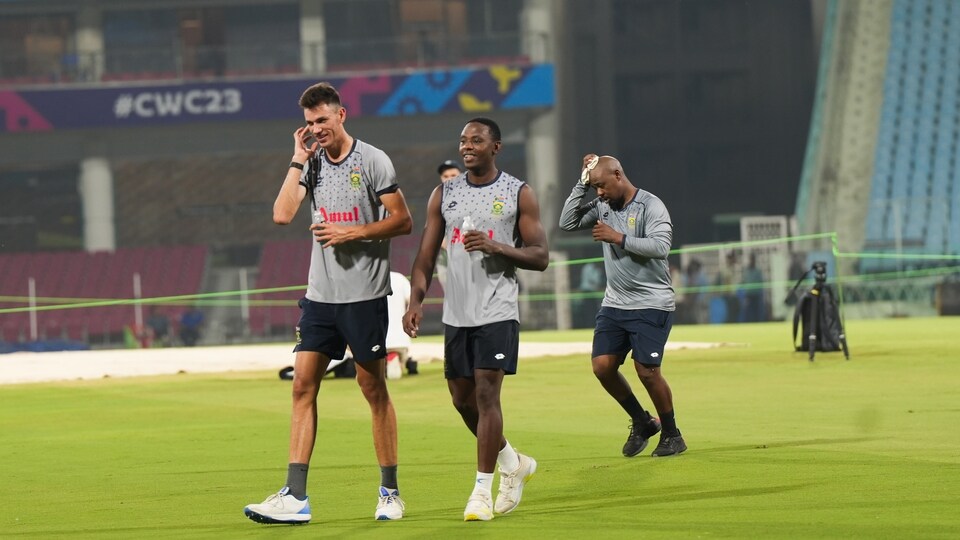
South African players during a practice session ahead of their ICC Men's Cricket World Cup 2023 match against South Africa at Bharat Ratna Shri Atal Bihari Vajpayee Ekana Cricket Stadium in Lucknow (PTI)
Quite expectedly, none of the matches went to the wire. Bangladesh won with 92 balls remaining, New Zealand with 82, and 250-260 seems to be emerging as a par score at most venues barring Delhi, where South Africa and Sri Lanka scored 754 runs. No pitch will be the same, meaning batters might hesitate to go on to their front foot, giving bowlers more scope to adapt and improvise. Powerplay batting too won’t be as productive as a result. Basics will matter, and only the most balanced team is likely to come out on top. This, and more, are some of the major gleanings from a promising first round of the World Cup.
Test basics matter
Ravindra Jadeja knew it the moment he had wheeled off some deliveries, Virat Kohli realised it after India had been reduced to 2/3 chasing Australia’s 199. On a Chennai pitch that had a mind of its own — and had infamously changed nature overnight after England had won the first Test back in 2021 — Jadeja didn’t try to improvise.
“When I started the first over, the ball was stopping after falling a little slow. I thought it was the afternoon, it was hot and the wicket was dry. I thought a stump-line would be better. From here some balls would turn, some would go straight so it won't be easy for the batsman to line up,” said Jadeja, who took three crucial wickets, after India’s win. “So, my plan was simple: I was thinking that this is a Test match bowling wicket. I shouldn't experiment too much because everything was happening in the wicket. So, I was trying to bowl it stump to stump.”
Kohli and KL Rahul adopted a similar outlook after Shreyas Iyer and Ishan Kishan got out chasing glory. Weaving out of deliveries, playing the ball as straight as possible, Kohli and Rahul seemed happy to concede Australia the momentum by scoring just 27 in the first 10 overs. The idea was clear — bat out the difficult early phase (like in Tests) and then exploit the older ball (also like in Tests) and relaxed fielding restrictions. “Virat said there's big help in the wicket, and (we) just have to play proper shots and play like it's Test cricket for some time and see where it goes,” Rahul said after guiding India to victory with an unbeaten 97.
Proteas the new power players?
South Africa decimating World Cup records is not exactly news. But usual suspects like AB de Villiers or David Miller didn’t engineer it this time. Neither did it come against a non-subcontinent team. Three hundreds, one of them the fastest in a World Cup, against Sri Lanka in a campaign opener is possibly the most emphatic statement coming from a side that had its issues in the past. And a warning shot that not all that shines is gold in this World Cup.
Quinton de Kock was possibly the most predictable name among the centurions. But Rassie van der Dussen’s nearly run-a-ball hundred was an engrossing study in how South Africa have quietly snuck up on the world with a grudge to prove that white-ball mastery need not be a reductive exercise. The best example was Aiden Markram, who had first made his Test debut before slowly making an impression in white-ball cricket till he was a non-negotiable name. To watch the same Markram, who till not long ago was considered a T20 A-lister, blast a hundred off 49 balls must have felt cathartic for the South African dressing room.
Are England, Australia light on spin?
Seems so. On paper, Australia (Adam Zampa) and England (Adil Rashid) went with just one specialist spinner in their opening games though Glen Maxwell, Moeen Ali and Liam Livingstone had been given a fair share of overs. But this isn’t the UAE or England where the tracks don’t misbehave a lot and all the slow arm bowlers need to keep an eye on is their economy. In India, specialists have the expertise to exploit pitches and take wickets at regular intervals, as exhibited by India and Bangladesh.
It’s a particularly tricky scenario for teams like Australia, England and New Zealand who want to rely on their fast bowlers and pace bowling all-rounders to take most of the wickets, and more importantly, add depth to their batting. It’s also a matter of perception, which can go awfully wrong on one day and be vindicated the other. India’s three spinners shared six wickets for 104 runs in 30 overs. Australia’s duo of Zampa and Maxwell didn’t take any wicket and conceded 86 runs in 16 overs.
For now, Australia want to believe they played to their strengths. “I think our quicks are our strength, probably up front as we saw tonight,” pacer Josh Hazlewood said after Sunday’s loss. “And then I think Glenn Maxwell is a frontline spinner, in particular in India. He's bowled a lot here throughout IPL and throughout one-dayers. So yeah, I consider him a front-line spinner. So, we’ve got two spinners and three quicks as you know, a lot of the other teams do so; no, I don’t feel that we’re short at all.” But one more defeat could quickly change that perception.
Dharamsala turf under scrutiny, again
Afghanistan English coach Jonathan Trott has asked England to be wary of a dangerous sand-based outfield in Dharamsala where several Afghan players slipped during their loss to Bangladesh. One of the most picturesque venues in the world, Dharamsala was dropped as a venue of an India-Australia Test (it went to Indore) in February.
Insufficient grass density was blamed as the reason, something that apparently hasn’t changed in all this time. Big-ticket matches will be hosted by Dharamsala, including one involving India (against New Zealand). On Monday, England captain Jos Buttler promised to be careful on the outfield, but wouldn’t the extra caution impact results, and the tournament, in the long run?
Somshuvra Laha is a sports journalist with over 11 years' experience writing on cricket, football and other sports. He has covered the 2019 ICC Cricket World Cup, the 2016 ICC World Twenty20, cricket tours of South Africa, West Indies and Bangladesh and the 2010 Commonwealth Games for Hindustan Times.Read More
Get live cricket scores, match updates, schedules, results and ICC rankings. Follow the latest news, statistics and performances of top teams and players on Hindustan Times.
Home/Cricket News/World Cup: Gleanings From A Promising First Round


 Live Score
 Cricket Teams
 Cricket Players