Three landslides in Hari Nagar this month and the slide of portions of the Lower Mall Road into the Nainital Lake twice last month have made people of the hill station apprehensive about the fragile ecology around the Himalayan water body.
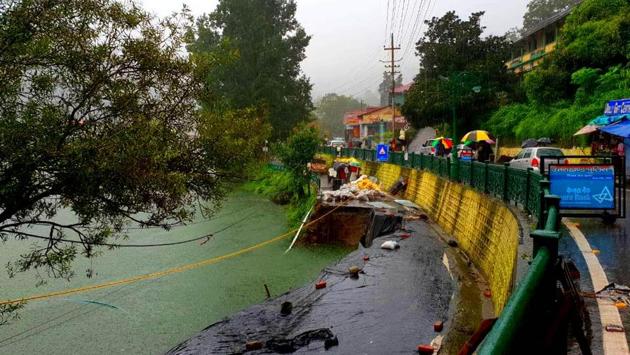
The steep slope of ‘Sher Ka Danda’ ridge above the Lower Mall Road that caved in on August 18 and August 25 is the same terrain in Nainital where a major landslide killed 151 people in 1880.
The fresh developments have rung alarm bells again and put the spotlight on the possibility of a major tragedy on the steep slopes around the Nainital Lake.
Fragile geological terrain
According to geologists, the area around the Nainital Lake is laden with soft sedimentary rocks, which make them fragile and prone to cave-ins. Ecologically sensitive Nainital Lake surrounded by hills is situated at an elevation of 1,938 metres, with a width of 360 metres and length of 1,442 metres. There has been a consistent demand that the hill station be declared an eco-sensitive zone.
Over a year ago, IIT Roorkee had conducted a study on the vulnerability of the slopes and roads around Nainital Lake, especially the adjoining Mall Road. Based on the study, the public works department had sent a detailed report on a ₹41-crore project to the state government, but nothing has materialised so far. Senior officials in Nainital said the government was not providing funds citing budgetary constraints.
{{/usCountry}}Over a year ago, IIT Roorkee had conducted a study on the vulnerability of the slopes and roads around Nainital Lake, especially the adjoining Mall Road. Based on the study, the public works department had sent a detailed report on a ₹41-crore project to the state government, but nothing has materialised so far. Senior officials in Nainital said the government was not providing funds citing budgetary constraints.
{{/usCountry}}After the fresh incidents, geologists and experts have again turned their focus on the fragile slopes around Nainital.
What has the government done so far?
A team of experts from IIT Roorkee came to the hill station thrice to study the fragile slopes around the Nainital Lake, said PWD executive engineer CS Negi.
“They took soil and rock samples and studied the slopes on technical points. They gave their report in March this year and based on that report we prepared a DPR, the execution of which would cost ₹41.12 crore. The report has been sent to the state government.”
Negi said the report mentioned that a 200-metre-high and 165-metre-long patch on the slope above the Mall Road was highly fragile and vulnerable up to 22 metres depth and “as such it needed immediate reinforcement.”
Delay in restoration work
Asked about the delay in restoration of the damaged stretch of the Mall Road, Negi said they had prepared a project. “The restoration work would cost around ₹58 lakh. When we sent the project to the state government, we were told to follow e-tendering process. And the tendering process takes some time,” he said. “We have put sandbags reinforced with iron rods there to stop further cave-in or erosion of the road.”
According to Negi, the disaster management department has formed a team of experts that is looking into geological and other factors behind the Lower Mall Road subsidence.
Nainital MLA Sanjeev Arya said continuous ground vibrations due to an increased traffic movement led to the sinking of the 172-year-old road stretch.
“But we have to look into the bigger picture of what will happen to the fragile slopes. We can’t overlook the past history of the area. The points raised in the IIT Roorkee report have to be addressed at the earliest,” Arya said.
“The ₹41-crore DPR was sent to the state government, but money for its implementation has not been released. I will request the chief minister to approve the funding at the earliest given the emergency situation.”
Fresh landslides
Three landslides and fall of boulders from the mountainside near Raees Hotel in Nainital this month posed a threat to the nearby government inter college and surrounding residential areas, according to locals. The landslides prompted the authorities to push for relocation of 17 families living near the affected area.
According to irrigation department assistant engineer Madan Mohan Joshi, there are two landslide-prone slopes -- landslide 1 and landslide 2 -- in the Hari Nagar area. “In 2001, the IIT Roorkee had conducted a landslide vulnerability study of these slopes, following which a ₹15-crore treatment plan for the slopes was framed and approved by the state government,” Joshi said. “Accordingly, a terraced wall treatment with drains for channelling rainwater was carried out, but all that was washed away in the landslides.”
Experts’ opinion
Environmental activist Ajay Singh Rawat, who has filed petitions over the last three decades for protection of Nainital’s fragile eco system, said the cave-ins of the road stretch signalled that all was not well with the slopes around the lake.
“After 1880 when a major landslide in Nainital killed 151 people, Britishers had developed a 79-km drain network on the hill slopes around Nainital and divided Nainital into safe and prohibited zones for constructions,” Rawat said. “But a lot of concretisation has happened over the slopes; many drains have either been blocked or narrowed due to illegal constructions and people throwing construction debris and solid wastes into them.”
Engineering geologist Varun Adhikari, who hails from Nainital and gives consultancy to authorities in the northeast on construction of tunnels and slopes, said the administration was not acting fast in an emergency situation.
“They should have by now consulted geologists and other experts and started taking short- and long-term remedial measures,” Adhikari said. “Experts need to have a comprehensive look at the site with past data and an analysis of present deformation of the soil and rock structures on the slopes. Then only we will know the cause of the problem and a solution can be found.”