Indicator of pollution levels in the Himalayas, Uttarakhand forest department has claimed to have developed country’s first lichen park in Kumaon’s Munsiyari area, spread over 1.5 acres with over 80 species of lichens collected from across the Himalayan state.
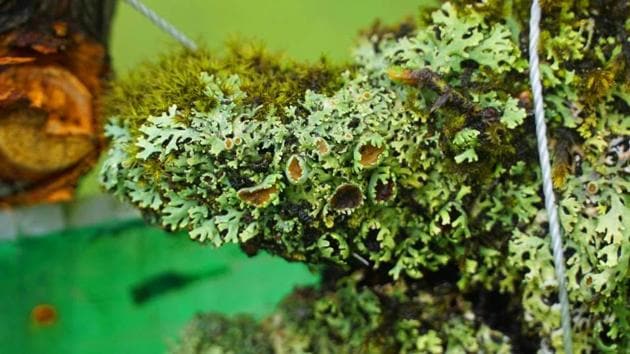
Considered most significant bio-indicator of ecosystem fluctuations as they are more sensitive towards habitat and climate changes, lichen species are facing many threats and continue to decline from some areas of Himalayan regions because of overexploitation of natural resources, mounting pressures of urbanization, habitat-destruction, deforestation and increasing pollution, according to forest officials.
Sanjiv Chaturvedi, Conservator of Forests (Research Wing) Uttarakhand said, lichens found in the Himalayas up to 5000 metres, are important species as they are the best bioindicators of the pollution levels.
“Lichen need pure air to grow. If pollution levels increase in a certain area, the lichen species decline there. So it serves as a natural indicator of pollution levels in an area. And they are important to study in the Himalayas, given various threats to Himalayan environment and ecology”
In July last year, HT had reported that state forest department had approved research project for studying lichens in the Himalayan state. The project aims to study the distribution of different lichen species, their habitat, their morphological and physiological aspects, surveying and literature review, the establishment of species, current threats to their habitat including anthropological and climatic factors, and coming up with suitable conservation strategies and protection strategies.
{{/usCountry}}In July last year, HT had reported that state forest department had approved research project for studying lichens in the Himalayan state. The project aims to study the distribution of different lichen species, their habitat, their morphological and physiological aspects, surveying and literature review, the establishment of species, current threats to their habitat including anthropological and climatic factors, and coming up with suitable conservation strategies and protection strategies.
{{/usCountry}}Chaturvedi said these Jurassic-era lichen species are used in food, perfumes, dyes and traditional medicines.
“Our aim of developing this Lichen Park is to create awareness among people here about their importance in the overall Himalayan ecology and how to link livelihood of these locals with these species and check their incriminate exploitation. One of the lichen species called Jhula Ghas is used as a flavouring agent in Hyderabadi biryani and some non-vegetarian dishes in North Indian cuisine. Their potential for antibiotics and sunscreen chemicals is also being explored by researchers. Some species can also withstand high levels of radiation and can be used as biological sensors that give us information about the environment”, said Chaturvedi.
“We chose Munsiyari area for the park as it has a rich diversity of lichen species. Over 120 lichen species are found in this area. So it was easy for us to develop the park here”, he said
According to experts, Uttarakhand has more than 600 species of lichens followed by Himachal Pradesh and Jammu and Kashmir with 503 and 386 species respectively.
In Uttarakhand lichens are found in Chamoli, Champawat, Pithoragarh, Nainital, Dehradun region. Some lichen species found in the state include Parmotrema pertatum, Usnea lognissima, Lecanora subfuseescens, Sarcogyne privigna, Arthonia impolitella, Acarospora fusca, Acarospora oxytona, Polysporina dubia and so on.
What is a lichen?
A lichen is a composite organism that arises from algae or cyanobacteria living among filaments of multiple fungi species in a mutualistic relationship. They come in many colours, sizes and forms. The properties are sometimes plant-like but lichens are not plants. Lichens may have tiny, leafless branches, flat leaf-like structures.
They are one of the oldest living things, grow in a wide range of habitat including some of the most extreme conditions like the arctic, tundra, hot dry desert rocky coasts, toxic heaps, roofs bare rocks, walls, exposed soil surfaces are some of the places where it can be easily found.