
 E-Paper



A city that dares to dreams of change: Towards building a new Delhi in 2019
After years of struggling to overcome delays, setbacks in plans, and repeated bureaucratic hurdles, Delhiites in 2019 finally hope to live in a transformed city that offers faster and greener mobility, cleaner living spaces and, most importantly, breathable air.


For a city that has long been plagued with traffic congestion, air pollution and garbage woes, 2019 could finally be the harbinger of change for Delhi.
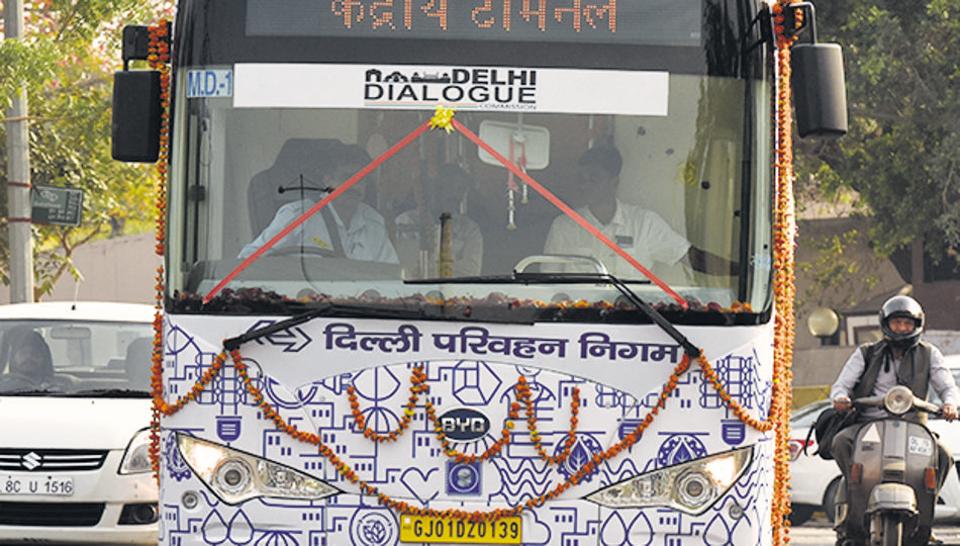
Overcoming delays, planning fails, and repeated bureaucratic hurdles, Delhi in 2019 may finally hope to offer its residents a better quality of life.
From adding more buses to cracking down on factories and by incentivising zero-emission vehicles to reducing the load on existing landfill sites — this year will see a host of projects that will hope to transform the city’s carbon footprint, offer faster and greener mobility, and cleaner living spaces.
While some projects were being planned for years, a few others had seen multiple failures and had to be sent back to the drawing board.
An Electric boost
The coming biggest leap for the coming year is likely to be the induction of 1,000 pure electric buses to the city’s depleting bus fleet.
The rollout of these e-buses, which is scheduled to begin from July, will make Delhi the first city or state in the country and the second in the world (after China) to have such a massive fleet of zero-emission buses.
The new electric buses will be in addition to the 3,000 CNG buses which will also be rolled out in batches this year.
“If all goes as per plan, then it will be the first time that Delhi will have such a massive state-run bus fleet which will entirely be environment friendly and disabled friendly,” said transport minister Kailash Gahlot. Until now, the national capital has been deficient in its public transport system as it only has 5,460 buses against the need of 11,000.
Integrating the idea of zero-emission vehicles on a bigger scale will be the government’s ‘Delhi Electric Vehicle Policy’ which is set to be notified by February. Moving beyond e-buses, the policy seeks to contain the growth of petrol-run two-wheelers in the national capital by offering subsidies on e-scooters and pushing the same in the commercial segment.
With two-wheelers covering three fourth of Delhi’s registered vehicular population of over 10 million, experts say the government’s target is on the right track.
Last mile connection
Adding to this will be Delhi Metro’s expansion under the Phase-3 and Phase-4. While major sections of Phase-3, which was Delhi Metro Rail Corporation’s (DMRC) largest expansion ever, were opened in through 2018, this year will see the beginning of Metro works for the Phase-4 project which will bring the rapid transit system to Delhi’s fringes for the first time.
The project was delayed by two years as the Delhi government had initially refused to give approval to it.
But, adding more buses and Metro lines on a city’s map would do little for residents if last-mile connectivity remains unfixed, experts say. “Agencies get so immersed in big-ticket projects which catch a lot of eyeballs that they often undermine the nitty-gritty details. No matter how many buses or Metro trains you pump into the city’s infrastructure, people will still use private cars and taxis if organised last-mile connectivity is absent,” said Sanjay Gupta, head (transport and planning), School Planning and Architecture (SPA).
He said that agencies have not even looked into planning multi-modal integration. “Just that multiplicity of authority is killing the entire programme. Someone, maybe the DMRC, has to take the lead and get down on implementing all the plans that remain on paper,” he said.
A coordinated battle against pollution
When it comes to mitigating Delhi’s air quality, which remains toxic for most of the year, experts say there is only one thing which agencies need to focus on — ‘enforcement’.
Instead of stringently implementing the anti-pollution measures only in the winter season, such measures should be enforced throughout the year, experts say.
“Issues such as garbage burning, landfill fires and open storage and dumping of construction waste remain rampant. Coordination among agencies needs to be improved further so all measures are effectively enforced,” said Bhure Lal, chairman of Environment Pollution (Prevention and Control) Authority.
The Comprehensive Action Plan (CAP), which lists both short and long term action plans, has been notified by the Union environment ministry. The plan fixes the responsibilities of each government agency and even provides the deadlines. If implemented in letter and spirit, experts say, the city’s pollution level could decline by 70%.
“The GRAP is more of an emergency response. Delhi’s hope of improving the air quality depends on the implementation of the CAP. While some of the measures have already been implemented, EPCA has stressed on the need to focus on public transport system and a parking policy to encourage people to shift to public transport,” said Sunita Narain, director general of Centre for Science and Environment and a member of EPCA.
Officials in the state transport department said Delhi’s parking policy will also see the light of day in 2019. Once implemented, the policy, a first in Delhi, is going to make the existing practice of ‘free parking’ in residential areas as well as public spaces a thing of the past. The rules state that parking rates will also be linked to pollution levels.
This year could also be the first when ‘green crackers’ may be introduced, paving the way for cleaner festivals. While prototypes of such crackers and fireworks, which purportedly bring down emission levels by at least 40%, have already been developed in laboratories, they would now have to be taken up by the manufacturers for mass production.
Waste management, road infrastructure
This year could also be different for the spaces we live in. Dhalaos may become a thing of the past as civic agencies said they will finally execute their long-promised schemes that would ensure waste segregation at source.
The South Delhi Municipal Corporation (SDMC) has already started this practice at certain colonies such as Defence Colony. The North Delhi Municipal Corporation also aims to start the project this year.
Also, several road infrastructure projects such as the 2.7-km long flyover parallel to existing RTR flyover, an underpass on NH-8 near Mahipalpur along with two flyovers (in Aerocity and Mahipalpur), are likely to be opened in 2019. These projects will improve connectivity to the airport from south Delhi areas.
Subhash Chand, head of traffic engineering and safety division at Central Road Research Institute (CRRI), however, said there is need to look at other future-oriented alternatives. “We will have to develop nearby towns such as Meerut, Panipat and Palwal in a way so that the people living in such places do not depend solely on Delhi,” he said.


