With the number of cases of Covid-19 cases in the city continuing to spike, several Delhi government hospitals are working on adding non-invasive ventilation mechanisms to existing beds in their wards, with plans in place to accommodate up to 1,000 hospital admissions a day, senior officials said on Monday. The plans will be implemented as the number of cases go up, the officials added.
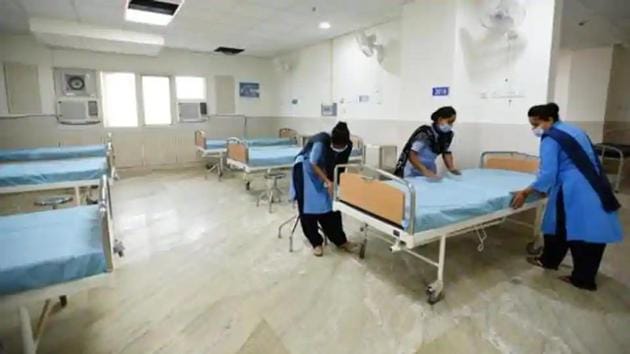
Currently, 68% of the over 3,000 intensive care unit (ICU) beds — with and without ventilators — are occupied, according to the government’s ‘Delhi Corona’ app, with the number of admissions on the rise.
On average, over 5,800 Covid-19 patients were admitted in Delhi hospitals during the last week. In comparison, the average hospitalisation the week that before had been 5,171, according to data shared by the Delhi government.
The 2,000-bed Lok Nayak hospital, the largest Covid-19 facility in Delhi, has added around 200 more ICU beds over the last 15 days. “With most mild to moderate Covid-19 patients preferring home isolation, those who do come to the hospitals are mostly in need of oxygen support and monitoring. So, we have increased the number of intensive care or high-dependence unit beds over the last 15 days,” a senior doctor from the hospital said.
To do so, the ward beds in the hospital have been fitted specialised high-flow oxygen nasal cannula (a tube used to deliver oxygen at high speed to the patient) or Bipap machines (Bilevel Positive Airway Pressure, which uses a mask to deliver oxygen). With a total of 430 “ICU beds” the hospital has reached its capacity.
{{/usCountry}}To do so, the ward beds in the hospital have been fitted specialised high-flow oxygen nasal cannula (a tube used to deliver oxygen at high speed to the patient) or Bipap machines (Bilevel Positive Airway Pressure, which uses a mask to deliver oxygen). With a total of 430 “ICU beds” the hospital has reached its capacity.
{{/usCountry}}“This is our maximum capacity at the hospital, but the government is working on increasing the ICU beds in other government and private hospitals,” the doctor said.
A committee headed by NITI Aayog member Dr VK Paul had said Delhi should prepare for 15,000 new daily infections during the winters.
Of the 500 beds at Rajiv Gandhi Superspeciality hospital in Tahirpur, 400 have already been converted into such make-shift ICU beds. Of the total 400 “ICU beds”, 200 have ventilators that can be used as a Bipap machine, 140 have Bipap machines, and the rest have high flow nasal oxygen support. “We are trying to convert 50 more beds into such ICU beds as that is what majority of the patients need,” said a senior official from the hospital administration.
At Guru Teg Bahadur hospital, which currently has 168 ICU beds, the beds will be increased as per availability of staff. “To run ICU beds, we need more doctors and nurses. And, they have to be trained in handling such critical patients. Subject to availability of staff, the number of such beds will be increased,” said a doctor from the hospital.
The government has also created a reserve stock of liquid oxygen. “There is enough liquid oxygen in store in case more ICU beds need to be created. In addition, all Delhi government hospitals were asked to remain prepared and purchase anything that needed during the previous surge, so any hospital can be converted into a Covid-19 hospital within a day,” said a senior official from the Delhi government.
“The Sardar Vallabhbhai Patel Covid-19 centre in South Delhi also has a good ICU capacity,” the official added. The make-shift hospital in Chhattarpur set up and staffed by the army has 250 beds of which currently 10 are operational. “With most patients staying in home isolation, a majority of the facility remains vacant,” said an official from the centre.
To increase ICU beds in the private sector, the government had in September ordered 33 major hospitals to reserve 80% of their total ICU capacity for Covid-19 patients. The order has been challenged in the Delhi high-court.
“When the first surge had happened in Delhi in June, the committee had predicted a huge case load. The government had started working on putting in place 30,000 Covid-19 beds. Currently, there are about 15,000 beds in the city, of which over 9,000 remain vacant still. In case, the need arises the government already has a plan in place to scale up to 30,000 beds. This includes beds in banquet halls – which is a facility between hospitals and home isolation – where patients who are fairly stable but need oxygen support can be admitted freeing more critical care beds in the hospital,” said Dr Arun Gupta, president, Delhi Medical Council and one of the members of the committee.
“We had added about 1,000 ICU beds one month ago. Today, there are 2,900 ICU beds available in Delhi, of which over 1,200 are empty. We had also directed some private hospitals to reserve 80% of their ICU beds for Covid-19. That matter is in court now,” Delhi health minister Satyendar Jain had said in a press briefing on Sunday.
Stay updated with all top Cities including, Bengaluru, Delhi, Mumbai and more across India. Stay informed on the latest happenings in World News along with Delhi Election 2025 and Delhi Election Result 2025 Live, New Delhi Election Result Live, Kalkaji Election Result Live at Hindustan Times.
Stay updated with all top Cities including, Bengaluru, Delhi, Mumbai and more across India. Stay informed on the latest happenings in World News along with Delhi Election 2025 and Delhi Election Result 2025 Live, New Delhi Election Result Live, Kalkaji Election Result Live at Hindustan Times.