For the first time since it helped end South Africa’s era of apartheid, the African National Congress (ANC) has failed to secure a simple majority in last week’s general election, whose outcome is being seen as a reflection of the people’s anger over the failure of successive administrations to deal with unemployment, crime, corruption and massive inequality in society. The future of the ANC and President Cyril Ramaphosa now hinges on negotiations with other parties that picked up significant vote
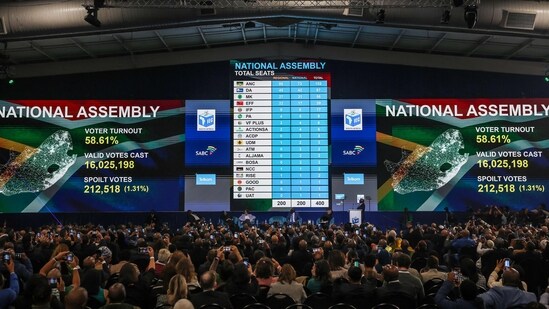
For the first time since it helped end South Africa’s era of apartheid, the African National Congress (ANC) has failed to secure a simple majority in last week’s general election, whose outcome is being seen as a reflection of the people’s anger over the failure of successive administrations to deal with unemployment, crime, corruption and massive inequality in society. The future of the ANC and President Cyril Ramaphosa now hinges on negotiations with other parties that picked up significant vote shares. To remain in power, the ANC could team up with two former party leaders — former president Jacob Zuma, a scandal-tainted populist who heads the new MK party, or Julius Makena of the Economic Freedom Fighters party. Both, however, have radical Left-wing reform agendas. Or the ANC will have to make the difficult choice of joining hands with the John Steenhuisen-led Democratic Alliance, a party that opposes policies favouring only the Black population.
The ANC’s sharp decline was expected in the wake of its failure to address South Africa’s numerous problems over the decades, especially inequality. In a way, its trajectory resembles the journey of the Indian National Congress (INC), the party of Mahatma Gandhi that inspired the ANC and Nelson Mandela. The Congress lost its first national election 30 years after India won Independence, in 1977. The ANC’s decline is similar to that of the Congress — both parties saw major splits after their top leaders bowed out — Jawaharlal Nehru for the INC and Mandela for the ANC – and their successors failed to meet the aspirations of a new generation of voters or stall a decline in values. For India, a strong and stable South Africa is crucial because of the role the country plays in the Global South and at multilateral platforms such as Brics.
One Subscription.
Get 360° coverage—from daily headlines
to 100 year archives.
Archives
HT App & Website