India’s second unmanned moon mission, Chandrayaan 2, was put on hold 56 minutes and 24 seconds before its scheduled lift-off at 2.51 am on Monday, from Sriharikota in Andhra Pradesh. This was due to the discovery of a technical snag in Indian Space Research Organisation (Isro)’s next-generation launch vehicle, GSLV Mk-III, which is indigenously designed to carry heavier payloads deeper into space. The timely detection of the glitch in the fully loaded and fuelled launch vehicle saved the 3.8-tonne spacecraft from potentially exploding, and destroying close to a decade worth of research, which began in 2008.
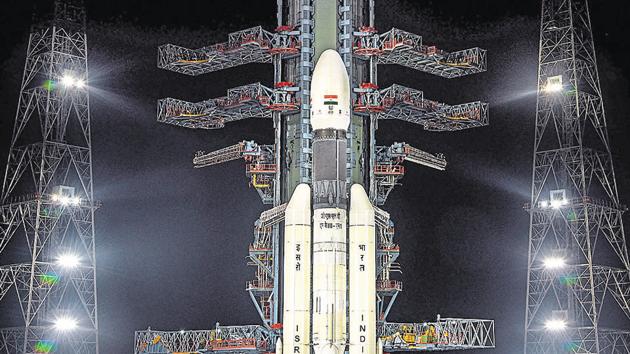
Chandrayaan 2 is a ₹978-crore mission, which comprises an orbiter and a lander with a rover that is designed to soft-land between two lunar craters in the south pole of the moon to study the topography, seismography and chemical and mineral composition of lunar rocks. The next window for launch is during the new moon on July 29 and 30. An expert committee is already reviewing whether the rocket can be fixed in time and be equipped for a successful liftoff by the end of the month. After July, the next launch window for a lift-off is in September this year. Scientists at Isro remain optimistic, as aborting lift-offs because of technical glitches is not unusual around the world. Most recently, Nasa delayed its $1.5 billion Parker Solar Probe to study the sun’s atmosphere by a day because of a technical glitch before lift-off on August 12, 2018. Failed missions after lift-offs are more common, such as Israel’s Beresheet spacecraft’s lander and rover crashing while attempting to make a soft-landing on the moon in April this year; Soyuz launcher carrying two astronauts to the International Space Station making an emergency landing in October 2018 because of a booster failure; and US government’s military satellite Zuma launched Elon Musk’s SpaceX’s reportedly crashing into the sea after three attempts in January 2018.
Isro has had 72 successful launch missions, including two successful deployments of communication satellites by GSLV Mk-III in June 2017 and in November last year. Each launch mission carries successful satellites. With Isro scientists saying the Chandrayaan 2 glitch in the launcher is minor can be addressed quickly, the lunar mission remains on track to make India the fourth country after the US, Russia and China to make a technically complex soft-landing on moon. It will be the world’s first landing on the far side of the moon, and the second major space exploration success for India after Chandrayaan 1’s discovery of water on the moon in 2008.
{{/usCountry}}Isro has had 72 successful launch missions, including two successful deployments of communication satellites by GSLV Mk-III in June 2017 and in November last year. Each launch mission carries successful satellites. With Isro scientists saying the Chandrayaan 2 glitch in the launcher is minor can be addressed quickly, the lunar mission remains on track to make India the fourth country after the US, Russia and China to make a technically complex soft-landing on moon. It will be the world’s first landing on the far side of the moon, and the second major space exploration success for India after Chandrayaan 1’s discovery of water on the moon in 2008.
{{/usCountry}}