When a political party has just won an electoral majority, it can be expected that it would use its numerical advantage to push through its legislative agenda. When the victory has been accompanied with the rout of other parties at the polls, the incumbent has an additional political and psychological edge. And, so, it is understandable that the Bharatiya Janata Party (BJP) has been able to convert its 2019 Lok Sabha victory into policy victories in the current session of Parliament, including on its constitutional moves on Jammu and Kashmir.
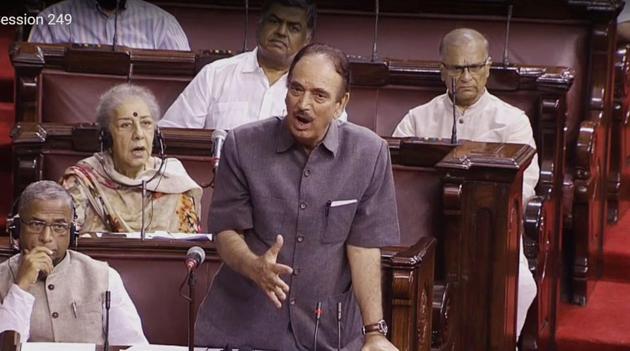
But this still does not explain, or justify, the utter abdication of responsibility by the Opposition parties. This abdication has taken two forms: the lack of clarity in its ranks on key policy matters being discussed in Parliament; and the inability to put up a democratic fight even in a chamber where they, collectively, outnumber the BJP. Take the first. On the government’s move to render Article 370 ineffective, bifurcate Jammu and Kashmir (J&K), and reduce the state to a Union Territory, the Congress response has been marked by complete incoherence and confusion. Rahul Gandhi took over 24 hours to put out his first critical tweet. Even as the leader of the party in the Rajya Sabha, Ghulam Nabi Azad, slammed the government, the chief whip of the Congress in the same House, Bhubaneswar Kalita, resigned, protesting, in principle, against the party’s stance. Adhir Ranjan Choudhary, the leader of the Congress in the Lok Sabha, suggested that Kashmir was actually an international — and not just an internal — issue, prompting Home Minister Amit Shah to ask if this was the party’s official stance. On the other hand, some other senior leaders like Janardhan Dwivedi backed the government. Do not be surprised if the Congress workers on the ground, let alone citizens, have no clue what the party actually believes in.
The incoherence is supplemented by the lack of unity and floor strategy. During the vote on the triple talaq bill, for instance, all Congress members did not turn up to vote. On Kashmir, the opposition fractured entirely, with parties as critical of the BJP as Bahujan Samaj Party and Aam Aadmi Party backing the government. A range of other regional parties — the Telangana Rashtra Samithi, YSR Congress Party, and Biju Janata Dal — have been supportive of the government, helping it gain numbers in the Rajya Sabha. And every other day, a member or two resigns from the Opposition benches, paving the way for fresh elections from states, which, in turn, helps swell BJP numbers. Put it all together, and it clear that not only was the Opposition trounced in the election, but it has also lost the will to fight. This bodes ill for democracy.
{{/usCountry}}The incoherence is supplemented by the lack of unity and floor strategy. During the vote on the triple talaq bill, for instance, all Congress members did not turn up to vote. On Kashmir, the opposition fractured entirely, with parties as critical of the BJP as Bahujan Samaj Party and Aam Aadmi Party backing the government. A range of other regional parties — the Telangana Rashtra Samithi, YSR Congress Party, and Biju Janata Dal — have been supportive of the government, helping it gain numbers in the Rajya Sabha. And every other day, a member or two resigns from the Opposition benches, paving the way for fresh elections from states, which, in turn, helps swell BJP numbers. Put it all together, and it clear that not only was the Opposition trounced in the election, but it has also lost the will to fight. This bodes ill for democracy.
{{/usCountry}}